Nefertiti: Egypt’s Most Famous Face and Greatest Mystery
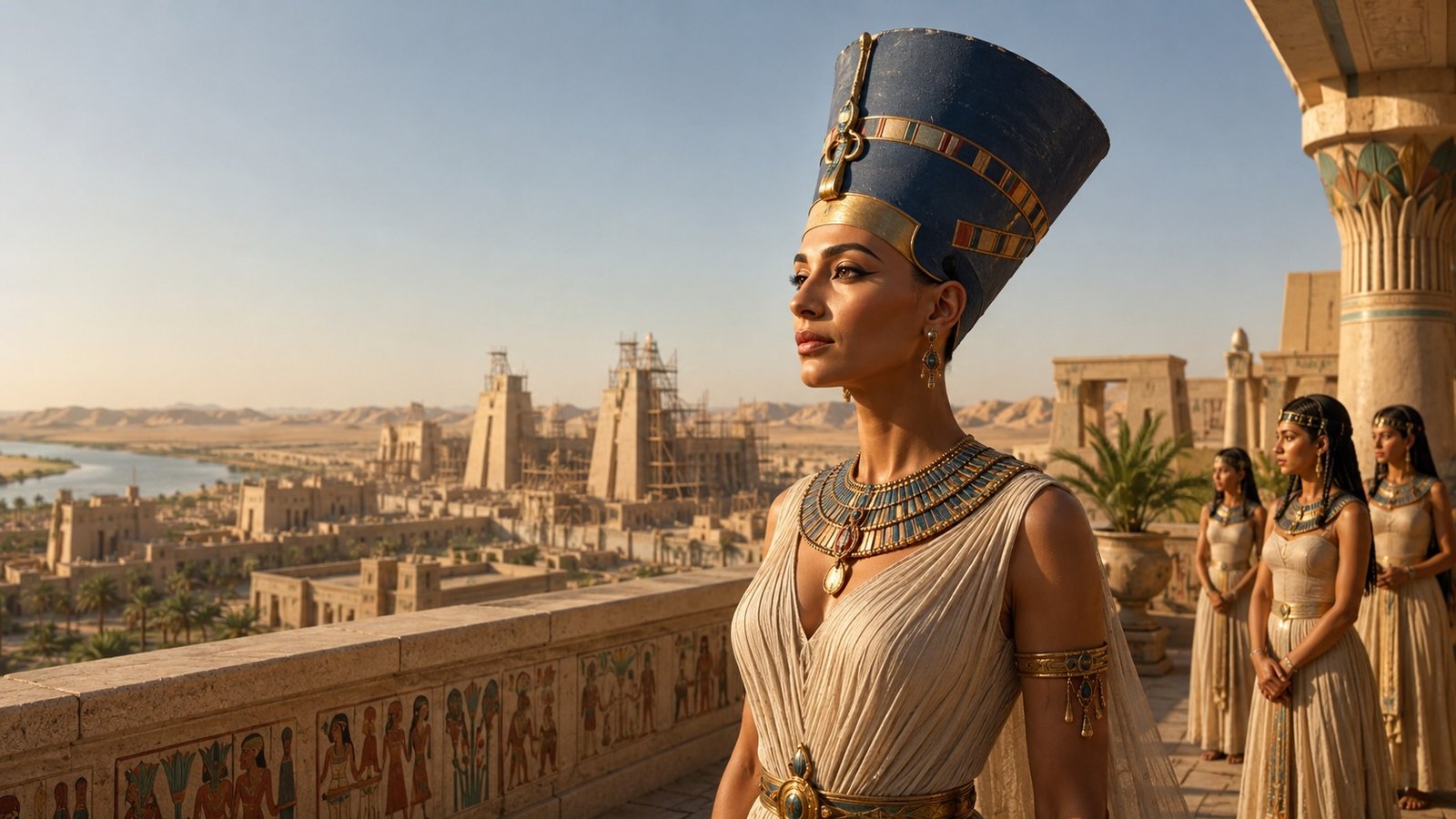
Nefertiti has one of the most recognisable faces in history and one of the least recognisable biographies. Millions know the elegant painted bust, with its long neck, high cheekbones and tall blue crown. Yet we cannot say with certainty where she came from, how she died, where she was buried or whether she eventually ruled Egypt as a pharaoh. For someone whose name means “the beautiful one has come”, she arrived in history rather dramatically, then left without signing the visitors’ book.
She lived during the fourteenth century BC and became the Great Royal Wife of Amenhotep IV, the pharaoh who later renamed himself Akhenaten. Together, they launched one of ancient Egypt’s boldest and most disruptive experiments. Akhenaten pushed the worship of the Aten, represented by the sun’s disc and its descending rays, above Egypt’s traditional gods. Temples lost influence, priests lost wealth, and the royal court abandoned Thebes for a purpose-built capital called Akhetaten, now known as Amarna.
Calling this a religious reform almost sounds too tidy. It involved theology, money, royal authority and a brutal reshuffling of institutional power. The temples of Amun controlled enormous estates and resources. Weakening them strengthened the crown. Akhenaten may have believed deeply in the Aten, but divine inspiration and political convenience have always made comfortable travelling companions.
Nefertiti did not simply stand behind her husband holding a ceremonial flower. Amarna art shows her making offerings to the Aten, riding in chariots and appearing at roughly the same scale as Akhenaten. In several scenes, she performs actions normally associated with kings. One striking image even presents her smiting a foreign enemy, a visual statement that Egyptian artists usually reserved for the pharaoh.
These images have helped create the modern picture of Nefertiti as an unusually powerful queen. However, Egyptian royal art communicated ideology rather than recording everyday reality like a palace photographer. A scene could advertise power without describing who attended which government meeting. Even so, the sheer frequency and prominence of Nefertiti’s appearances suggest that she occupied a position far beyond that of a decorative consort.
She and Akhenaten had six known daughters. The royal family appeared together in remarkably intimate scenes, sitting beneath the Aten’s rays, holding children and exchanging affection. Earlier Egyptian royal imagery often favoured stiff, timeless majesty. Amarna art showed elongated faces, narrow limbs, rounded stomachs and surprisingly domestic moments. The family almost looks approachable, although nobody should confuse affectionate wall carvings with a modern family album.
One persistent myth claims that Nefertiti invented monotheism alongside Akhenaten. The Aten religion certainly moved towards exclusive worship, especially in the later years of the reign. Nevertheless, scholars debate whether it qualifies as full monotheism in the modern sense. Other divine concepts did not vanish overnight, and the king himself acted as the essential intermediary between humanity and the Aten. Ordinary Egyptians did not simply enjoy a direct personal relationship with one universal god. They largely approached the Aten through the royal family, which rather conveniently placed Akhenaten and Nefertiti at the centre of the cosmos.
Another popular story describes Nefertiti as a foreign princess, perhaps from Mitanni in northern Mesopotamia. This theory often identifies her with Tadukhipa, a Mitannian princess sent to Egypt as a diplomatic bride. The identification remains speculative. Nefertiti may instead have belonged to an Egyptian elite family, possibly connected to the future pharaoh Ay. Her nurse, Tey, later carried the title “nurse of the Great Royal Wife”, while Ay enjoyed exceptional prominence at court. Unfortunately, ancient Egyptian inscriptions rarely provide the sort of family details that would spare later historians several centuries of argument.
The greatest mystery begins late in Akhenaten’s reign. For a long time, scholars believed Nefertiti disappeared from the record around his twelfth regnal year. That absence inspired theories of plague, disgrace, divorce, murder and quiet retirement. Then an inscription found at a limestone quarry showed that she remained alive and held her royal title in Akhenaten’s sixteenth year. The discovery did not solve the mystery. It merely removed several confident answers and replaced them with better questions, which archaeology does with admirable efficiency.
Around this period, a female ruler called Neferneferuaten appears in the evidence. Many Egyptologists think Nefertiti adopted this royal identity, perhaps first as Akhenaten’s co-regent and later as pharaoh. Her expanded political role, king-like imagery and personal use of the name Neferneferuaten make the theory plausible. Yet the surviving inscriptions remain damaged, reused and frustratingly ambiguous. Other candidates include Nefertiti’s daughter Meritaten, while arguments over the mysterious ruler Smenkhkare add another layer of dynastic fog.
Suppose Nefertiti really did become pharaoh. She may have faced an almost impossible job. Akhenaten’s religious revolution had disrupted the old order, foreign policy appeared neglected, and the royal succession looked fragile. A female ruler with deep connections to the Aten cult might have tried to preserve the dynasty while quietly repairing relations with the traditional priesthood. In that scenario, the later restoration under Tutankhamun did not represent an instant counter-revolution. It may have begun as a controlled retreat organised by Nefertiti herself.
What if she had ruled for another twenty years? Atenism might have survived in a softer form, sharing space with Amun and the older gods. Egypt could have developed a hybrid religious system rather than erasing the Amarna experiment. Tutankhamun might never have become the global celebrity we know today because he may have remained a minor prince under the formidable authority of his stepmother.
Alternatively, a long reign by Nefertiti could have provoked civil conflict. The Amun priesthood, military elites and provincial administrators had strong reasons to oppose the Amarna regime. Her public identification with Akhenaten’s revolution may have made compromise difficult. Instead of stabilising Egypt, she might have deepened the crisis and accelerated the fall of her dynasty.
Another tempting possibility asks what might have happened if Nefertiti had openly rejected Akhenaten’s policies before his death. She possessed visibility, royal daughters and perhaps an independent political following. A carefully timed break with the Aten project could have allowed her to present herself as Egypt’s saviour. History might then remember her not as Akhenaten’s partner, but as the ruler who rescued the country from him.
Her tomb remains missing. Claims appear regularly, often with dramatic headlines and suspiciously convenient timing. Some researchers have proposed that hidden chambers behind the walls of Tutankhamun’s tomb could contain Nefertiti’s burial. Radar surveys produced conflicting interpretations, and no confirmed chamber containing her remains has emerged. Other theories connect her with unidentified female mummies from the Valley of the Kings, but DNA and family relationships complicate those proposals. The search continues, accompanied by documentaries, press conferences and the ancient archaeological tradition of announcing certainty before the ground has agreed.
Then there is the bust. German archaeologists uncovered it at Amarna in 1912 in the workshop of the sculptor Thutmose. The limestone and plaster portrait eventually reached Berlin, where it became the centrepiece of the Neues Museum. Egypt has repeatedly demanded its return, arguing that the object left under questionable circumstances and belongs within Egyptian cultural heritage. German authorities maintain that the division of finds followed the rules of the time and that the bust cannot travel safely because of its fragility.
The controversy reaches beyond one object. It asks who owns antiquity, whether colonial-era agreements deserve permanent authority, and whether universal museums preserve global culture or continue old imbalances. Nefertiti has therefore become more than an ancient queen. Her face now represents modern debates about restitution, national identity and the power to tell history.
Ironically, the famous bust may not even show an entirely realistic face. It came from a sculptor’s workshop and may have served as an idealised model. The left eye lacks its inlay, prompting theories that the queen suffered an eye condition. More likely, the sculptor simply never finished the piece. Modern viewers treat the bust as the definitive Nefertiti, yet ancient portraiture aimed to express beauty, authority and order rather than document every wrinkle.
That tension explains her enduring appeal. Nefertiti feels vividly present because one extraordinary object gives her a face. At the same time, the woman behind that face remains elusive. She may have been a devoted religious partner, a ruthless political operator, a cautious reformer, a reigning pharaoh or several of these things at once.
Her story reminds us that fame does not always grow from abundant information. Sometimes it flourishes in the empty spaces. Nefertiti survives because history left enough evidence to make her important and enough uncertainty to make her irresistible.