Marco Polo had a credibility problem that feels surprisingly modern. He returned to Venice with stories so extravagant that sensible people struggled to take him seriously. Cities larger than anything in Europe, paper that functioned as money, black stones that burned, imperial postal stations, enormous armies, fabulous wealth and a Mongol ruler who governed territories stretching across much of Asia. To a thirteenth-century Venetian audience, some of this sounded less like travel journalism and more like a man who had spent too long at sea. The awkward thing is that many of his supposedly ridiculous claims turned out to describe real things. That is what makes Marco Polo so difficult to dismiss and so entertaining to argue about.
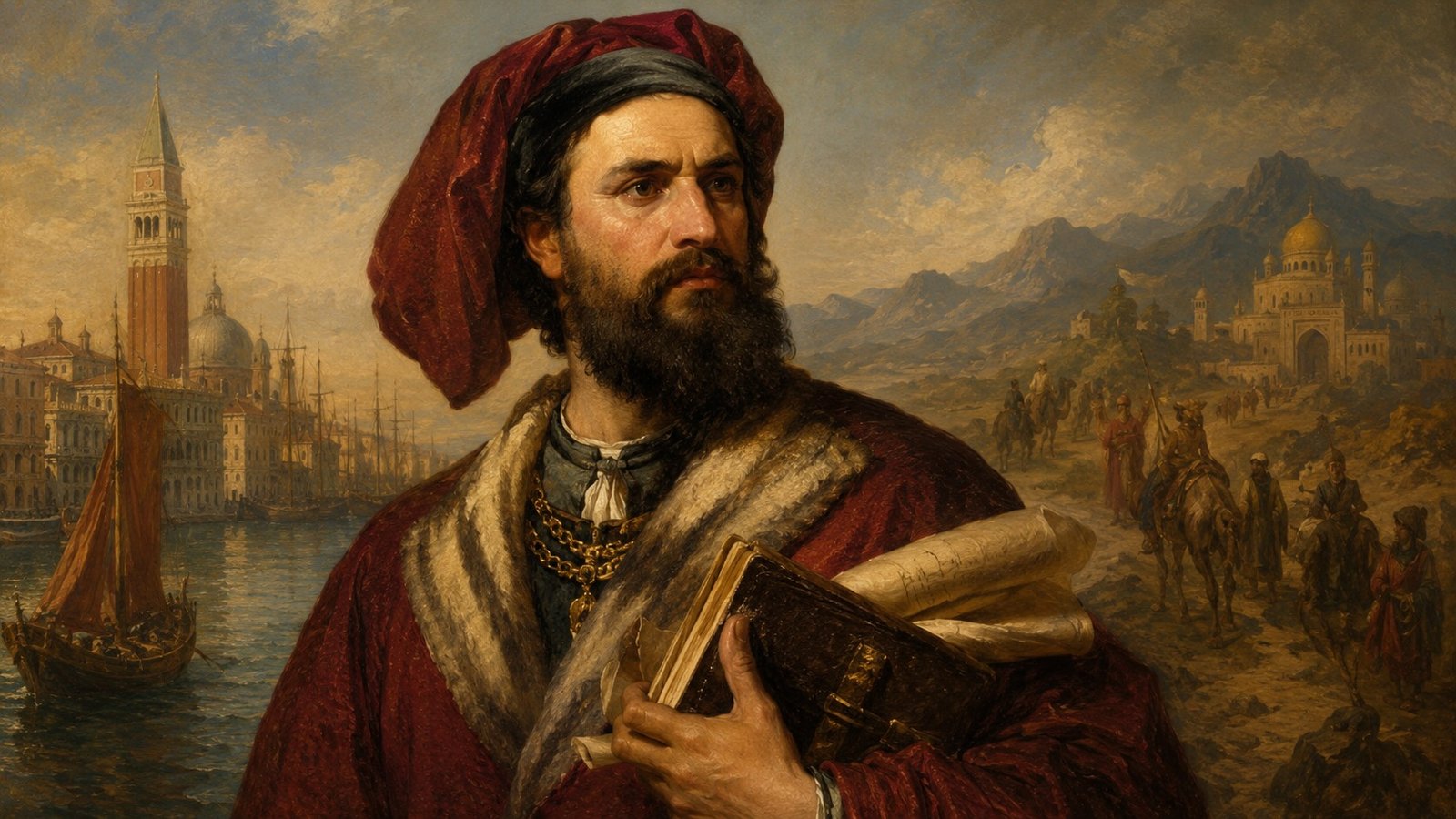
Marco was born in Venice around 1254 into a merchant family. His father Niccolò and uncle Maffeo already traded deep into Asia, where commercial networks connected the Mediterranean with Persia, Central Asia and the Mongol world. In 1271, when Marco was about seventeen, he joined them on a journey east. According to the traditional account, the expedition took roughly three years and eventually brought the Polos to the court of Kublai Khan, grandson of Genghis Khan and ruler of the Yuan dynasty. That sounds romantic now, but in practice it probably involved years of dust, bad food, difficult negotiations, unreliable transport and an impressive variety of ways to die.
The Polos travelled through regions that now fall within Turkey, Iran, Afghanistan and Central Asia before crossing towards China. Marco later described deserts where travellers heard strange noises, mountain routes, prosperous trading cities and peoples whose habits seemed wonderfully peculiar to a Venetian merchant. His interest often followed money. He noticed commodities, taxation, transport systems and markets with the enthusiasm of someone mentally calculating margins. Marco Polo may have been an explorer, but he remained a merchant’s son with a very practical eye.
Kublai Khan fascinated him most. Marco presented the Mongol ruler not as the savage horseman many Europeans imagined, but as the head of an extraordinarily organised state. He described imperial roads, relay stations where horses could quickly carry messages across vast distances, government granaries and elaborate taxation. Above all, he marvelled at paper money. For Europeans accustomed to coins made from metal with obvious intrinsic value, the idea seemed slightly insane. The emperor, Marco explained, could turn pieces of paper into something everyone accepted as money. Refusing those pieces of paper could bring serious trouble, which certainly helped public confidence. Seven centuries later, anyone staring at a contactless payment terminal might recognise the basic principle: money works remarkably well when everybody agrees to play along.
Marco also described coal, which he called stones that burned like wood. To many Europeans this sounded peculiar, yet he reported that people in northern China used the substance extensively for heating. He wrote about porcelain, salt production, bustling ports and enormous cities. Some of these observations proved detailed enough that historians still use them when studying the Yuan world. The sheer volume of accurate information remains one of the strongest arguments that Marco really did travel deep into China.
After perhaps seventeen years in Kublai Khan’s territories, the Polos eventually headed home. Their return journey took them largely by sea through Southeast Asia, India and Persia. They reached Venice around 1295, roughly twenty-four years after leaving.
Then Marco’s story acquired another useful ingredient: prison. Venice and Genoa were commercial rivals with fleets, money and a healthy willingness to attack each other, so Marco eventually found himself a Genoese prisoner around 1298. There he met Rustichello of Pisa, a writer associated with popular romances. Marco told his stories, while Rustichello turned them into the work usually known in English as The Travels of Marco Polo. That collaboration matters because we do not possess a neat diary written every evening by Marco beside a campfire. His book travelled through manuscripts, languages, editors and copyists, and different versions contain different details.
Rustichello also knew how to make a story entertaining. Consequently, separating Marco’s observations from literary decoration can sometimes feel like investigating a witness statement rewritten by a novelist. Even contemporaries apparently struggled with the result. The book became known as Il Milione, although scholars disagree about exactly how the nickname arose. Later tradition claimed that people mocked Marco as “Marco Millions” because everything in his stories came in millions.
His reputation for exaggeration followed him to his deathbed. A famous story claims that friends urged him to retract his wildest tales before dying, and Marco supposedly replied that he had not told half of what he had seen. The line fits him perfectly, which should immediately make any historian slightly suspicious. Like many perfect historical quotations, its pedigree remains uncertain. And this brings us to the question that refuses to disappear: did Marco Polo actually go to China? Modern sceptics have argued that perhaps he did not, pointing to several striking omissions in his account.
Marco never clearly discusses tea drinking, chopsticks, Chinese writing or foot-binding. Most famously, he says nothing about the Great Wall, while Chinese records have also failed to produce an unambiguous Marco Polo serving Kublai Khan. At first glance, that looks awkward. Imagine someone claiming to have spent years in modern Britain while never mentioning tea, the NHS, football or complaining about the weather.
Yet the objections weaken when examined closely. The spectacular stone Great Wall familiar today largely dates from the Ming period, after Marco’s lifetime. Earlier fortifications existed, but they did not necessarily resemble the monument tourists now photograph. Marco also spent much of his time around the Mongol ruling elite rather than documenting Chinese domestic life. Travellers regularly omit things later readers regard as obvious, and several other celebrated historical travellers did exactly the same.
Then there are the details Marco does include. His descriptions of paper currency, salt revenues, Mongol administration and several places align strikingly with other sources. Sceptics can argue that he gathered information from Persian merchants or other travellers. They cannot easily explain every accurate observation as a lucky guess, especially when some details were obscure to medieval Europeans.
A few popular Marco Polo legends deserve disposal altogether. He did not bring pasta to Italy from China, because pasta existed in Italy before his return. Nor should we credit him with introducing ice cream to Europe. These stories reveal more about our desire for tidy origin myths than about medieval trade. Famous travellers attract inventions almost as enthusiastically as they collect genuine adventures.
Marco eventually settled back into Venetian life, married Donata Badoer and had three daughters. His surviving will shows a prosperous merchant rather than a permanently restless explorer. It mentions property, money, religious bequests and even a servant named Peter whom Marco ordered freed. After emperors, deserts and fabulous cities, there is something wonderfully mundane about the great traveller eventually having to sort out his estate like everyone else.
Marco Polo died in 1324. By then, however, his most important journey had barely begun. His book circulated across Europe and reshaped European ideas about Asia. Christopher Columbus owned a copy and filled it with notes, while cartographers absorbed information associated with Marco’s travels. Merchants read him as evidence that astonishing wealth existed beyond familiar horizons. Explorers found in his pages a world worth reaching, even if they did not always understand exactly where they were going.
Perhaps that explains Marco Polo’s endurance better than the argument about whether every sentence was true. He stood at a peculiar historical junction, when medieval Europe still inhabited a world filled with rumours, biblical geography and fabulous monsters, while commerce increasingly demanded better information about what actually existed beyond the horizon.
Marco offered both at once. He gave readers practical observations about trade, cities and government, but he also delivered enough marvels to keep copyists, readers and sceptics interested for centuries. He could exaggerate, Rustichello could embellish, copyists could distort and memory could fail after decades of travel. Nevertheless, behind all that noise sits a recognisable observer describing a world considerably larger, richer and more sophisticated than most Europeans imagined. That may have been Marco Polo’s real problem. A liar usually tells people something they want to believe, while Marco sometimes told them things that seemed impossible.
Unfortunately for his critics, the world really was that strange.