Watch the election of a new Speaker of the House of Commons and something rather odd happens. After MPs vote, the successful candidate does not stride triumphantly towards the magnificent chair at the end of the chamber. Instead, two colleagues take hold of them and ceremonially drag them towards it.
It looks like one of those Westminster traditions nobody dares question because somebody once did it in 1724. Yet this particular piece of theatre carries a surprisingly grisly explanation. Becoming Speaker was once an honour that could, at least indirectly, end with the new office-holder losing his head.
Today, the Speaker occupies one of the strangest positions in British politics. The holder sits at the centre of political conflict while officially belonging to neither side. Once elected, the Speaker abandons party affiliation, avoids campaigning on political issues and must treat government and opposition impartially. Ministers, backbenchers and opposition leaders may shout at one another across the green benches, while above them sits someone whose professional task involves pretending not to have an opinion.
The medieval version was rather different. The office developed because the emerging House of Commons needed somebody to speak on its behalf. Presiding officers existed earlier, but Sir Thomas Hungerford became the first person formally recorded under the title Speaker in 1377. The word described the job quite literally: the Speaker spoke for the Commons, particularly when dealing with the king.
That sounds harmless until you remember what medieval kingship involved. Parliament might complain about taxation, criticise royal advisers or refuse the Crown’s requests. Somebody then had to walk into the royal presence and explain the problem. The Commons could remain collectively unhappy, but the Speaker had to give that unhappiness a face.
He therefore occupied an awkward position between two institutions whose interests increasingly collided. The Crown expected loyalty, while the Commons expected representation. Pleasing both could resemble trying to negotiate a family inheritance while holding the only copy of the will. Unfortunately, the consequences of choosing the wrong side could become considerably more serious than an awkward Christmas dinner.
The statistics certainly look alarming. Parliamentary records note that seven men who served as Speaker were beheaded between the late fourteenth century and 1535. Others met violent deaths as well. William Tresham, who served several times as Speaker, was murdered in 1450, while Sir John Wenlock, another former Speaker, died at the Battle of Tewkesbury in 1471.
Sir John Bussy, Speaker under Richard II, was executed in 1399. Thomas Thorpe was beheaded in 1461, Thomas Tresham followed in 1471, and William Catesby lost his head after Richard III’s defeat at Bosworth in 1485. Richard Empson and Edmund Dudley were executed together in 1510. Then came perhaps the most famous former Speaker of them all: Sir Thomas More.
More served as Speaker in 1523 before becoming Lord Chancellor. Henry VIII had him executed in 1535 after More refused to accept the king’s supremacy over the Church in England. Four centuries later the Catholic Church canonised him, producing the unusual career progression of Speaker, Chancellor, condemned traitor and saint. Westminster careers have always had their twists, although few modern politicians would regard that particular trajectory as aspirational.
There is, however, a wonderfully inconvenient detail in Westminster’s favourite horror story. These men generally did not die simply because they had performed their duties as Speaker. Many became casualties of the brutal politics surrounding dynastic struggles, regime changes and royal service. Catesby, for example, belonged to Richard III’s inner political circle and died after Henry Tudor took the throne.
Empson and Dudley became notorious financial administrators under Henry VII, then convenient targets when Henry VIII succeeded him. More’s execution concerned the royal supremacy, not an awkward parliamentary message he had delivered twelve years earlier. So the familiar idea that medieval Speakers routinely approached the monarch thinking, “I hope His Majesty likes today’s minutes,” exaggerates matters considerably.
Still, the mythology captures something real. The Speaker occupied exposed political territory, and medieval England did not provide particularly generous severance packages for people who backed the wrong political faction. The office also lacked the neutrality we now associate with it. Early Speakers could act as royal agents, monarchs influenced their selection, and Speakers often maintained close connections with government.
Rather than standing serenely above politics, they operated inside a complicated relationship between Commons and Crown. That arrangement worked only while everybody accepted the rules of the game, and seventeenth-century England became increasingly poor at doing that. Then, on 4 January 1642, one Speaker helped redefine the office.
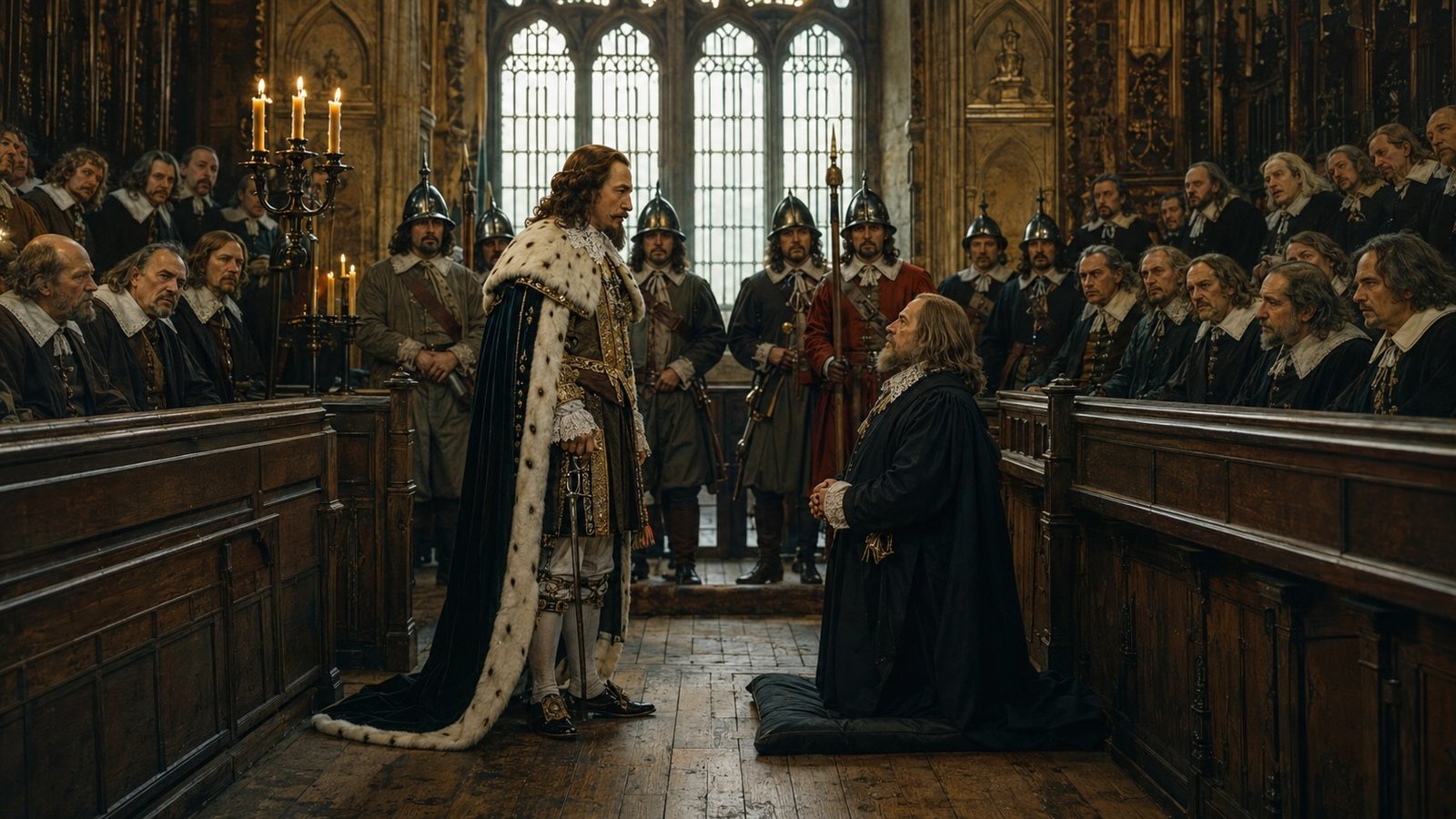
England was sliding towards civil war when Charles I entered the House of Commons accompanied by armed men. He wanted to arrest five MPs whom he accused of treason. It was an extraordinary move, because the king personally entered the Commons chamber and demanded to know where his targets had gone. Fortunately for the five MPs, they had wisely disappeared.
Charles turned to Speaker William Lenthall for assistance. Lenthall knelt before the king but refused to provide it. He told Charles that he had “neither eyes to see, nor tongue to speak” except as the House directed him. It remains one of the great lines in British constitutional history because its meaning could hardly have been clearer: inside this chamber, Mr Speaker worked for the Commons, not the king.
Charles looked around for himself and reportedly observed that “the birds have flown”. He left without the five MPs, and within months England descended into civil war. No monarch has entered the House of Commons chamber since. A constitutional principle had emerged from a remarkably uncomfortable afternoon.
The incident did not magically create the modern Speaker. That transformation took another couple of centuries. After the Restoration, Speakers could still maintain government connections. Arthur Onslow, who held the chair from 1728 to 1761, did much to strengthen the office’s independence, and by the middle of the nineteenth century political neutrality had become an established expectation.
That history helps explain why modern parliamentary rituals contain so many echoes of conflict. Consider the ceremonial dragging towards the chair. Parliament links the custom to the genuine reluctance early Speakers might have felt about accepting such an exposed position. Over time, reluctance became ritual, although nobody seriously thinks today’s Speaker expects a royal executioner to be waiting outside Westminster Hall.
British constitutional history has an unusual talent for turning old political trauma into ceremonial comedy. The Speaker’s election captures that perfectly: the successful candidate wins one of the highest offices in Parliament and then behaves as though colleagues are forcing them into it against their better judgement. Given the historical record, perhaps the old Speakers had a point.
The modern Speaker also possesses substantial authority. They decide who may speak, maintain order, interpret parliamentary rules and select certain amendments and urgent questions. MPs address one another through the Chair rather than directly, creating the curious spectacle of politicians conducting ferocious arguments while grammatically pretending they are having a polite conversation with one person sitting several metres away.
Neutrality therefore does not mean weakness. Quite the opposite: the Speaker’s authority works because the office-holder theoretically represents the House rather than a government, party or monarch. That principle took centuries to develop. Lenthall’s confrontation with Charles I gave it perhaps its most memorable expression, while later Speakers gradually turned independence into convention.
There is another lovely historical twist. Lenthall himself eventually discovered that even parliamentary independence had limits. In 1653 Oliver Cromwell marched soldiers into the Commons and dissolved the Rump Parliament. Lenthall was removed from the chair by troops, proving that the seventeenth century remained unconvinced that Speakers should have quiet careers.
Today the dangers have changed dramatically. A Speaker may face political criticism, procedural controversies or furious headlines, but decapitation has mercifully disappeared from the performance review. Nevertheless, the ritual survives. MPs still drag the newly elected Speaker towards the chair, the monarch still does not enter the Commons chamber, and the Speaker still owes loyalty to the House rather than to a political party.
Seen without its history, these practices can look like charming constitutional eccentricities. Seen with it, they tell a more interesting story. Britain’s famously neutral Speaker emerged from centuries in which neutrality was barely imaginable and parliamentary independence was something people occasionally had to defend against kings, armies and executioners.
Westminster eventually transformed one of its most politically exposed jobs into a symbol of impartiality. The chair stayed, the ceremonies survived, and thankfully the axe disappeared.