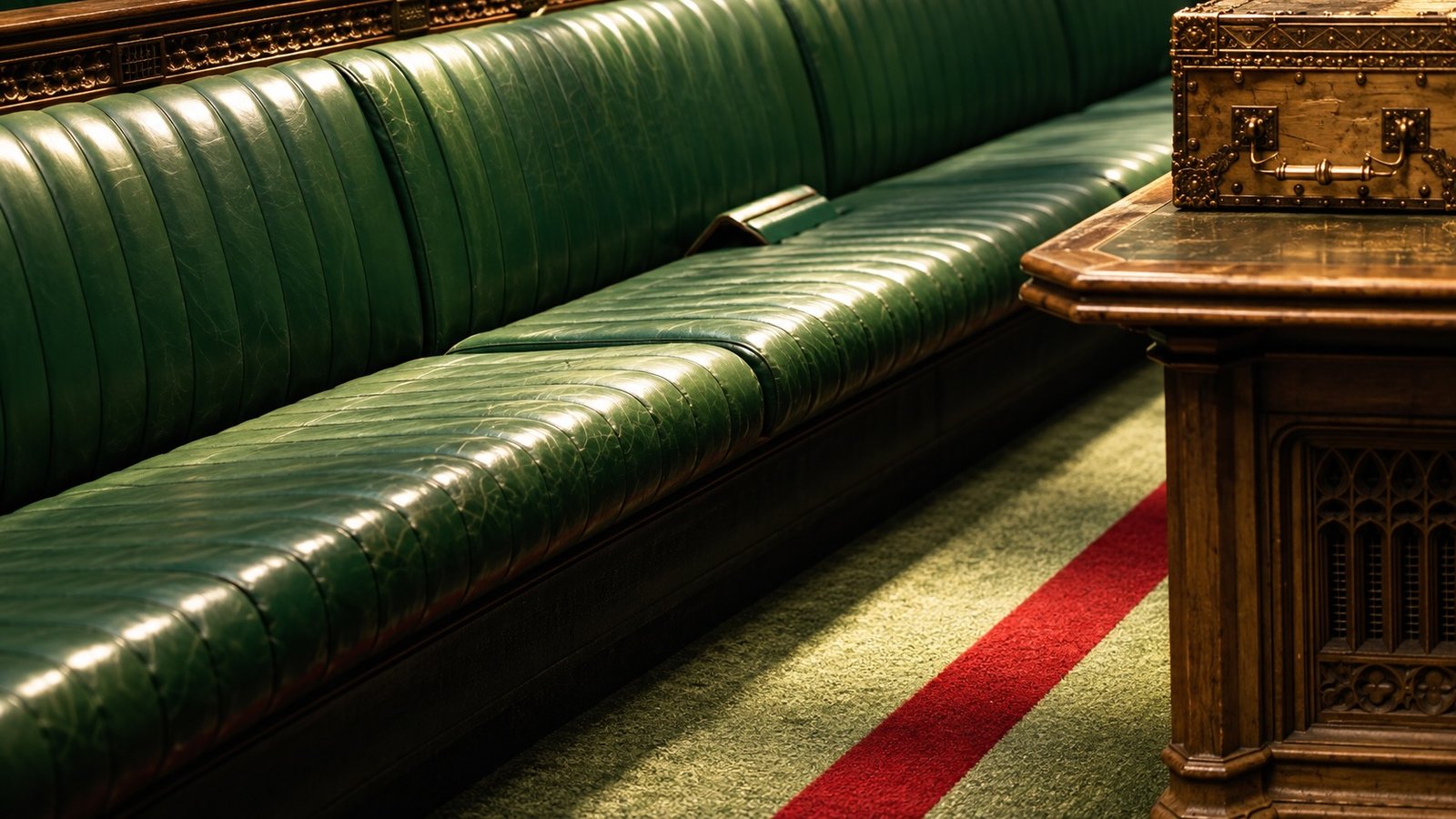
The British House of Commons has 650 Members of Parliament, but its debating chamber has seats for only 427 of them. In a country that has spent centuries developing parliamentary government, this might seem an unfortunate oversight. It is nothing of the sort. The shortage of seats was deliberately preserved when the chamber was rebuilt after the Second World War, largely because Winston Churchill believed that a crowded room encouraged better political debate. The result is a parliament where elected representatives sometimes have to stand, squeeze together or compete for space on the famous green benches. British democracy, it seems, was never intended to be particularly comfortable.
The House of Commons occupies part of the Palace of Westminster, one of London’s most recognisable buildings. Its Gothic towers, riverside terraces and ceremonial halls suggest an institution untouched by time. In reality, the Commons chamber is considerably younger than its surroundings. The room familiar from televised parliamentary debates opened on 26 October 1950, replacing its predecessor, which German bombs had destroyed in May 1941. Its appearance is a carefully reconstructed version of an older parliamentary tradition, complete with architectural features designed to influence how politicians behave.
The institution itself emerged gradually during the Middle Ages. Under Edward III, representatives of English counties and towns became a permanent element of Parliament. By the 1330s, these representatives were meeting together, and from 1341 they deliberated separately from the king and his nobles. Their early responsibilities centred on taxation and petitions, rather than the legislative authority exercised by modern MPs. Nevertheless, the principle that ordinary communities should have representatives capable of challenging royal decisions was beginning to take shape. The word ‘Commons’ referred to those represented, not to any particularly egalitarian membership. Medieval parliamentary representatives generally came from the prosperous and influential sections of society.
One early turning point came in 1376, during the so-called Good Parliament. Representatives challenged the conduct of royal ministers and used impeachment to pursue accusations of corruption. They also selected Peter de la Mare to speak on their behalf. The following year, Thomas Hungerford became the first person officially recorded with the title Speaker. It was not necessarily an attractive career opportunity. Early Speakers could find themselves caught between an increasingly assertive Parliament and monarchs who disliked criticism. Between 1394 and 1535, seven Speakers were executed by beheading. The modern Speaker’s principal occupational hazard, by comparison, is having to shout ‘Order!’ repeatedly.
The relationship between Crown and Commons reached a particularly dangerous moment in January 1642. King Charles I entered the chamber intending to arrest five MPs accused of treason. They had already escaped, and the king demanded information from Speaker William Lenthall. Lenthall refused to identify their whereabouts, declaring that he could speak only as directed by the House. The confrontation became a defining episode in the struggle between royal authority and parliamentary independence. The monarch’s exclusion from the Commons chamber remains a powerful constitutional convention. Even today, the State Opening of Parliament takes place in the House of Lords, rather than in the elected chamber.
For much of its history, the Commons met in a converted medieval chapel. St Stephen’s Chapel, originally built for royal worship, became the chamber’s permanent home in the sixteenth century. Its rectangular arrangement helped establish the opposing benches that still distinguish Westminster from many European legislatures. Instead of sitting in a semicircle, MPs face one another across the floor, with the government traditionally occupying the benches to the Speaker’s right and the principal opposition those to the left. This layout makes disagreement physically visible. Parliamentary politics becomes a contest between two sides, even when the actual political divisions are considerably less straightforward.
The old Palace of Westminster was devastated by fire in 1834, leading to the construction of the present Gothic Revival complex designed by Charles Barry, with much of its decorative character developed by Augustus Pugin. The new Commons chamber opened in 1852, but MPs complained about its acoustics, forcing changes to the ceiling. It was hardly the last time that politicians would demand alterations to their working environment. Yet the most consequential redesign came after a far greater catastrophe.
On the night of 10 May 1941, German aircraft launched a devastating raid on London. Incendiary bombs struck the Palace of Westminster, setting fire to the Commons chamber and threatening the medieval Westminster Hall. Firefighters concluded that they could not save both buildings, so they concentrated their efforts on preserving the ancient hall. By morning, the Commons chamber was a ruined shell. Three people died on the parliamentary estate during the raid. MPs subsequently used the House of Lords chamber for nearly a decade, while the Lords themselves moved into the Robing Room. The arrangement was not widely publicised during the war.
Churchill approached reconstruction with unusually firm architectural opinions. Speaking in October 1943, he insisted that the chamber should retain its rectangular form and remain too small to accommodate every MP simultaneously. He feared that a larger, semicircular assembly would encourage different political habits and weaken the character of Britain’s parliamentary system. His argument produced one of the most frequently quoted observations about political architecture: ‘We shape our buildings and afterwards our buildings shape us.’ Whether the layout actually sustains two-party politics is debatable, but the connection between physical space and political behaviour is difficult to dismiss.
The reconstructed chamber, designed by Sir Giles Gilbert Scott, opened in 1950. Its furnishings included gifts from Commonwealth countries: Australia provided the Speaker’s Chair, Canada contributed the central table, and Jamaica supplied the Bar of the House. The green benches remained, as did the close arrangement of opposing parties. Even the damaged stone arch leading from the Members’ Lobby was preserved at Churchill’s request. Known today as Churchill Arch, it retains visible traces of the wartime destruction. Parliament thus incorporated the evidence of its own vulnerability into the rebuilt building.
One particularly revealing dispute concerned the benches themselves. Scott initially proposed improvements to their dimensions, including more legroom and higher backs. Yet MPs resisted changes that might interfere with their established habit of reclining during lengthy speeches. Oxford University’s Anatomy Department reportedly raised concerns about the old seating’s ergonomics, but parliamentary attachment to familiar discomfort prevailed. There is something distinctly Westminster about consulting medical expertise and then deciding that the old benches were perfectly adequate.
The chamber also preserves a theatrical vocabulary of parliamentary confrontation. The government and opposition front benches are separated by two red lines, traditionally associated with the idea that opponents should remain beyond sword’s reach, although the familiar explanation is better treated as parliamentary folklore than established historical fact. MPs may speak forcefully, but formal debate is directed through the Speaker rather than personally at opponents. The central table, despatch boxes and ceremonial Mace reinforce the distinction between political argument and the authority of the institution itself.
Modern parliamentary business extends well beyond the chamber. Committees scrutinise legislation, investigate public administration and question ministers, while much of the practical work of representation takes place in offices, constituency surgeries and correspondence. Yet the green room retains an influence disproportionate to its size. Prime Minister’s Questions, major government statements and closely contested votes can turn its narrow floor into the centre of national political attention.
There is a final architectural irony. The House of Commons is frequently presented as an ancient institution housed in an ancient chamber. In fact, its present debating room is a twentieth-century reconstruction of a nineteenth-century chamber whose arrangement owed much to a medieval chapel. Each generation has inherited, destroyed, rebuilt or adapted something from the previous one. Britain did not simply preserve its parliamentary traditions. It repeatedly reconstructed the surroundings that make those traditions feel permanent.