The Last Days of Severus in Eboracum
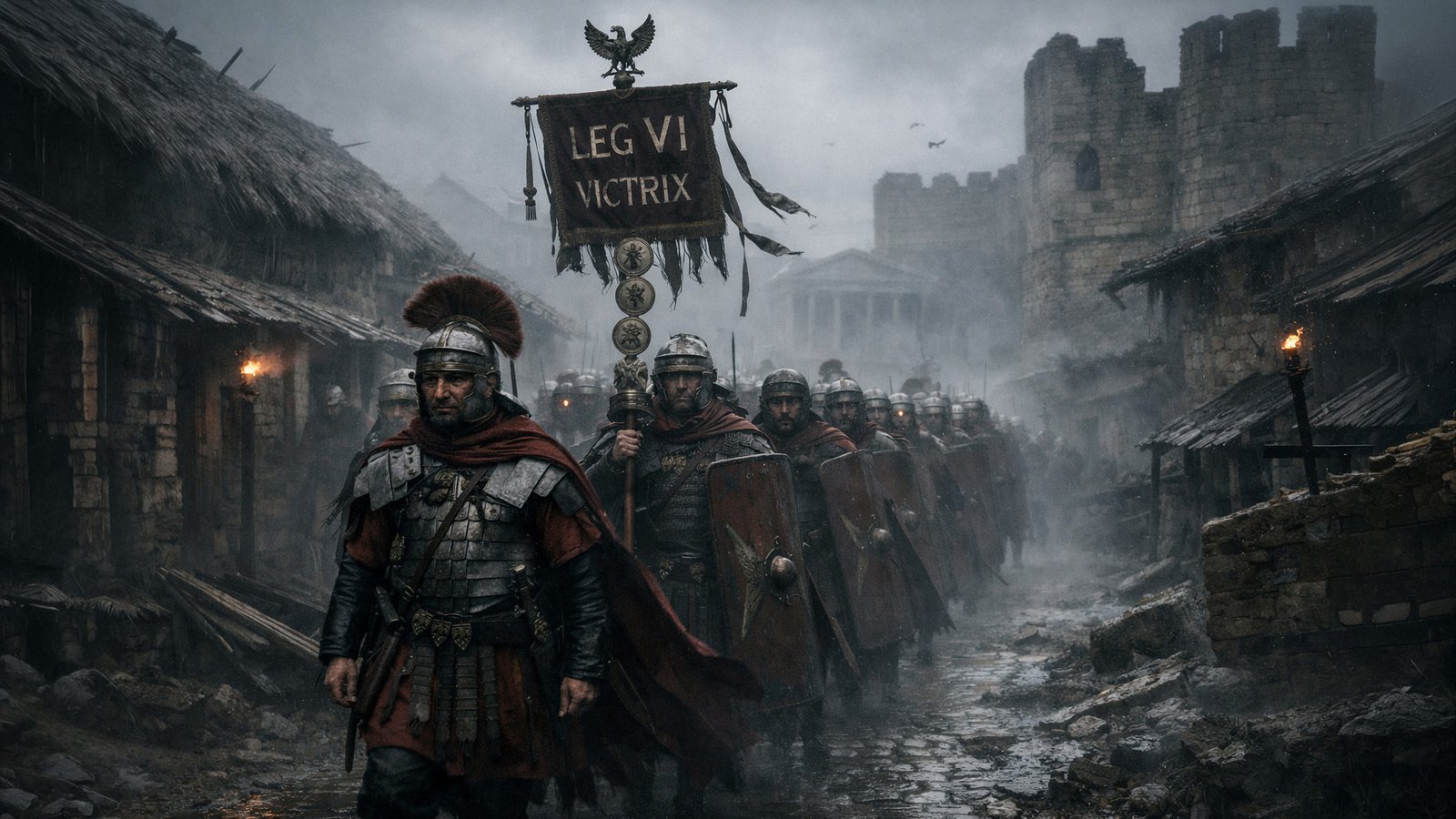
There is something quietly revealing about the fact that one of Rome’s most formidable emperors chose to spend his final years in Eboracum, modern-day York, a windswept outpost at the edge of the empire, rather than in Rome itself. By the time Septimius Severus arrived there in AD 208, he had already secured power the hard way—through civil war, calculated alliances, and relentless discipline. What remained, at least on paper, was to finish the job, to tidy the fringes of the empire and leave behind something that looked complete. Eboracum, however, was not the sort of place where neat endings tended to happen.
Britain had always resisted that kind of narrative. The Romans had occupied the island since AD 43, and much of it had adapted to Roman systems with surprising ease. Towns emerged, roads connected distant regions, trade flourished, and Roman habits blended into local life. Yet the north remained a persistent irritation. Beyond Hadrian’s Wall stretched a landscape that seemed determined to remain inconvenient—dense forests, marshes, and tribal networks that shifted just enough to avoid full control. It was less a province than an unresolved question.
Severus did not approach that question gently. Ancient sources suggest he brought an enormous force to Britain, possibly exceeding 50,000 troops. This was not routine enforcement; it was theatre on an imperial scale. Roads were extended, forts strengthened, and supply lines pushed further into territory that had never quite submitted. The message was unmistakable: Rome could still project overwhelming force, even at its most distant edge.
And yet, Britain refused to cooperate with the script. The tribes of the north—often grouped under names like the Caledonii and the Maeatae—had little interest in meeting Rome on its own terms. They avoided decisive battles, retreated into terrain that favoured them, and reappeared just when the Roman army believed it had achieved something resembling control. Progress became slow, costly, and oddly intangible. There were no triumphant moments, no single victory that could be celebrated. Instead, there was a creeping realisation that the land itself was part of the resistance.
Logistics began to tell the real story. Moving such a large force through northern Britain was not simply a matter of Roman efficiency. Mud swallowed movement, weather eroded morale, and distances stretched supply lines to their limits. Ancient accounts speak of heavy losses, not from dramatic clashes but from exhaustion, disease, and attrition. It is one thing to conquer a city; it is quite another to impose order on a landscape that resists being organised.
At some point, strategy hardened. Rather than chasing elusive opponents, the campaign shifted towards something more severe. Crops were destroyed, settlements disrupted, and the environment itself was turned into a weapon. It was effective in the short term, at least superficially. Yet it exposed a deeper problem. Even if resistance could be broken temporarily, what would replace it? Roman control depended on stability—on towns, administration, taxation, and a degree of cooperation. Northern Britain offered very little of that.
Meanwhile, Severus remained in Eboracum, far from the political centre of the empire. That decision carries weight. Britain was not the wealthiest frontier, nor the most strategically vital compared to the eastern provinces. Yet he stayed, overseeing the campaign personally. Part of it was about legacy. A final conquest would have fitted neatly into the story of a ruler who had restored order after chaos. Another part involved his sons, Caracalla and Geta. Bringing them to Britain allowed him to present a united imperial front, a family visibly in control.
The unity did not quite hold. The relationship between the brothers was already strained, and the pressures of the campaign only made matters worse. Britain became a stage not only for military operations but for an uneasy rehearsal of succession. One can almost picture the forced displays of harmony, the underlying tension that everyone sensed but no one addressed directly. The edge of the empire was not a comfortable place to test family politics.
By AD 210, there were signs of progress. Some northern groups appeared willing to negotiate, perhaps even submit. Reports suggested that the campaign was achieving its aims. Yet these successes felt provisional. Nothing about the region suggested permanence. Control depended on continued presence, continued pressure, continued effort. It was not the kind of victory that could be completed and left behind.
Then Severus’s health declined. He withdrew to Eboracum, the administrative heart of Roman Britain, where order existed but always with a sense of distance from Rome. There, in February AD 211, he died. The image is difficult to ignore: an emperor at the height of his power ending his life not in a triumphant return but in a provincial stronghold, still engaged in a campaign that had not quite resolved.
What followed was telling. His sons, now in charge, chose not to continue the push into the north. Instead, they pulled back. The frontier was restored along Hadrian’s Wall, and the deeper ambitions of conquest were quietly abandoned. It was not framed as defeat. There were no dramatic admissions. Yet the decision spoke clearly. Rome had reached a point where further expansion offered more strain than reward.
This is where the story shifts from one emperor to the nature of empire itself. Rome liked to imagine that it could integrate almost any region into its system. In many cases, it did exactly that. Yet northern Britain presented a different kind of challenge. Geography, climate, and local resistance combined into something that could be managed but not transformed. The cost of full control outweighed the benefits, even if Rome rarely admitted such calculations openly.
Eboracum, in this sense, becomes more than the place where Severus died. It becomes a symbol of proximity to a limit. Not a dramatic collapse, not a decisive defeat, but a quiet boundary. A recognition that power, however extensive, cannot simply expand without consequence.
Severus likely did not see it that way. For him, the campaign was unfinished business, a final assertion that Rome could still do what it had always done. And in a sense, it could. The army marched, the roads extended, the frontier held. But the deeper ambition—the idea of turning the entire island into something orderly and predictable—remained just out of reach.
That is why his final chapter feels less like a victory or a failure and more like a moment of clarity. At the edge of the empire, in Eboracum, Rome encountered something it did not often acknowledge: there are places that resist becoming part of the story. And sometimes, even an empire has to stop there.