How Charles Dickens Invented Victorian Britain
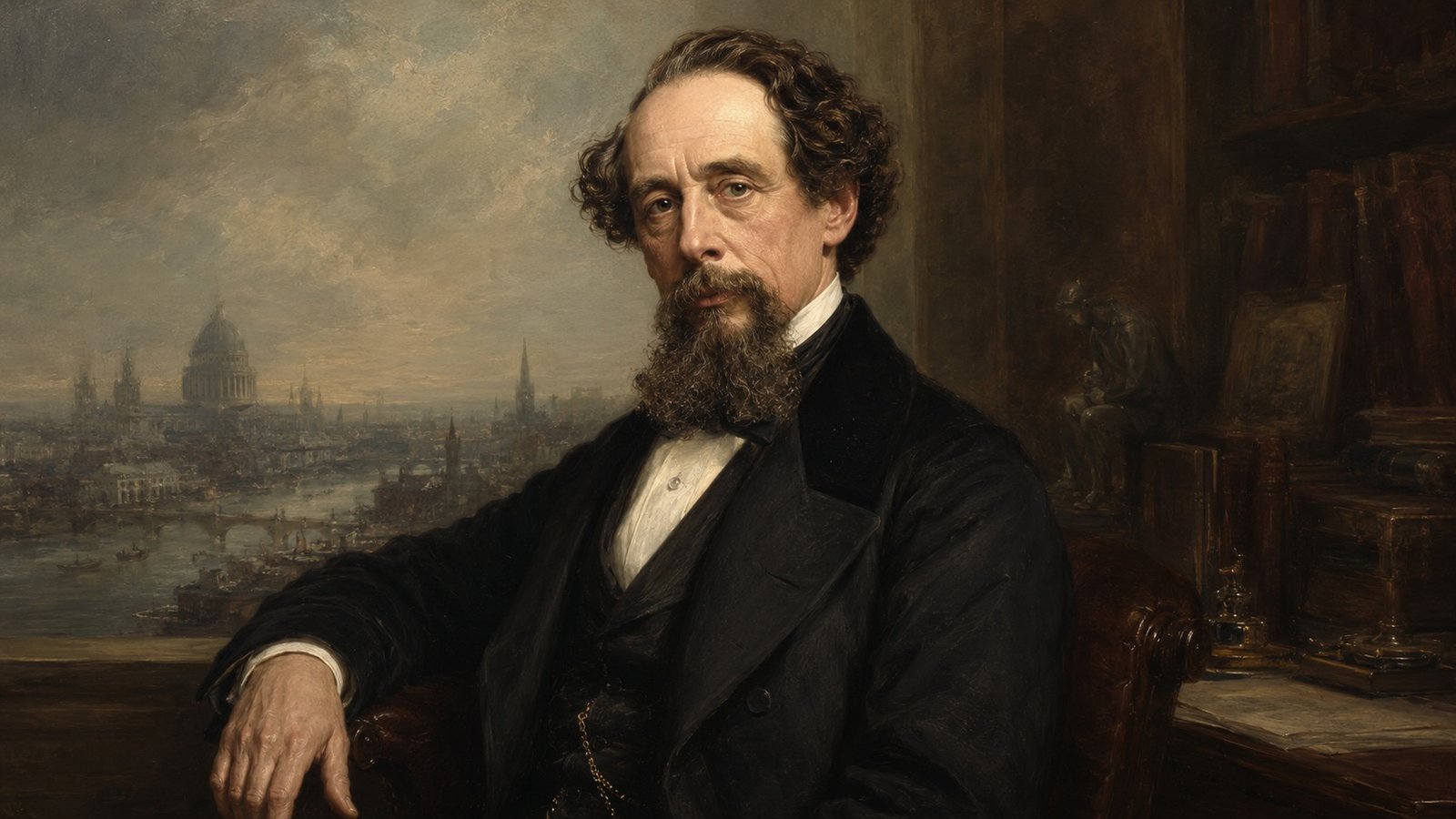
Charles Dickens did not merely write about Victorian Britain. He helped later generations imagine it. Mention his name and an entire world appears: foggy streets, crooked lawyers, hungry children, debtors’ prisons, miserly businessmen and cheerful families gathered around dangerously flammable Christmas trees. Real Victorian Britain looked more varied than this, but Dickens supplied such memorable scenery that history has struggled to compete.
He was born in Portsmouth on 7 February 1812, the second of eight children. His father, John Dickens, worked as a naval clerk and possessed an almost artistic inability to manage money. John enjoyed the appearance of prosperity, spent freely and accumulated debts until the authorities sent him to the Marshalsea debtors’ prison in 1824. Most of the family joined him there, as families of debtors sometimes did.
Twelve-year-old Charles, meanwhile, went to work at Warren’s Blacking Warehouse near the Thames. He spent long days sticking labels onto pots of shoe polish while living apart from his family. The experience lasted only a few months, but Dickens remembered it as a personal catastrophe. He felt abandoned, humiliated and terrified that he might remain a factory boy for life.
That childhood wound became one of the engines of his fiction. Oliver Twist asks for more because Dickens knew what hunger and powerlessness felt like. David Copperfield works in a warehouse because its author had done the same. Little Dorrit grows up around the Marshalsea because Dickens could never entirely escape its walls, even after becoming one of the most famous men in Europe.
However, Dickens did not rise from the factory bench straight to literary immortality. He returned to school, became a solicitor’s clerk, taught himself shorthand and worked as a parliamentary reporter. This training sharpened his ear for speech and introduced him to lawyers, politicians, civil servants, frauds, bores and professional windbags. In other words, Parliament provided excellent material.
He began publishing sketches under the name “Boz”, a family nickname derived through several stages of joking mispronunciation. Then, in 1836, The Pickwick Papers transformed him into a celebrity. Dickens was only twenty-four. Within a few years, he produced Oliver Twist, Nicholas Nickleby, The Old Curiosity Shop and Barnaby Rudge. Five major successes appeared in roughly the time some modern writers spend discussing their unwritten novel at dinner parties.
Serial publication helped create the excitement. Readers bought novels in monthly or weekly instalments, discussed each episode and waited anxiously for the next. Dickens adjusted plots as he wrote and watched public reactions. His relationship with readers resembled a modern television drama releasing one episode at a time, except that nobody could leak the finale because Dickens himself often had not written it yet.
Americans reportedly crowded the docks for news of Little Nell’s fate in The Old Curiosity Shop. Whether people actually shouted, “Is Little Nell dead?” at arriving ships remains debated, but the story survives because it captures the intensity of Dickens mania. His characters felt less like inventions and more like eccentric relatives who might unexpectedly request money.
Names helped. Ebenezer Scrooge sounds as if he was born refusing to pay for heating. Uriah Heep almost wriggles off the page. Mr Gradgrind crushes imagination before he says a word. Dickens understood that a good name could perform half a character description and leave the reader free to enjoy the damage.
His novels also turned social problems into human stories. He attacked brutal schools, child labour, unhealthy cities, legal absurdity, workhouses and the indifference of comfortable people. Bleak House transformed delays in the Court of Chancery into a nightmare that consumes families. Hard Times challenged an education system obsessed with facts and utility. Oliver Twist forced respectable readers to accompany a workhouse child into hunger, crime and exploitation.
Yet Dickens was not a political revolutionary with a neat programme. He distrusted institutions, but he often placed his faith in personal kindness rather than structural change. A cruel businessman might redeem himself; a generous benefactor might rescue a child. This emotional approach made his criticism accessible, although it could also turn poverty into theatre.
Christmas offers the clearest example. Dickens did not invent Christmas, despite the persistent myth. Britons already celebrated it, while older customs and newer Victorian fashions were evolving around him. Nevertheless, A Christmas Carol, published in 1843, helped popularise an ideal of Christmas built around family, generosity, food, memory and responsibility towards the poor.
The book succeeded because it mixed a ghost story with a moral ambush. Scrooge begins as a caricature of greed, yet the spirits reveal loneliness, regret and fear beneath his stinginess. Dickens gives him a second chance, which is comforting because most readers prefer redemption to taxation. The story has remained adaptable precisely because every age can find its own Scrooge.
Dickens cultivated his public image with extraordinary energy. He edited magazines, supported charities, travelled widely and performed dramatic readings from his works. These were not polite literary evenings. He acted out dialogue, altered his voice, paced the stage and drove audiences towards laughter or tears. His performance of the murder of Nancy from Oliver Twist became particularly intense and may have placed serious strain on his health.
Behind the public warmth stood a more complicated man. Dickens married Catherine Hogarth in 1836, and they had ten children. After more than twenty years, the marriage collapsed. Dickens became emotionally involved with the young actress Ellen Ternan, although the precise nature and timeline of their relationship remain subjects of historical debate.
During the separation, Dickens publicly portrayed Catherine as an inadequate wife and mother. Evidence uncovered by scholars suggests that he also explored whether doctors might declare her mentally ill, but a physician found no grounds for such a judgement. More recently studied letters show Catherine as an affectionate mother who longed for greater contact with her children, contradicting the cold image Dickens promoted.
The episode creates an uncomfortable contrast. The novelist who pleaded for compassion towards fictional women could behave ruthlessly towards the woman who had shared his home and borne his children. Understanding that contradiction does not require burning Great Expectations. It does, however, make the familiar portrait of the kindly bearded humanitarian considerably less tidy.
His treatment of race also troubles modern readers. Dickens defended the oppressed within Britain, yet some of his journalism expressed contemptuous views of non-European peoples and supported brutal imperial responses during the Indian Rebellion of 1857. Fagin in Oliver Twist drew on antisemitic stereotypes, particularly in the novel’s repeated identification of him as “the Jew”.
Dickens later modified some references to Fagin and created the sympathetic Jewish character Mr Riah in Our Mutual Friend after correspondence with the Jewish reader Eliza Davis. That shift suggests he could listen and reconsider, although it does not erase the earlier portrayal. The contradiction remains important: a writer may possess enormous sympathy in one direction while displaying alarming blindness in another.
Not every dark story about Dickens carries equal weight. Claims that he routinely visited morgues for entertainment exaggerate his fascination with death, crime and urban life. He certainly walked through London at night, sometimes covering remarkable distances, and used those wanderings to observe neighbourhoods across class boundaries. The city became both his laboratory and his stage.
Walking also helped him manage restlessness. Dickens could write intensely, edit other people’s work, organise theatrical productions, maintain a vast correspondence and then march through the countryside as though pursuing a fugitive chapter. His energy impressed friends but also exhausted those around him. Hosting Hans Christian Andersen for five weeks in 1857 apparently tested even Dickens’s celebrated hospitality; after Andersen departed, Dickens reportedly indicated that the visitor had overstayed by several weeks.
Success eventually allowed Dickens to buy Gad’s Hill Place in Kent, a house he had admired as a child. His father had once suggested that hard work might enable him to own it. Dickens bought the property in 1856, turning a childhood symbol of unattainable respectability into his home. It was the only house he ever owned and the place where he spent the final fourteen years of his life.
He died there on 9 June 1870 after suffering a stroke. Dickens had expressed a wish for a quiet burial, but the nation claimed him. He was buried in Poets’ Corner at Westminster Abbey, surrounded by the official grandeur that his novels had so often regarded with suspicion.
His unfinished novel, The Mystery of Edwin Drood, left readers with a final puzzle. Dickens died before revealing what had happened to Edwin, producing generations of theories, adaptations and literary investigations. Even his departure arrived with a cliffhanger.
Dickens survives because he combined anger with entertainment. He could expose institutional cruelty, invent a ridiculous surname, describe a London fog as if it possessed political ambitions and then break the reader’s heart within a few pages. His sentimentality sometimes overwhelms, his plots rely heavily on coincidence and his moral vision contains serious blind spots. Still, the characters breathe.
Perhaps that explains why “Dickensian” remains one of the few literary adjectives people use in ordinary conversation. It can describe poverty, bureaucracy, eccentricity, gloom or festive warmth, sometimes all before lunchtime. Charles Dickens contained those contradictions himself: generous and controlling, compassionate and prejudiced, wounded child and ruthless celebrity. He did not simply record his age. He exaggerated it, argued with it and transformed it into a story we are still reading.