Is Your Microbiome Secretly Managing Your Working Day?
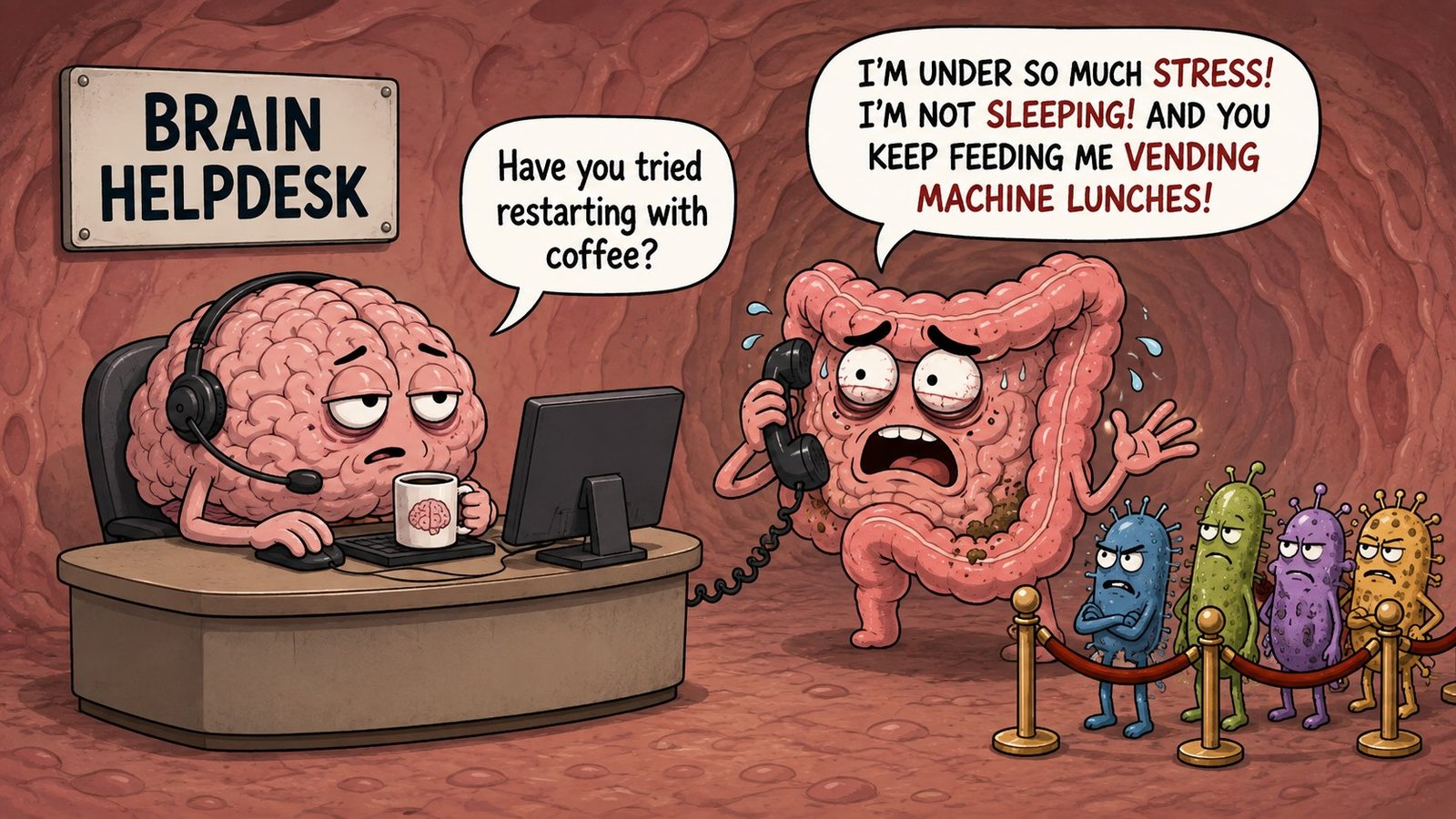
You may believe that your working day begins when you open your laptop. In reality, several trillion microscopic colleagues have already started their shift. They live mainly in your gut, never attend meetings and rarely respect organisational charts. Nevertheless, scientists increasingly suspect that this internal community can influence stress, mood, sleep and certain aspects of cognition.
This community forms part of the human microbiome: the bacteria, fungi, viruses and other microorganisms that live in and on the body. Most workplace conversations focus on the gut microbiome because it communicates with the brain through an elaborate network involving nerves, hormones, immune signals and microbial chemicals. Researchers call this network the microbiota–gut–brain axis, which sounds like a multinational infrastructure project but operates inside your digestive system.
The connection runs in both directions. Gut microbes can produce or modify substances that affect inflammation, metabolism and nervous-system activity. Meanwhile, stress hormones, sleep disruption, medication, illness and diet can alter the environment in which those microbes live. Your brain influences your gut, and your gut may influence your brain. It resembles a slightly dysfunctional management relationship in which neither side can remember who started the argument.
That matters at work because good performance depends on more than intelligence or motivation. Concentration, memory, emotional control, energy and resilience all affect how well someone handles pressure and makes decisions. A person who has slept badly, feels bloated and cannot concentrate will probably contribute less than their job description optimistically predicts.
Researchers have found associations between gut microbial patterns and anxiety, depression, stress and cognitive health. They have also identified plausible biological mechanisms. Certain gut bacteria produce short-chain fatty acids when they ferment fibre. These compounds can support the intestinal barrier, interact with immune cells and influence processes linked to brain function. Other microbes affect the availability of compounds involved in producing neurotransmitters.
This does not mean bacteria sit in your colon composing serotonin and emailing it directly to the brain. Popular wellness explanations often turn a complicated system into a cheerful cartoon. Much of the body’s serotonin occurs in the gut, but it does not simply travel into the brain and improve your quarterly results. The real pathways involve many interacting systems, and researchers still debate their relative importance.
Studies of probiotics illustrate both the promise and the problem. Some trials involving stressed adults have reported improvements in selected measures of stress, memory or cognitive performance after participants consumed particular bacterial strains. Other well-designed trials involving healthy adults have found no significant improvement in cognition, mood or brain structure.
The phrase “particular bacterial strains” deserves attention. Probiotics do not form one interchangeable category. One strain may behave differently from another, while the dose, duration and health of the participant also matter. Buying a random bottle labelled “50 billion friendly bacteria” therefore resembles recruiting 50 billion employees without checking their skills, responsibilities or ability to survive the commute.
Even positive studies do not prove that probiotics will transform workplace performance. Many trials involve small groups, last only a few weeks and measure narrow outcomes. A statistically significant improvement in one memory test does not automatically produce better leadership, sharper commercial judgement or fewer passive-aggressive emails.
Individual variation creates another complication. Two people can eat the same lunch and develop different biological responses because their existing microbiomes, genes, medication, sleep and lifestyles differ. Scientists have not identified one perfect microbial community that every ambitious professional should try to acquire. Diversity often appears beneficial, but more diversity does not always equal better health in every context.
Commercial microbiome tests frequently move faster than the science. They may provide an interesting snapshot of the organisms found in a stool sample, yet interpretation remains difficult. Microbial communities change, laboratory methods differ and many organisms remain poorly understood. A colourful report that labels your gut health “72 out of 100” offers precision, but not necessarily truth. The number may look authoritative because decimals have always dressed uncertainty rather well.
The famous advice to eat 30 different plants each week comes from a large observational research project. Participants who reported eating more than 30 types of plant food tended to have more diverse gut microbiomes than those eating fewer than ten. Yet 30 does not represent a biological password. Researchers did not establish that the twenty-ninth plant does nothing while the thirtieth unlocks supreme mental clarity.
Still, the idea offers useful practical guidance. Different plants provide different fibres and plant chemicals, which feed different microbes. Whole grains, beans, lentils, vegetables, fruit, nuts, seeds, herbs and spices all contribute. Diversity matters more than performing nutritional heroics with an obscure fermented root that costs £14 and tastes like garden furniture.
Workplaces can support better gut health without launching an invasive “microbiome performance programme”. A varied canteen menu, proper lunch breaks, drinking water, healthier meeting food and flexible working practices may help. So can a culture that does not reward employees for replacing sleep with caffeine and lunch with biscuits found beside the printer.
Fermented foods such as live yoghurt, kefir, kimchi and sauerkraut may add useful microorganisms or microbial products, although their effects vary. Fibre remains particularly important because many beneficial gut bacteria rely on it. Increasing fibre gradually makes sense, since a sudden dietary revolution can produce enough gas to damage both personal comfort and workplace diplomacy.
Exercise also supports microbial diversity and improves mood, sleep and cognitive health through routes that extend far beyond the microbiome. Likewise, regular sleep helps regulate stress, appetite and biological rhythms. Recent research suggests that microbial activity itself follows daily rhythms, which means irregular sleep and meals may disrupt more than your calendar.
Antibiotics can profoundly disturb the gut microbiome, but they also save lives. Rejecting necessary treatment to protect microbial diversity would represent wellness logic at its most theatrical. The sensible approach involves using antibiotics appropriately under medical guidance rather than treating them as either harmless sweets or civilisation-ending chemicals.
Employers should also resist turning gut health into another way to blame individuals for organisational problems. No amount of kefir can compensate for abusive management, impossible workloads, insecure employment or six hours of video calls. Stress can affect the gut, but the existence of the gut–brain axis does not give companies permission to serve kombucha while ignoring burnout.
The most credible interpretation sits between dismissal and hype. The microbiome probably contributes to the biological conditions that shape how people feel and function. However, it acts alongside sleep, movement, diet, mental health, medical conditions, workplace culture and countless other factors. It represents one influential participant, not the chief executive of human performance.
For individuals, the practical strategy looks reassuringly ordinary: eat a varied, fibre-rich diet; include fermented foods when they suit you; exercise; sleep consistently; manage stress; and seek medical advice for persistent digestive or psychological symptoms. Supplements may help in specific circumstances, but they cannot replace those foundations.
For organisations, the lesson carries a subtle irony. Businesses often search for advanced technologies and sophisticated productivity systems while employees eat poor lunches at their desks, remain sedentary for hours and answer messages late at night. Supporting the microbiome does not require collecting stool samples at the annual appraisal. It requires treating people like biological organisms rather than rechargeable office equipment.
Your microscopic colleagues may influence the quality of your working day. But they respond to the world you create for them. Feed them reasonably well, move your body, protect your sleep and stop expecting a capsule to repair a chaotic lifestyle. They may not guarantee a promotion, but they could help you feel more capable of surviving the meeting that should have been an email.