American copyright law began with a noble idea and quickly developed the personality of an overcomplicated filing cabinet. It promised to encourage learning, reward creators and enrich the public. Over the next two centuries, however, it also accumulated extensions, exceptions, licensing systems, lawsuits, technological panic and enough legal terminology to make an ordinary reader quietly close the browser tab.
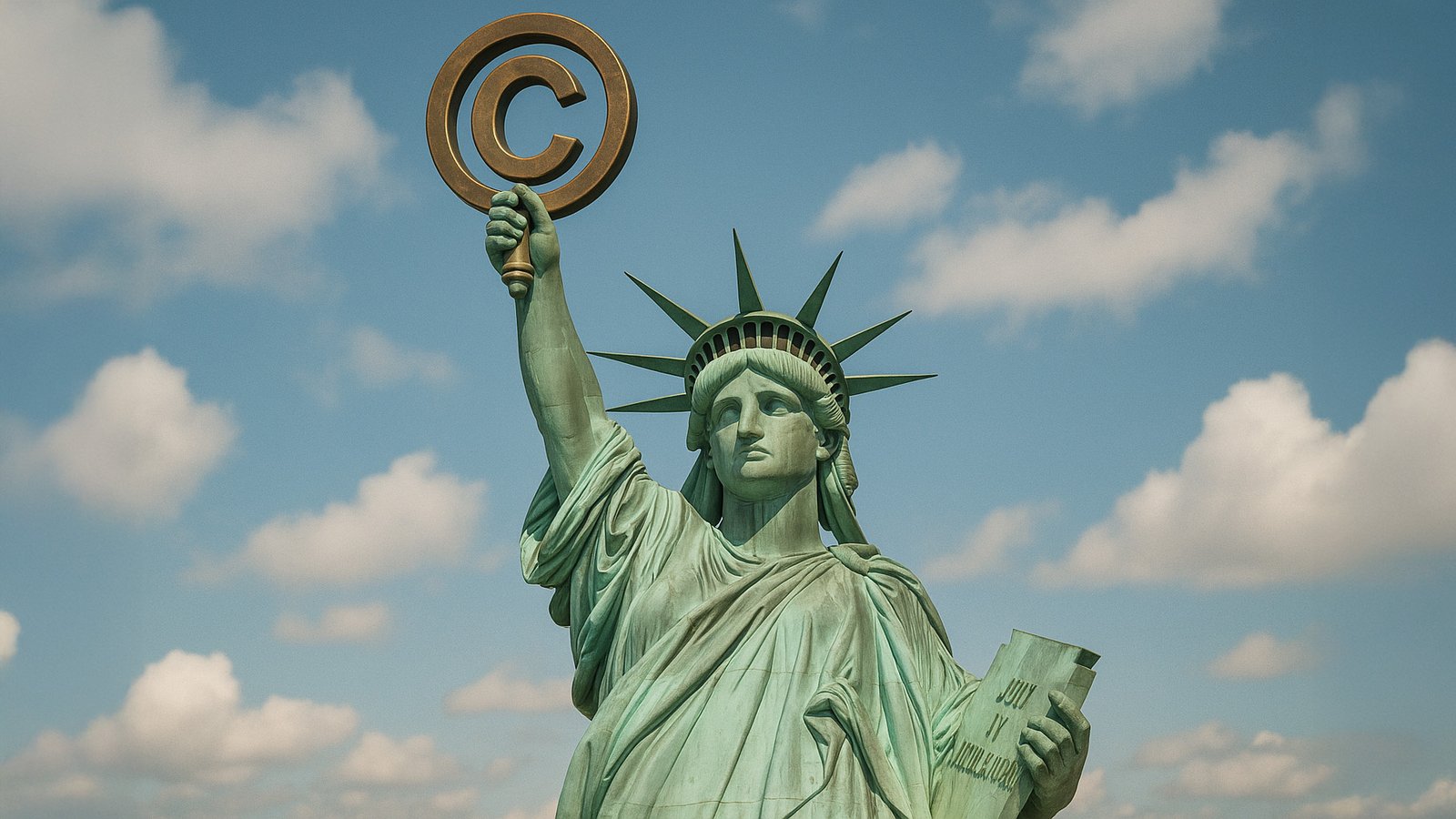
The basic principle appears in the United States Constitution. Congress received the power to grant authors exclusive rights to their writings for “limited Times”, not simply to make writers wealthy, but to promote knowledge and cultural progress. That distinction matters. Copyright was designed as a bargain: society gives creators temporary control, creators eventually give society a richer public domain.
Before the Constitution, several American states had already experimented with copyright legislation. Their rules differed, creating exactly the sort of confusion that publishers dislike and lawyers mysteriously survive. A book might receive protection in one state but not another. The new federal government therefore created a national system.
George Washington signed the first federal Copyright Act on 31 May 1790. It protected books, maps and charts for fourteen years, with a possible fourteen-year renewal if the author remained alive. The law borrowed heavily from Britain’s Statute of Anne of 1710, although the young republic presented its version as an encouragement to learning rather than an inheritance from the former colonial landlord.
The system looked modest by modern standards. Authors had to register their claims, publish notices and deposit copies. Copyright did not appear automatically the moment somebody wrote a dramatic sentence in a notebook. Protection depended on following formal procedures, and mistakes could carry serious consequences.
The original law also mainly protected American citizens and residents. Foreign authors enjoyed little sympathy. During the nineteenth century, American publishers freely reprinted British books without paying British writers. Charles Dickens complained bitterly about the practice during his American visits, although his complaints did not immediately inspire Congress to hand him a cheque.
Pirated British literature gave American readers cheap access to popular novels. It also allowed publishers to sell famous foreign works more cheaply than books by American authors, who demanded payment. In other words, the absence of international copyright sometimes hurt the very domestic literary culture that American policy claimed to encourage.
Congress gradually expanded protection. The Copyright Act of 1831 extended the initial term from fourteen to twenty-eight years and allowed a fourteen-year renewal. Musical compositions received federal protection, reflecting the growth of commercial sheet music. Later legislation brought photographs, dramatic works, paintings, sculptures and other creative forms into the system.
Technology repeatedly forced lawmakers to reconsider what counted as copying. Photography produced images mechanically, so critics questioned whether photographs contained genuine authorship. Player pianos reproduced music through perforated rolls, leading to arguments over whether a machine-readable sequence constituted a copy of a composition. Each new invention arrived looking suspiciously like the end of civilisation. Then copyright law adjusted, usually several years late and wearing a worried expression.
The Copyright Act of 1909 became the next great overhaul. It gave protected works an initial twenty-eight-year term followed by a possible twenty-eight-year renewal, creating a maximum of fifty-six years. It also expanded the law’s reach and introduced a compulsory mechanical licence for musical compositions.
That musical licence addressed a fear that one company might control the rapidly growing market for mechanical music. Once a song had received authorised mechanical distribution, other manufacturers could record it by paying a statutory royalty. Congress originally set the rate at two cents per copy, where it remained for decades. Songwriters gained compensation, manufacturers gained access, and everyone gained a licensing system that future generations would spend considerable energy trying to modernise.
Under the 1909 regime, publication played a decisive role. An unpublished work often received protection under state common law, while publication with the correct notice brought it into federal copyright. Publication without proper notice could send it into the public domain. A missing symbol or poorly placed statement might therefore destroy valuable rights, which seems a harsh punishment for untidy typesetting.
Cinema, radio, recorded music, photocopying, television and computers eventually overwhelmed the assumptions behind the 1909 Act. Congress spent years preparing a replacement. The result, the Copyright Act of 1976, still forms the foundation of American copyright law.
The 1976 Act changed almost everything. Copyright began automatically when an original work became fixed in a tangible medium. A novelist no longer needed to register a manuscript before receiving any protection. A songwriter gained copyright when recording or writing down the song. Registration remained important, especially when bringing an infringement action and seeking certain remedies, but it no longer created the underlying right.
The law also replaced the old publication-based term for new works with a term connected to the author’s life. For most individually authored works, protection initially lasted for the author’s lifetime plus fifty years. It also established a separate term for anonymous works, pseudonymous works and works made for hire.
Most importantly, the Act clearly recognised several exclusive rights. Copyright owners could control reproduction, distribution, public performance, public display and the creation of derivative works. Yet Congress also codified fair use, which allows certain unauthorised uses for purposes such as criticism, comment, news reporting, teaching, scholarship and research.
Fair use does not operate through a simple word-count rule. Courts examine the purpose of the use, the nature of the original work, the amount taken and the effect on the potential market. The popular myth that copying ten per cent always counts as fair use has roughly the same legal authority as declaring “no copyright intended” beneath an uploaded film.
American law eventually joined the international mainstream. The United States entered the Berne Convention in 1989, more than a century after the agreement first appeared. Berne membership pushed the country away from strict formalities such as mandatory copyright notices. The familiar copyright symbol remained useful, but forgetting it no longer automatically donated a new work to humanity.
Then came the internet, which turned everyone with a modem into a printer, broadcaster, distributor and occasional accidental infringer. Congress responded with the Digital Millennium Copyright Act of 1998. The DMCA prohibited certain attempts to bypass technological protection measures and created a notice-and-takedown framework for online service providers.
Under that system, platforms may receive limited protection from liability when they respond appropriately to infringement notices. Rights holders gained a rapid method for requesting removal, while users gained a counter-notice process. In practice, the system attracts constant controversy. Critics point to automated claims, mistaken removals and efforts to suppress lawful criticism. Supporters argue that online platforms could not operate at scale without a practical mechanism for handling millions of uploads.
The same year brought the Copyright Term Extension Act, commonly associated with the late congressman Sonny Bono. It added twenty years to many copyright terms. For individual authors, the standard term became life plus seventy years. Many corporate and older published works could receive protection for as long as ninety-five years from publication.
Critics nicknamed it the “Mickey Mouse Protection Act”, arguing that large entertainment companies had pushed Congress to delay valuable characters and films from entering the public domain. Supporters cited longer lifespans, international harmonisation and the interests of authors’ descendants. The Supreme Court upheld the extension in Eldred v. Ashcroft, accepting that a repeatedly extended term could still qualify as “limited”.
Software created another difficult frontier. Courts had to distinguish protectable expression from ideas, systems, procedures and methods of operation. In Google v. Oracle, the Supreme Court ruled in 2021 that Google’s copying of portions of the Java application programming interface constituted fair use. The ruling did not settle every question about software copyright, but it acknowledged that functional computer code requires careful treatment.
Music streaming produced its own legal maze. The Music Modernization Act of 2018 created a blanket licensing structure for many digital uses of musical works and established a central system for collecting and distributing mechanical royalties. It attempted to update rules originally shaped by piano rolls for a world of interactive streams, enormous databases and songs played on demand several billion times before breakfast.
Today, American copyright protects far more than printed books. It covers films, music, photographs, architecture, software, choreography, visual art, podcasts and countless other original works. Nevertheless, it does not protect facts, ideas, systems, titles or general concepts. You may copyright a particular novel about a school for wizards, but not the broad idea of young magicians attending lessons. Otherwise, literature would have ended after the first person described a heroic journey.
The law still struggles to balance private incentive and public access. Long terms help creators and companies exploit successful work, yet they can also keep culturally important material unavailable, expensive or legally uncertain. Orphan works create another problem because copyright may endure even when nobody can identify the owner. Libraries and filmmakers sometimes avoid using such material because the legal risk remains unclear.
Artificial intelligence now presents the latest argument. Courts, regulators, artists and technology companies disagree over the use of copyrighted material in training systems and the status of AI-generated output. The United States Copyright Office maintains that copyright requires human authorship, although difficult questions remain when people guide, edit or combine machine-generated material.
The history of American copyright therefore resembles a long negotiation rather than a settled doctrine. Printers worried about books, composers worried about piano rolls, studios worried about video recorders, record labels worried about file sharing, and creators now worry about generative AI. Sometimes those fears proved justified. At other times, new technology created markets larger than the industries it supposedly threatened.
Copyright law works best when it remembers its original bargain. Creators need a realistic opportunity to earn from their work. Society also needs criticism, education, experimentation, preservation and a healthy public domain. Tilt too far towards unrestricted copying and creative livelihoods suffer. Tilt too far towards permanent control and culture becomes a private collection that nobody may touch.
The American system has spent more than two centuries adjusting that balance, usually after technology has already changed the rules of the game. Its history shows something rather reassuring: copyright survives every new medium. Unfortunately, so do the arguments.