Horatio Nelson has spent more than two centuries standing above Trafalgar Square, watching London traffic perform manoeuvres that would have horrified even the most reckless admiral. He looks calm, dignified and conveniently distant. Down at street level, however, the real Nelson appears far less tidy. He was brilliant, ambitious, vain, frequently ill, spectacularly brave and hopelessly entangled in one of Georgian Britain’s juiciest celebrity scandals.
Britain remembers him mainly as the hero of Trafalgar, the admiral who defeated the combined French and Spanish fleets and died at the perfect dramatic moment. Yet Nelson’s story contains far more than a famous battle, a missing arm and an unusually tall column. It also reveals how national heroes emerge, how public relations worked before television, and how a talented man helped turn his own life into a legend.
Born in Norfolk in 1758, Nelson entered the Royal Navy at the age of twelve. His uncle, Captain Maurice Suckling, helped him secure a place, which proves that networking mattered even when professional networking involved wooden ships, cannon fire and the possibility of scurvy. The young Nelson did not look like an obvious warrior. He was small, physically fragile and prone to seasickness, a condition that seems inconvenient for someone planning a naval career.
Nevertheless, he possessed enormous energy and a fierce appetite for recognition. Nelson wanted promotion, command and glory. More importantly, he understood that naval warfare depended on initiative. Eighteenth-century admirals often followed formal battle lines and complex signals. Nelson preferred aggressive action, close combat and officers who understood his intentions before the shooting started.
His approach rested on trust. Before major battles, he discussed his plans with his captains so thoroughly that they could respond without waiting for detailed orders. This group became known as his “band of brothers”, although the phrase sounds rather warmer than life aboard a warship actually felt. The system encouraged independence, but it also depended heavily on Nelson’s judgement. When he calculated correctly, the results looked like genius. Had he calculated badly, Britain might remember him as a courageous man with a serious planning problem.
Nelson’s reputation grew through a succession of victories. At the Battle of Cape St Vincent in 1797, he disobeyed the normal line of battle and moved HMS Captain to intercept Spanish ships. The decision helped secure victory and demonstrated the quality that admirers later called daring. Less charitable observers might have called it ignoring instructions until everything worked out.
Later that year, an unsuccessful attack on Santa Cruz de Tenerife cost Nelson his right arm. Surgeons amputated it without modern anaesthetic, and he returned to command after recovering. He had already lost much of the sight in his right eye during fighting in Corsica, although he did not wear the famous eye patch often associated with him. Popular memory evidently decided that one damaged eye required a decorative accessory.
In 1798, Nelson achieved a stunning victory at the Battle of the Nile. He found the French fleet anchored in Aboukir Bay after Napoleon’s expedition to Egypt. Rather than waiting for daylight, Nelson attacked immediately. British ships sailed between the French vessels and the shore, striking them from both sides. The French flagship L’Orient exploded, producing a spectacle so dramatic that painters could dine out on it for decades.
The victory isolated Napoleon’s army in Egypt and transformed Nelson into an international celebrity. It also brought him into the orbit of Sir William Hamilton, the British ambassador in Naples, and Hamilton’s wife Emma. Emma Hamilton had risen from poverty to become a celebrated beauty, performer and society figure. She and Nelson began a passionate affair while both remained married to other people.
Their relationship became impossible to hide. Emma gave birth to their daughter, Horatia, and the couple lived openly together at Merton Place in Surrey. Georgian society tolerated a remarkable amount of misbehaviour, provided everyone maintained sufficient discretion. Nelson and Emma, unfortunately, displayed approximately none.
Nelson’s wife, Fanny, suffered public humiliation, while newspapers and caricaturists seized upon the scandal. Even so, the affair strengthened Nelson’s romantic image. He no longer appeared merely as a naval officer. He became a tragic lover, wounded hero and public celebrity, complete with domestic complications that would suit a modern television drama.
His actions in Naples created a darker controversy. Nelson supported the restored Bourbon monarchy after a republican uprising and became involved in the treatment of its defeated supporters. Admiral Francesco Caracciolo, who had served the republic, received a rapid court martial and execution. Critics accused Nelson of abandoning agreed terms of surrender and allowing political vengeance to replace military honour.
The evidence remains debated, but the episode disrupts the comfortable portrait of Nelson as an uncomplicated hero. He operated within the brutal politics of revolutionary Europe, yet he also made choices. His willingness to support repression in Naples reminds us that bravery in battle does not automatically produce wisdom or justice elsewhere.
Then came Copenhagen. In 1801, a British fleet attacked the Danish fleet during a confrontation with the Armed Neutrality League. Nelson’s commander, Admiral Sir Hyde Parker, signalled that he could withdraw if necessary. According to the famous story, Nelson raised his telescope to his blind eye and declared that he could not see the signal.
The phrase “turning a blind eye” already existed, so Nelson did not invent it. Still, the episode suited his personality perfectly. He technically received permission to disengage, chose not to notice it and won. Few careers have benefited so consistently from selective interpretation.
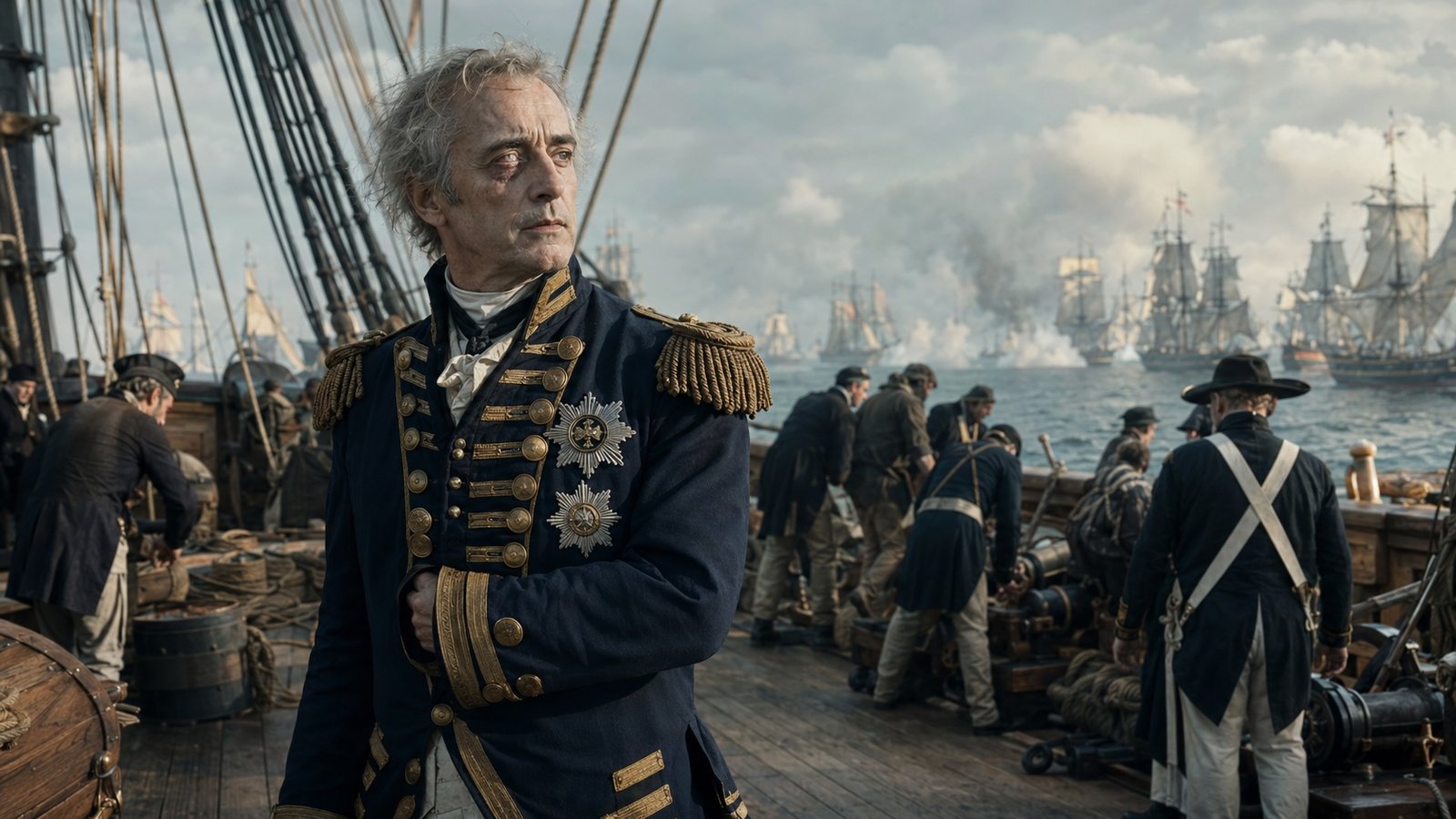
By 1805, Napoleon dominated much of continental Europe, while Britain depended on naval power to prevent invasion and maintain its global position. Nelson took command of HMS Victory and pursued the French fleet across the Atlantic before confronting the combined French and Spanish fleet near Cape Trafalgar on 21 October.
Traditional naval battles placed fleets in parallel lines. Nelson instead divided his twenty-seven ships into two columns and drove them directly towards the enemy’s line of thirty-three ships. The approach exposed the leading British vessels to heavy fire because they could not immediately reply with their broadsides. Nelson accepted the risk because he wanted to break the enemy formation and create a chaotic close-range battle in which British training and gunnery offered an advantage.
Before the attack, Victory raised the signal: “England expects that every man will do his duty.” Nelson originally wanted to say that England “confides” in every man, but the signal officer suggested “expects” because the word already existed in the signal book. One of Britain’s most famous quotations therefore owes part of its elegance to administrative efficiency.
Nelson wore his full uniform and decorations on deck, making him easily recognisable. Some accounts suggest officers warned him about the danger, although the precise details remain uncertain. Vanity may have played a role, but visible leadership mattered during battle. Nelson wanted sailors throughout the fleet to know that their commander stood among them.
A musket ball fired from the French ship Redoutable struck his shoulder, passed through his lung and damaged his spine. Sailors carried him below deck, where he remained conscious for several hours. He learned that the British had won before dying at about half past four in the afternoon.
His supposed last words created another layer of mythology. “Kiss me, Hardy” remains the best-known version, although witnesses recorded several remarks, including requests for care of Emma and Horatia. Some later commentators tried to transform the line into “Kismet, Hardy”, as though an English admiral suddenly chose a Turkish-derived word while dying. Most historians regard that explanation as an awkward Victorian attempt to avoid the thought of two men showing affection.
Nelson’s body travelled home preserved in a barrel of spirits, probably brandy mixed with camphor and myrrh rather than ordinary rum. The tale that sailors secretly drank from the barrel produced the phrase “Nelson’s blood” for rum, but evidence for the drinking story remains thin. It survives because history enjoys a memorable anecdote even when facts politely stand to one side.
Britain gave Nelson a state funeral at St Paul’s Cathedral in January 1806. Thousands lined the streets, while the government, navy, artists and publishers helped transform him into a national icon. Nelson’s Column appeared decades later, completed in the 1840s, when Victorian Britain wanted symbols of naval power and imperial confidence.
Modern arguments about Nelson often focus on slavery. He never owned a plantation or participated directly in slave trading, but he maintained friendships with Caribbean plantation interests and expressed hostility towards the abolitionist campaign. A frequently quoted letter defending West Indian slaveholders has faced questions over its later publication and wording, yet Nelson’s broader sympathies clearly did not place him among the abolitionists.
That does not erase Trafalgar, nor does Trafalgar erase the moral world he supported. Historical judgement becomes useless when it offers only sainthood or cancellation. Nelson can remain an exceptional commander while also representing an empire built through warfare, commerce and exploitation.
Perhaps that tension explains his endurance. Nelson was not a marble hero who accidentally became human. He was deeply human first: insecure, theatrical, affectionate, ruthless, courageous and hungry for applause. His greatest talent lay in understanding risk, inspiring sailors and acting before opponents could recover.
He also understood something modern celebrities know instinctively. A public figure needs a recognisable image, a compelling personal story and a dramatic final scene. Nelson supplied all three. Britain supplied the column.