Westminster Abbey looks as though someone tried to turn the whole of British history into a Gothic building. Then, apparently, they forgot when to stop. Kings, queens, poets, scientists, soldiers, politicians and saints crowd its chapels, floors and walls. Every few steps reveal another tomb, plaque or memorial. Death itself starts to resemble a particularly competitive London property market.
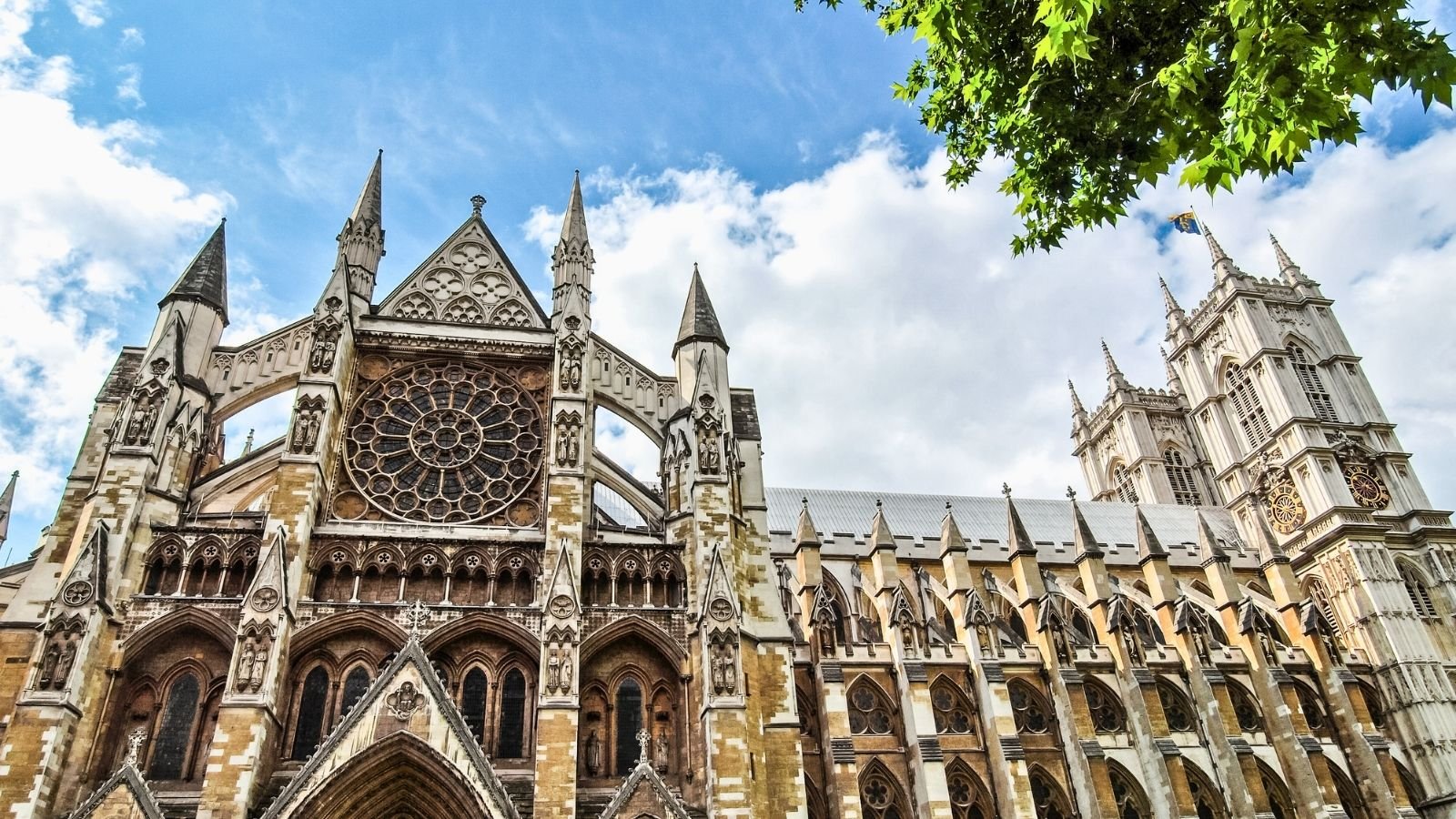
Yet the Abbey is not simply a grand cemetery with excellent stonework. It remains a working church, a royal stage and a national archive. It is also an architectural scrapbook covering almost a thousand years. Coronations unfold beneath its vaults, while royal weddings fill the nave. State funerals turn it into the solemn centre of public life. Meanwhile, ordinary worship continues among monuments to deeply extraordinary people.
The building’s official name is the Collegiate Church of Saint Peter at Westminster. Curiously, it has not technically been an abbey since the sixteenth century. It no longer houses an abbot or a community of monks. The familiar name survived because “Westminster Collegiate Church” sounds more like a government department than a great national shrine.
A Benedictine monastery probably stood on the site by the mid-tenth century. Later legend pushed its origins much further back. One story claims that a fisherman named Aldrich saw Saint Peter beside the Thames. The saint then personally consecrated the church. Medieval storytellers rarely allowed paperwork to obstruct a supernatural anecdote.
Westminster takes its name from the “west minster”. This distinguished it from Saint Paul’s Cathedral, London’s “east minster”. King Edward the Confessor transformed the monastery into a major royal foundation during the eleventh century. His vast Romanesque church was consecrated in December 1065, only days before his death.
Very little of Edward’s building remains visible. Even so, his presence still dominates the Abbey. His shrine stands at its spiritual heart.
William the Conqueror chose Westminster for his coronation on Christmas Day 1066. The ceremony did not proceed smoothly. When the congregation loudly acclaimed the new king, Norman guards outside misunderstood the noise. They assumed an attack had begun and set nearby houses on fire.
Inside, bishops continued the coronation as smoke and panic spread outside. Britain’s coronation tradition therefore began with pageantry, confusion and an avoidable emergency. Somehow, that feels entirely appropriate.
Almost every English and British monarch since William has been crowned at Westminster Abbey. Edward V and Edward VIII remain the exceptions because neither reached a coronation. The ceremony still contains medieval rituals. Television cameras, security teams and modern communications now surround the ancient prayers, sacred oil and elaborate robes.
The most famous object involved is the Coronation Chair. Edward I commissioned it around 1300. It originally enclosed the Stone of Scone, which Edward had seized from Scotland.
The chair once glittered with gilding, coloured glass and painted decoration. Today, it looks austere, scratched and deeply uncomfortable. It resembles something found in the storeroom of an unusually ambitious parish church.
Boys from Westminster School carved initials and graffiti into it during the eighteenth and nineteenth centuries. One visitor even claimed to have slept in the chair. Modern conservators would probably describe such behaviour using language unsuitable for a royal church.
The Stone of Scone returned to Scotland in 1996. However, it travels south for coronations. Its history contains a glorious complication.
Scottish students removed the stone from the Abbey on Christmas Day 1950. They carried it back across the border, although the operation went badly. During the escape, the stone broke into two pieces and needed repair.
Some sceptics have long wondered whether the object later returned was the original stone. No conclusive evidence supports the substitution theory. Still, the mystery adds a pleasing hint of national mischief to a solemn royal ritual.
Henry III began rebuilding the Abbey in its present Gothic form in 1245. He admired the great churches of France. He also wanted a setting worthy of Edward the Confessor.
The rebuilding introduced soaring arches, slender columns and elaborate sculpture. It also created an unusually high nave. Henry spent extravagantly on the project. Eventually, he secured a burial place close to Edward’s shrine. Perhaps this was the medieval equivalent of reserving the best table through a very large donation.
Later monarchs added their own architectural statements. Henry VII built the spectacular Lady Chapel at the eastern end. Its ceiling appears to hang in the air. Rows of carved pendants descend like frozen lace.
The chapel became the resting place of Henry VII and Elizabeth of York. Their marriage helped unite the rival houses of Lancaster and York. Politics, dynastic survival and exquisite stonework came together under one roof.
Elizabeth I lies nearby, sharing a monument with her half-sister Mary I. Their religious policies could hardly have differed more. Their relationship never resembled sisterly harmony either.
Nevertheless, death placed them together beneath an inscription expressing hope in the resurrection. Mary, Queen of Scots, received an even more imposing tomb across the chapel. Elizabeth had kept her imprisoned and eventually ordered her execution. History clearly enjoys awkward seating arrangements.
More than 3,000 people have received burial or commemoration in the Abbey. At first, the privilege belonged mainly to monarchs, aristocrats and senior clergy. It later expanded to writers, musicians, scientists, actors and public figures.
Poets’ Corner began almost by accident. Geoffrey Chaucer was buried there in 1400. His royal employment probably mattered more than his literary reputation at the time. Nobody appears to have predicted several centuries of literary tourism.
Later generations placed Edmund Spenser, Charles Dickens and Rudyard Kipling nearby. William Shakespeare has a monument there, although he lies buried in Stratford-upon-Avon. Jane Austen also has a memorial. It arrived long after her death, once the nation finally noticed her importance.
Scientists occupy another distinguished part of the Abbey. Isaac Newton received an enormous monument filled with mathematical and astronomical symbols. Charles Darwin lies close to him, despite nineteenth-century disputes over evolution and religion.
Stephen Hawking’s ashes joined them in 2018. His memorial stone carries an equation describing the temperature of a black hole. The Abbey is therefore one of the few churches where visitors can encounter advanced theoretical physics beneath their shoes.
The Grave of the Unknown Warrior offers a different kind of remembrance. An unidentified British serviceman from the First World War was buried in the nave in 1920. His grave represents everyone who died without a known resting place.
The black Belgian marble remains the only Abbey floor stone visitors may not walk across. Royal brides traditionally leave their wedding bouquets there. Elizabeth Bowes-Lyon began the custom in memory of her brother Fergus, who died during the war.
Not every episode in the Abbey’s history has carried dignity. Samuel Pepys visited the exposed remains of Catherine de Valois in 1669. He then kissed the dead queen on the mouth.
Earlier building work had disturbed her tomb and left the coffin open. Pepys seemed unusually pleased with himself. Modern readers generally prefer several steps of emotional and hygienic distance.
Oliver Cromwell received an elaborate funeral and burial in the Abbey after his death in 1658. The restoration of Charles II changed his fortunes. Royalists dug up Cromwell’s body, subjected it to a posthumous execution and displayed his head.
Westminster Abbey could therefore honour someone as a national leader, then remove him as a traitor. Historical reputation sometimes comes with a surprisingly flexible tenancy agreement.
The Abbey also survived religious upheaval, wartime bombing and political protest. Suffragettes disrupted services during the early twentieth century. A bomb exploded near the Coronation Chair in 1914.
During the Blitz, incendiary bombs struck the roof and surrounding precincts. Fire watchers saved much of the building. However, several areas suffered serious damage.
Conservation never truly ends. Medieval stone, stained glass, lead roofs and ancient timber constantly require attention. Millions of footsteps create their own slow damage.
Major work on the nave ceiling in 2026 took conservators more than 30 metres above the floor. From there, they could inspect details rarely seen since repairs around Elizabeth II’s coronation period. A new sacristy is also being built on the footprint of a lost medieval structure. It should improve visitor access without making the Abbey resemble an airport terminal in Gothic costume.
That balance remains one of Westminster Abbey’s greatest challenges. It must serve worshippers, tourists, the monarchy and historians. It also represents a nation that cannot always agree about its past.
Some memorials now provoke debate about empire, privilege and religion. Others raise questions about whose achievements deserve national recognition. The Abbey cannot avoid these arguments because it physically contains the history behind them.
Still, its contradictions give the building life. It celebrates royal power while honouring anonymous sacrifice. Catholic saints remain inside an Anglican institution. Scientists rest beside theologians, while political enemies share chapels.
Monarchs lie beneath floors crossed by tourists and schoolchildren. Famous writers compete for space with generals, composers and actors. Even the grandest monuments must tolerate visitors checking maps and searching for the toilets.
Westminster Abbey does not offer a neat version of Britain. Instead, it preserves the country much as history created it. The result is brilliant, violent, inventive, pompous, moving and occasionally very strange.
That may explain why the Abbey feels more compelling than a flawless monument ever could. It holds thousands of competing stories rather than one tidy national narrative. All of them continue whispering beneath the same extraordinary roof.