
In July 2026, an Airbus A350 completed a remarkable test flight from Melbourne to Toulouse. It remained airborne for 24 hours and 24 minutes and covered more than 14,300 miles without stopping. Flights are becoming longer, but the human body does not cross time zones as efficiently as the aircraft carrying it. Jet lag feels like a rather personal betrayal. You pack the correct adapters, download your boarding pass and survive airport security. Somehow, you also transport yourself across several thousand miles. Yet your body refuses to participate. It remains loyal to the time zone you left behind. It may demand breakfast at midnight and sleep before an important morning meeting.
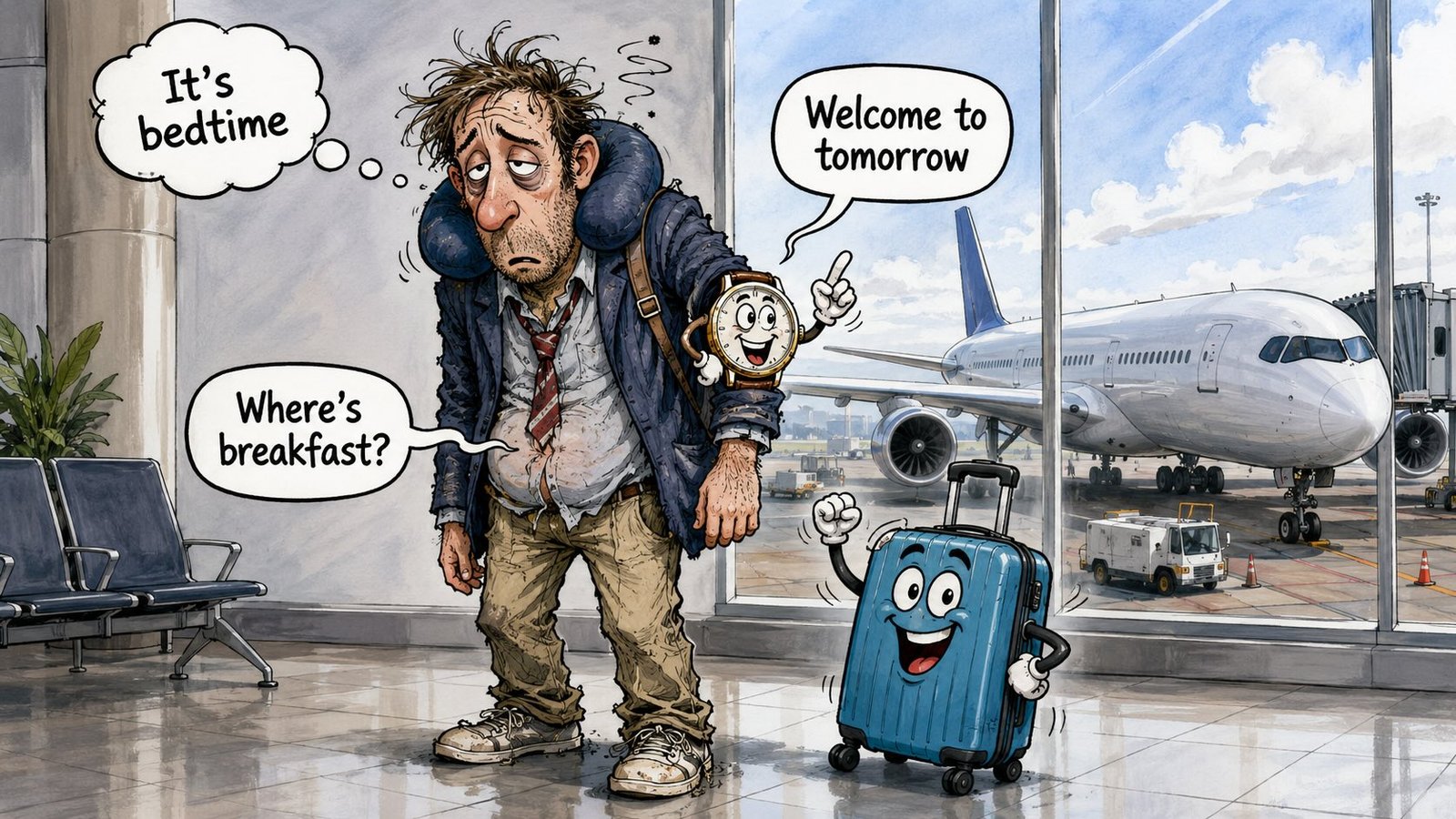
Jet lag is not simply tiredness after a long flight. It occurs when rapid travel pushes the internal body clock out of step with local daylight and darkness. Your watch may say 9am in Singapore. Meanwhile, your brain remains convinced that it is 1am in London. Changing the time on a smartphone is easy. Persuading the body to change its entire schedule takes rather longer.
Humans run on circadian rhythms. These roughly 24-hour cycles influence sleep, alertness, appetite and body temperature. They also affect digestion and hormone production. A small region in the brain acts as the main timekeeper. Scientists call it the suprachiasmatic nucleus. Light entering the eyes gives it the strongest clue about the time of day.
Meals, exercise and familiar routines provide additional signals. However, the body does not contain one obedient clock. The liver, digestive system and other organs also follow daily rhythms. After a long journey, the brain may begin responding to local daylight. The stomach, however, may still expect dinner on another continent.
This helps explain why jet lag causes more than insomnia. Symptoms can include headaches, digestive trouble and daytime sleepiness. Poor concentration and irritability are also common. Some travellers experience a vague sense that somebody has replaced their personality with an inferior airport version.
Travel direction matters too. Eastward journeys usually cause more trouble because they require earlier sleep and waking times. Most human body clocks naturally run a little longer than 24 hours. As a result, delaying sleep often feels easier than bringing it forward.
Flying west gives you a longer day. Flying east removes several hours and then expects you to behave sensibly before breakfast. Crossing one or two time zones may cause little more than temporary tiredness. Jet lag becomes more likely after crossing three or more. Journeys across eight, ten or twelve zones can disrupt sleep for several days. Age, sleep debt and flight timing all influence the severity. Your natural preference for early mornings or late nights matters as well.
You may have heard that recovery takes one day for every time zone crossed. It is a useful rough estimate, but not a biological law. People often adjust faster after westward travel than after eastward travel. An eight-hour eastward shift may therefore require about a week of recovery.
Feeling better does not always mean that every internal rhythm has recovered. You may sleep for a reasonable number of hours but still wake frequently. Concentration, digestion and mood can also remain unsettled. This matters when the journey ends in a conference room rather than beside a swimming pool.
Preparation can reduce the shock. Before travelling east, move your bedtime and waking time earlier. A daily shift of 30 to 60 minutes may help. Before a westward journey, move both later instead. Even two or three days of gradual adjustment can soften the change. Unfortunately, work and family routines often interfere. So does the temptation to watch one more episode before bed. Light remains the most powerful tool for resetting the body clock. Morning light usually encourages an earlier schedule. Evening light pushes the clock later.
After a modest eastward journey, spend time outdoors after waking. This can help the body move towards local time. Reducing bright light before bed supports the same shift. After travelling west, seek daylight in the late afternoon or early evening. It can help you stay awake and adopt a later bedtime. The process becomes more complicated when you cross many time zones. Light at the wrong moment can move the body clock in the wrong direction.
Darkness matters almost as much. Blackout curtains and sleep masks can create an artificial night. Reducing screen use before bed may also help. Sunglasses can limit unwanted light exposure. Wearing them inside an airport lounge at 6am may also make you look internationally famous.
Meals offer another time signal. Eating according to the destination schedule helps the digestive system adopt local time. A light meal often works better when the body believes it should be asleep. Scientists have also started studying “gut jet lag”. Rapid changes in sleep and meal timing may disturb the daily rhythms of intestinal microbes. Researchers continue to explore how this affects metabolism and recovery. Sadly, nobody has invented a scientifically perfect anti-jet-lag sandwich. Even so, eating at sensible local times offers practical benefits. It may also prevent sudden hunger at three in the morning.
Hydration can reduce the general discomfort of flying. It does not reset the body clock. Long flights combine jet lag with ordinary travel fatigue. Dry cabin air, cramped seats, noise and poor sleep can leave anyone exhausted. Even a long north-to-south flight can cause severe tiredness. However, it may not produce true jet lag because it crosses few time zones.
Alcohol can make it easier to fall asleep. Unfortunately, it often disrupts sleep later and worsens dehydration. Sleeping tablets may force unconsciousness, but they do not necessarily reset the circadian system. They may also cause lingering drowsiness. Combining sleeping tablets with alcohol is especially unwise. It can turn a confused traveller into a deeply confused traveller with limited balance.
Caffeine can improve alertness when used carefully. Coffee during the destination morning may help you stay awake until bedtime. The same coffee late in the afternoon may ruin the coming night. More caffeine does not produce faster adjustment. Instead, it may create a peculiar condition. You feel exhausted, restless and completely unable to sleep.
Melatonin causes the greatest debate. The body naturally produces this hormone in darkness. It tells the brain that biological night has begun. Taken at the correct local time, melatonin may reduce some jet-lag symptoms. It can also help certain travellers adapt faster. In the UK, melatonin remains a prescription-only medicine. Doctors may prescribe it for short-term jet lag in adults.
Timing matters more than enthusiasm. Taking melatonin at the wrong hour may shift the body clock in an unwanted direction. Larger doses can cause headaches, vivid dreams or morning grogginess. They do not always provide better results.
Travellers who take other medicines should seek professional advice. The same applies to people with medical conditions and pregnant travellers. Parents should not give melatonin to children without medical guidance. A mysterious gummy offered by another passenger does not count as medical guidance.
Sleeping throughout the flight does not always prevent jet lag. The destination time should guide the decision. Sleep makes sense when it is night at your destination. Staying awake may work better when the destination considers it daytime.
Economy-class seating often settles this argument. Proper sleep becomes less a decision and more an optimistic theoretical concept. Exercise can improve alertness and reinforce a new daily routine. It works particularly well when combined with outdoor light. A brisk walk after landing often beats collapsing onto the hotel bed at 3pm. Gentle movement also counters the stiffness caused by hours of sitting. However, intense exercise immediately before bedtime may keep some travellers awake.
Naps require discipline. A brief sleep of 20 or 30 minutes can rescue a difficult afternoon. It is also less likely to ruin the night. A three-hour nap behind blackout curtains may feel magnificent. However, it can preserve the old time zone. You may then find yourself awake at 2am, reconsidering the minibar and every decision made since leaving home.
Short journeys create a different challenge. Full adjustment may not make sense when you will return after two or three days. A business traveller might preserve part of the original schedule. This works best when meeting times allow it. Other journeys demand faster adaptation. A wedding, sporting event or important presentation may depend on performance at a particular hour. In those cases, adjusting towards local time becomes more important.
The simplest strategy remains reassuringly unglamorous. Begin the journey reasonably well rested. Adjust your sleep beforehand when practical. Change your watch to destination time after boarding.
Use daylight deliberately and eat according to the new schedule. Keep naps short and avoid caffeine late in the local day. After landing, spend time outside. Then try to remain awake until a respectable local bedtime.
Modern aircraft can remain in the air for almost an entire day. They can link cities that once required several flights and an overnight stop. Human biology will not upgrade at the same speed.
Evolution prepared us to notice sunrise, find food and sleep after darkness. It did not prepare us to eat breakfast in Heathrow and dinner in Australia during the same biological day.
Jet lag cannot always be defeated, but it can usually be managed. The aim is not to perform an instant factory reset on the body. Instead, give every internal clock the same clues. Eventually, they will stop arguing and reluctantly agree that you have landed.