A lemur can look like a monkey, move like a cat, stare like an insomniac and scream like something being murdered behind a hotel wall. Yet lemurs are not monkeys, despite decades of cartoons encouraging that assumption. They form their own ancient branch of the primate family and live naturally almost nowhere except Madagascar, an island where evolution appears to have misplaced the instruction manual.
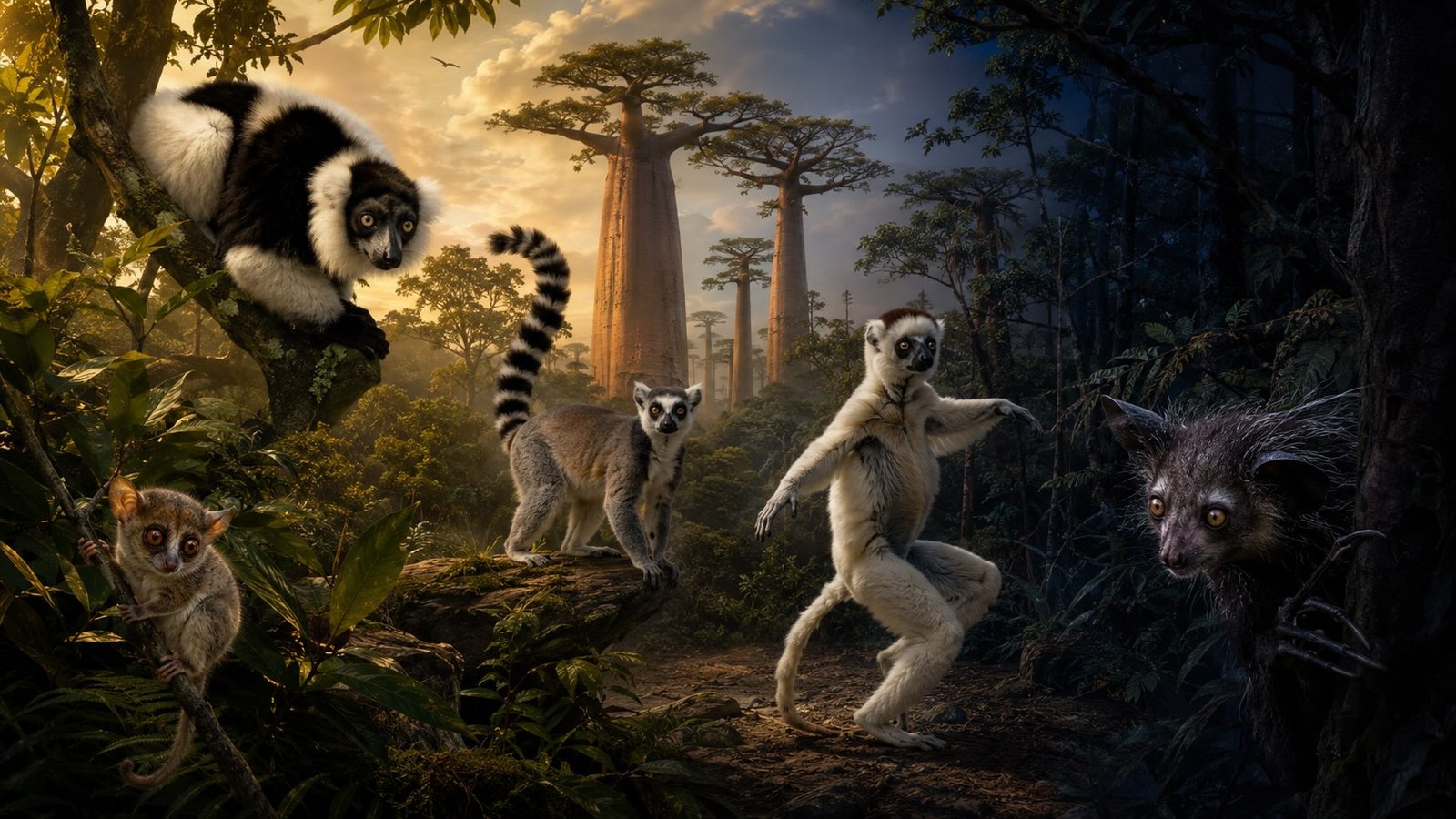
More than 100 living lemur species inhabit Madagascar and the nearby Comoros. They range from tiny mouse lemurs, light enough to sit comfortably in your palm, to the indri, a large, tailless forest singer whose calls travel for kilometres. Some creep through trees after dark. Others sunbathe, quarrel, dance sideways across the ground or launch themselves between trunks with the confidence of athletes who have never met an insurance adviser.
Their story probably began tens of millions of years ago, when small ancestral primates crossed the Mozambique Channel from mainland Africa. There was no convenient bridge, scheduled ferry or discount airline. The leading explanation suggests that they floated across on tangled rafts of vegetation, perhaps after storms swept trees and soil into the sea. Ocean-current models indicate that such accidental voyages were more plausible in the distant past than they would be today.
This journey sounds improbable until one remembers that evolution has had an enormous amount of time to buy lottery tickets. Only a few animals needed to survive. Once established on Madagascar, their descendants found an island with no native monkeys or apes competing for the same ecological roles. Consequently, lemurs diversified into fruit eaters, leaf specialists, insect hunters, nectar drinkers and creatures that appear to have been assembled from leftover parts.
The aye-aye takes this approach furthest. It has enormous ears, permanently growing incisors and an extremely thin middle finger. At night, it taps on branches, listens for hollow spaces, gnaws through the bark and pulls out insect larvae. The technique resembles a woodpecker’s feeding method, except the aye-aye performs it with one skeletal finger and the expression of a Victorian undertaker.
That finger also has an unusually flexible joint, allowing the animal to rotate it while probing narrow spaces. Researchers have even observed aye-ayes inserting it deep into their nostrils, apparently reaching as far as the throat. Science has not settled whether this serves hygiene, sensory investigation or simple enjoyment. Either way, the aye-aye has transformed nose-picking into a specialist primate adaptation.
Unfortunately, its appearance has not always helped its public relations. In parts of Madagascar, people have regarded the aye-aye as an omen of illness, death or misfortune. Local traditions vary greatly, but some communities have killed the animals after encounters. Other Malagasy beliefs protect certain lemurs because people associate them with ancestors, family origins or spiritual power. The same cultural system can therefore save one species while placing another in danger.
The indri enjoys a warmer reputation in several regions. Its Malagasy name, babakoto, has often been interpreted as “ancestor of man” or “little father”. With its upright posture, short tail and vaguely human proportions, the indri readily attracts stories connecting it with people. Its haunting calls reinforce the effect. Family groups sing long, coordinated sequences that announce territory and maintain social bonds, creating something between a whale song and an operatic dispute among neighbours.
Sifakas offer a more visual performance. Their long legs suit spectacular leaps between trees, sometimes covering distances of more than six metres. On the ground, however, those proportions become inconvenient. Sifakas hold their bodies upright and bounce sideways with their arms raised for balance. Tourists call it dancing, although the animals are simply trying to cross an open space without falling on their faces.
Ring-tailed lemurs have become the celebrity representatives of the family. Their striped tails photograph beautifully, although the animals cannot use them to grip branches. Instead, the tails provide balance and visual signals. During territorial confrontations, males rub scent from glands onto their tails and wave them towards rivals. Scientists call these encounters “stink fights”, proving that academic terminology occasionally achieves perfection.
Females often dominate lemur societies, particularly among ring-tailed lemurs. They claim preferred food, displace males and direct group movement. This arrangement remains unusual among primates, where males more commonly hold the advantage through greater size. A ring-tailed male may attempt to appear impressive, but a female can usually settle the matter with one sharp look, a lunge and the social authority of someone who controls the lunch table.
Not every familiar belief about lemurs survives scrutiny. They are not primitive monkeys waiting for evolution to improve them. Lemurs and monkeys followed separate evolutionary paths, each adapting successfully to different conditions. Their large eyes do not necessarily mean poor intelligence, either. Many species show sophisticated memory, problem-solving skills, social learning and complex communication through calls, posture and scent.
Nor do all lemurs behave alike. Nocturnal mouse lemurs may forage largely alone, while ring-tailed lemurs live in organised troops. Red ruffed lemurs build nests for newborns, a rare habit among primates. Bamboo lemurs consume plants containing enough cyanide to make an ordinary mammal reconsider dinner. How they process those toxins remains a subject of scientific interest, although the lemurs themselves seem remarkably relaxed about it.
Their relaxed appearance hides a conservation emergency. Almost every lemur species faces some degree of extinction risk, while many rank among the world’s most threatened mammals. Forest clearance, charcoal production, agriculture, mining, illegal logging, hunting and the pet trade all contribute to the decline.
Recent research has also challenged the convenient idea that lemur hunting occurs only because desperately poor rural families need food. Investigations suggest that an illegal urban market supplies lemur meat to wealthier consumers, sometimes as a status symbol or supposed source of rejuvenation. Thousands may be killed each year, with many transactions hidden through private networks.
Tourism presents another awkward contradiction. Visitors bring money, employment and international attention to protected areas. However, poorly managed encounters can disturb animals, encourage feeding and turn wild lemurs into accessories for holiday photographs. A lemur sitting on someone’s shoulder may look charming online, but it can normalise captivity and increase demand for pets.
Effective protection therefore requires more than fences and stern notices. Conservation groups increasingly work with Malagasy communities on education, sustainable farming, forest restoration and locally managed ecotourism. These projects recognise an uncomfortable truth: people cannot protect wildlife indefinitely while lacking food, income or secure access to land.
Lemurs matter because they represent an entire evolutionary experiment found in one extraordinary place. They pollinate flowers, disperse seeds and help forests regenerate. More importantly, they remind us that nature does not move towards one ideal design. It improvises, branches and occasionally produces a singing primate with no tail or a nocturnal carpenter equipped with one deeply suspicious finger.
Saving lemurs means protecting more than a collection of photogenic animals. It means preserving Madagascar’s forests, cultural traditions and ecological relationships. Otherwise, future generations may know these creatures mainly through animation, museum specimens and cheerful merchandise. That would feel particularly ironic: humanity finally appreciating evolution’s strangest masterpieces just after removing them from the world.