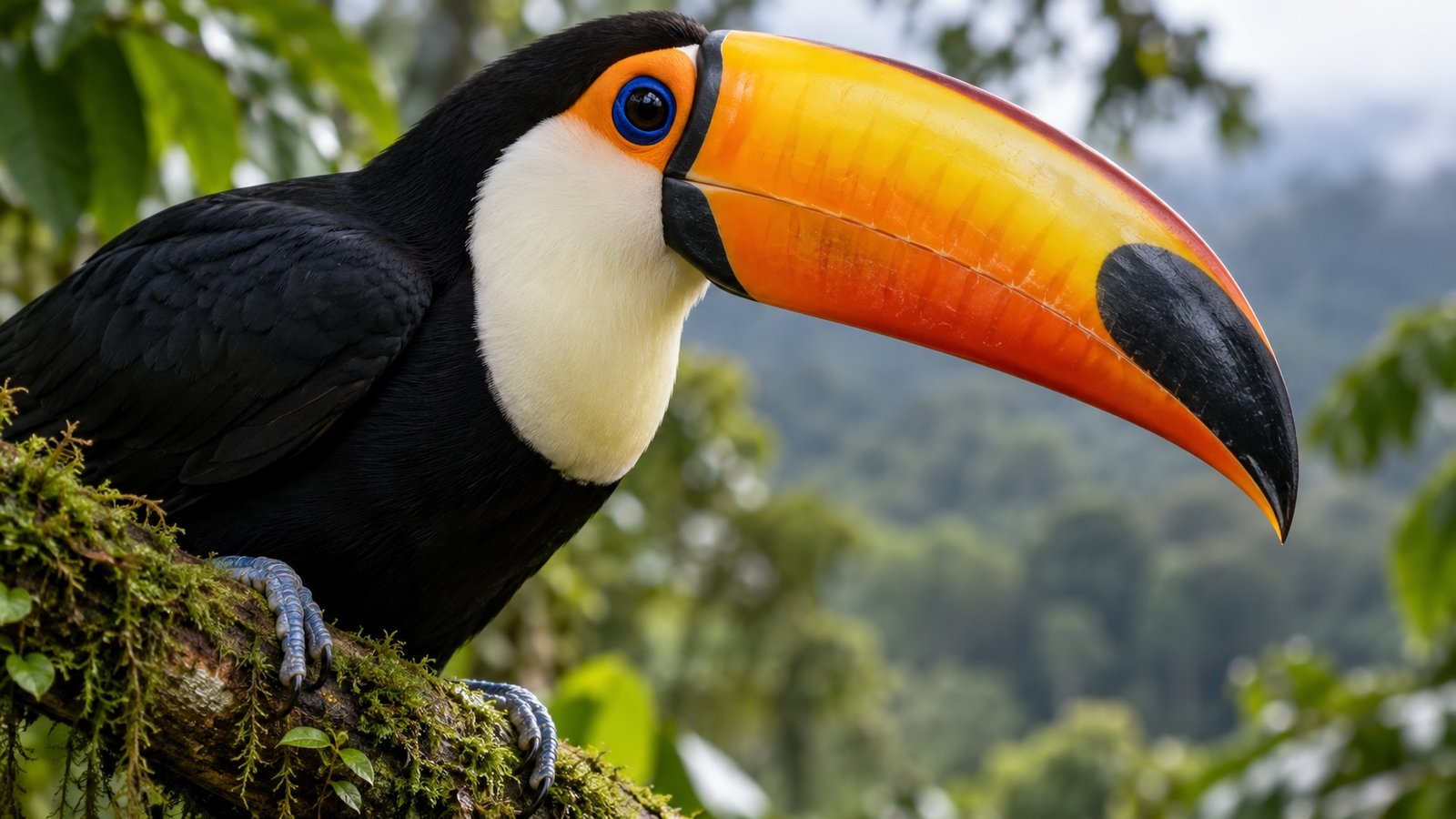
The toucan has a beak so enormous that it looks like an evolutionary miscalculation. In the largest species, the toco toucan, this brightly coloured structure can measure nearly 20 centimetres, an impressive attachment for a bird weighing less than a kilogram. For centuries, naturalists wondered what possessed nature to equip a relatively modest bird with such extravagant facial equipment. Was it for attracting mates, frightening rivals or reaching fruit? All reasonable suggestions, but scientists eventually uncovered something rather unexpected. The toucan’s beak also works as a remarkably efficient cooling system. In effect, this tropical bird carries its own adjustable radiator, cleverly disguised as a giant orange banana.
The breakthrough came in 2009, when researchers led by Glenn Tattersall at Brock University in Canada investigated how toco toucans regulate their body temperature. Using infrared cameras, they watched heat move through the birds’ enormous bills as surrounding temperatures changed. The results were striking. By adjusting blood flow into the beak, toucans could release substantial amounts of body heat. Under certain experimental conditions, the bill accounted for almost all the bird’s measured heat loss. When temperatures dropped, blood circulation towards its surface decreased, reducing unnecessary heat loss. A subsequent study published in 2023 reinforced the beak’s role in cooling at high temperatures. The design rivals an elephant’s ears as a biological heat exchanger, although the toucan has managed to make its version considerably more colourful.
The engineering behind this arrangement is equally impressive. Despite appearances, the toucan’s beak is surprisingly light. Its outer covering consists of keratin, the same material found in human fingernails, while a network of tiny internal supports provides strength without excessive weight. The structure resembles an exceptionally lightweight piece of natural composite engineering. A solid beak of comparable dimensions would be a terrible burden, particularly for a bird that spends much of its life navigating branches. Instead, the toucan can lean forward to collect fruit from slender twigs without carrying an impractical weight on its face. Sometimes nature produces a structure that looks ridiculous until someone examines the specifications.
Not all toucans look alike. The family Ramphastidae includes dozens of species distributed across Central and South America, ranging from relatively small toucanets to the imposing toco toucan. The latter, with its black plumage, white throat and enormous orange bill, is probably the most recognisable. The keel-billed toucan takes a different approach, sporting a multicoloured beak in shades of green, yellow, orange and red. Mountain toucans inhabit the Andes, sometimes at elevations exceeding 3,000 metres, where the climate differs considerably from the steamy lowlands. Despite their tropical reputation, toucans are not exclusively creatures of dense Amazonian rainforest. The toco toucan also occupies open woodland, savannah and wooded areas of the Pantanal and Cerrado.
Their appearance suggests a distant relationship with parrots, but appearances are misleading. Toucans belong to the same order as woodpeckers, an evolutionary connection that becomes clearer when examining their feet. Both possess two toes pointing forwards and two backwards, an arrangement called zygodactyly. This provides a firm grip on branches and helps them manoeuvre through trees. Toucans are capable of flight, although their relatively short, rounded wings make them less graceful in the air than their advertisements might suggest. They commonly move through the canopy in short flights and hops. Their calls can be equally unexpected. Rather than producing delicate tropical melodies, some sound like croaking frogs, barking dogs or other animals with limited musical ambitions.
Fruit forms the foundation of most toucan diets, and the famous beak is particularly useful when collecting it. A toucan can reach beyond the branch supporting its weight, grasp a fruit and manipulate it towards its mouth. The bird then often throws its head backwards to swallow the food. The long, narrow tongue, with its feather-like edges, assists in handling food. Toucans are not strict vegetarians, however. They also consume insects, small reptiles, frogs and occasionally the eggs or nestlings of other birds. Their cheerful appearance therefore conceals a certain dietary opportunism. The same bird that spends the morning eating figs may raid a neighbouring nest later in the day. Rainforest life rarely respects the distinction between adorable and ruthless.
Yet fruit-eating toucans perform a service that extends well beyond their own appetites. Many tropical trees rely on animals to transport seeds away from their parent plants. Toucans swallow fruit and subsequently deposit viable seeds elsewhere, helping plants colonise suitable locations. Because some species can swallow relatively large fruits and travel between feeding sites, they play a valuable role in forest regeneration. This creates an intriguing reversal of appearances. The bird’s most conspicuous feature may attract human attention, but its less glamorous digestive activities help maintain the forest itself. A toucan depositing seeds on a distant branch contributes to a process that may influence the composition of woodland decades later.
Reproduction presents another logistical puzzle. Given the dimensions of its bill, one might expect a toucan to build an enormous nest. Instead, toucans generally nest in tree cavities, often occupying holes formed naturally or excavated by other animals. Both parents participate in raising the young. The chicks hatch blind, almost naked and with relatively modest beaks, which grow as they mature. Adult birds have a peculiar way of fitting themselves into confined spaces. They turn their heads backwards, tuck the bill against their bodies beneath a wing and fold the tail upwards. The result is a surprisingly compact bundle of feathers, bearing little resemblance to the extravagant creature seen perched in the open.
Toucans have also acquired an unusually successful career outside the rainforest. In 1935, the advertising agency S. H. Benson created a toucan character for Guinness, an association that helped transform the bird into one of the twentieth century’s familiar advertising animals. The toucan later became associated with breakfast cereals, particularly through Kellogg’s Toucan Sam, who appeared in 1963. Neither fictional bird offers especially useful information about actual toucan behaviour, but both demonstrate the commercial advantage of an instantly recognisable silhouette. Few animals can be reduced to a black body and an enormous colourful beak while remaining so immediately identifiable. The advertising industry recognised this advantage long before thermal-imaging cameras revealed another purpose for the design.
Unfortunately, popularity brings problems as well as fame. Habitat loss threatens several toucan species, particularly those dependent on extensive tropical forests. Hunting and capture for the wildlife trade create additional pressures. Their attractiveness makes them desirable as exotic pets, although toucans are demanding wild birds with specialised diets, complex social behaviour and a need for substantial space. Their conservation status varies considerably between species, and some remain widespread. Others face serious threats from shrinking or fragmented habitats. Protecting toucans therefore means protecting the trees they feed in, the cavities they nest in and the forest connections that allow them to disperse seeds.
Perhaps the most entertaining aspect of the toucan is how thoroughly it confounds first impressions. Its bill appears excessive, yet weighs remarkably little. It looks like a feeding tool, yet also regulates temperature. Its cheerful colours suggest harmlessness, although it occasionally eats other birds’ young. And while humans have spent decades admiring its appearance on cereal boxes and advertising posters, the toucan has quietly been doing something considerably more useful: cooling itself, transporting seeds and helping maintain the forests on which it depends. The extravagant beak that once seemed like nature showing off turns out to be a rather practical piece of equipment. It simply happens to have excellent branding.