
Long before the kitchen fridge started humming in the corner like a small, slightly bored robot, people still had the same problem: food spoils, summer is rude, and warm drinks do very little for morale. In ancient Persia, where desert heat could turn daily life into an argument with the sun, engineers came up with something wonderfully audacious. They built refrigerators out of earth, shadow, wind and water.
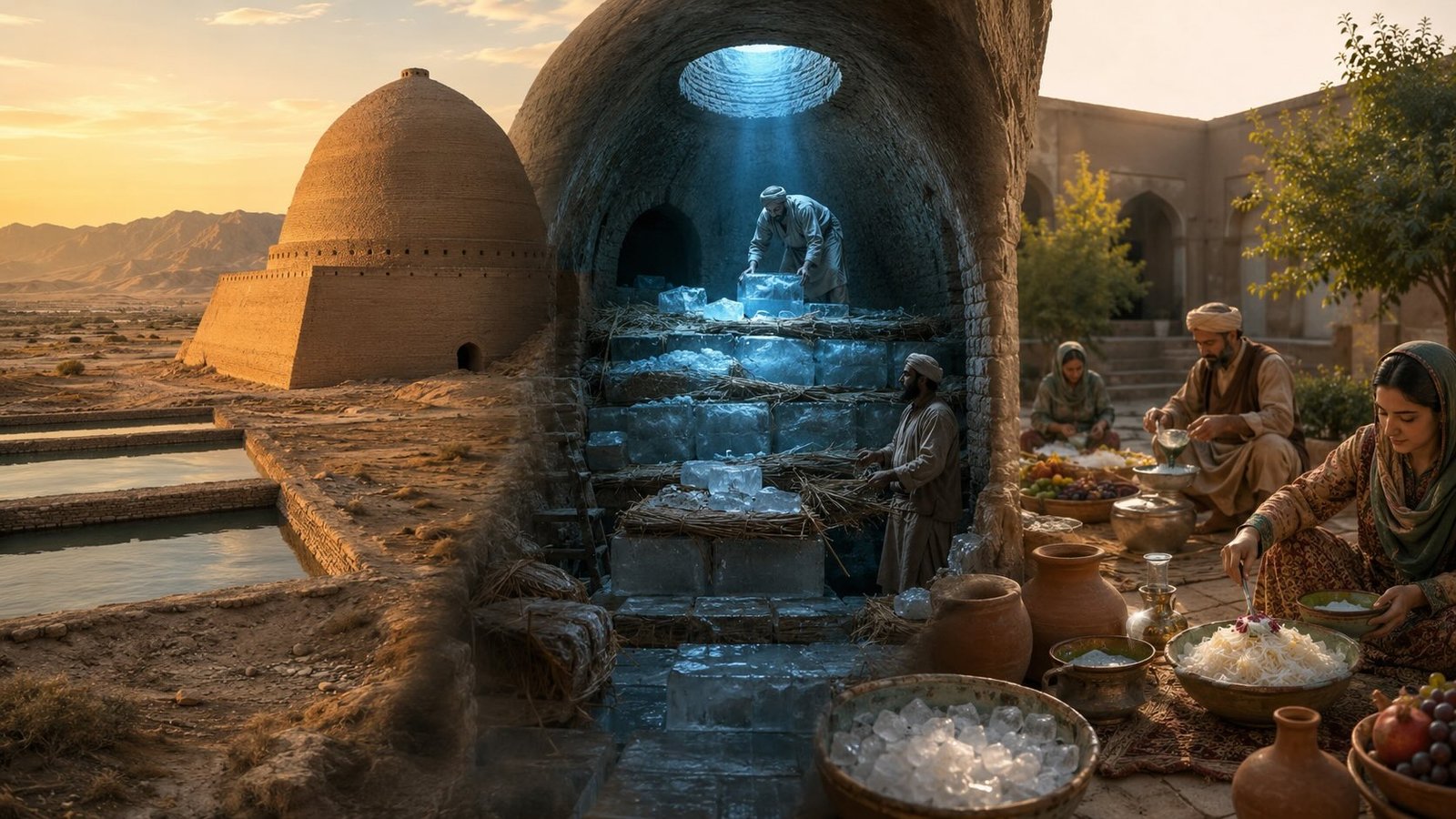
They called them yakhchals. The word comes from Persian: “yakh” means ice and “chal” means pit. That already gives away the basic idea, although “ice pit” sounds far too humble for what these structures achieved. A yakhchal was not just a hole in the ground with good intentions. It was a carefully designed ice house, usually with a huge domed structure above ground and a deep storage chamber below. In winter, ice was collected or made nearby, then stored for use during the brutal summer months. In some parts of Iran, the related word “yakhdan” also referred to these ice-storage buildings, and Encyclopaedia Iranica notes that such structures remained important until mechanical refrigeration spread widely in Iran in the twentieth century.
The first surprise is that yakhchals did not fight the desert so much as negotiate with it. They used the very things that made the environment difficult — dry air, cold desert nights, clear skies and dramatic temperature swings — and turned them into a cooling system. Winter water could be channelled into shallow pools beside long shade walls. At night, especially under clear skies, the water froze. The walls blocked the sun during the day, buying precious time before the next freezing cycle. Layer by layer, ice formed, rather like a patient geological argument against summer.
Once the ice reached a useful thickness, workers cut it into blocks and moved it into the underground chamber. There, the yakhchal’s design did the quiet magic. Thick mud-brick or adobe walls slowed heat transfer. The dome helped hot air rise away from the stored ice. The pit kept the coldest air low, exactly where the ice needed it. Straw, reeds or other insulating materials could separate layers of ice so that the blocks did not simply fuse into one unhelpful frozen boulder. Some yakhchals also included drainage so melted water could escape rather than sit around causing trouble. This was architecture behaving like physics with a better wardrobe.
The material mattered too. Many traditional accounts describe a water-resistant mortar called sarooj, commonly associated with Iranian architecture. It could include ingredients such as clay, lime, ash, sand and organic fibres, though recipes varied by region and period. The important point was not whether every yakhchal used the exact same mixture, but that builders knew how to create thick, durable walls suited to heat, dryness and occasional moisture. In a world without electricity, insulation was not an optional feature. It was the whole business model.
Yakhchals often belonged to a broader family of Persian environmental engineering. Qanats, the famous underground water channels, carried water from aquifers to settlements across arid landscapes. UNESCO describes the Persian qanat as an exceptional system for supplying water to dry regions and supporting permanent settlements. Windcatchers, or badgirs, also formed part of this cooling culture, guiding air through buildings and sometimes across water to reduce temperature. Put these ideas together and you get something richer than a single clever gadget. You get a civilisation that understood comfort, storage and survival as design problems.
Naturally, the internet has slightly overexcited itself about yakhchals. You may see claims that ancient Persians casually made ice in the middle of blazing summer, as if desert engineers simply looked at July and said, “Not today.” The reality seems more interesting and less cartoonish. Many yakhchals stored winter ice for summer use. Some systems helped water freeze during cold nights by using shade walls, shallow pools and radiative cooling. But there is no strong evidence that they produced ice from water during peak summer heat in the way a modern freezer does. A more careful account from Iran Safar makes that distinction clearly: the traditional method relied on winter ice collection or winter ice-making, then seasonal storage.
That does not make yakhchals less impressive. Actually, it makes them more impressive. The myth says, “Ancient people had magic refrigerators.” The truth says, “Ancient people understood climate, materials, timing and social organisation well enough to preserve winter inside summer.” Frankly, the second version deserves more applause. Anyone can admire a miracle. It takes better taste to admire maintenance, logistics and mud-brick thermal mass.
The social side also matters. Ice was not just a luxury cube bobbing in a drink. It helped preserve food, cool water and make chilled desserts. In Persian food culture, cold treats such as faloodeh — a semi-frozen dessert of thin starch noodles, rosewater and syrup — belong to a long tradition of enjoying coolness as pleasure, not merely practicality. The existence of stored ice in hot months changed what people could serve, sell and celebrate. It also gave cities and caravan routes another layer of infrastructure. A yakhchal near a caravanserai was not just a building. It was a promise to travellers that the desert had not won completely.
Some surviving examples still stand in Iran, including well-known ice houses in places such as Meybod, Kerman and Yazd Province. They look strangely futuristic, which is always what happens when very old architecture solves a problem better than expected. The domes rise from the earth like giant clay beehives or stranded spacecraft. Their beauty comes partly from honesty. They do not pretend to be decorative follies. They look like machines made from soil.
Modern architects and sustainability researchers have good reason to pay attention. Building-physics work on yakhchals has explored how these structures used passive cooling and seasonal storage, with potential lessons for low-energy architecture today. That does not mean we should replace every supermarket cold aisle with a clay dome and a man carrying straw. Still, the principle feels painfully relevant. Before we reached for more energy, earlier builders reached for orientation, mass, shade, ventilation and the calendar.
There is a quiet irony here. Modern refrigeration changed the world, but it also made cold feel effortless. We press a button, open a door and complain when the milk is not quite chilled enough. The yakhchal reminds us that cold was once planned months in advance. People had to read the season, manage water, build carefully and store wisely. Ice carried labour inside it. Every summer block contained winter nights, desert engineering and a great deal of patience.
Perhaps that is why the yakhchal still feels so compelling. It sits somewhere between architecture, climate science, food history and human stubbornness. It proves that technology does not always need to beep, glow or demand a firmware update. Sometimes technology is a dome, a pit, a shadow wall and a community that knows exactly when the night will be cold enough.
The yakhchal did not conquer the desert. That would be the wrong lesson. It did something smarter. It listened to the desert, borrowed its cold moments, protected them from its hot ones, and served summer a chilled dessert with a very straight face.