Oliver Cromwell is one of those historical figures who refuses to sit neatly on the shelf. Put him among the heroes and someone will immediately mention Ireland. Put him among the villains and someone else will point out that he helped defeat royal absolutism, backed a republic and tolerated some Protestant religious dissent. He overthrew a king, rejected the crown, ruled with king-like powers, closed parliaments, quoted scripture, fought brilliantly and left behind a country that sprinted back to monarchy almost as soon as it could find a suitable Stuart with a pulse.
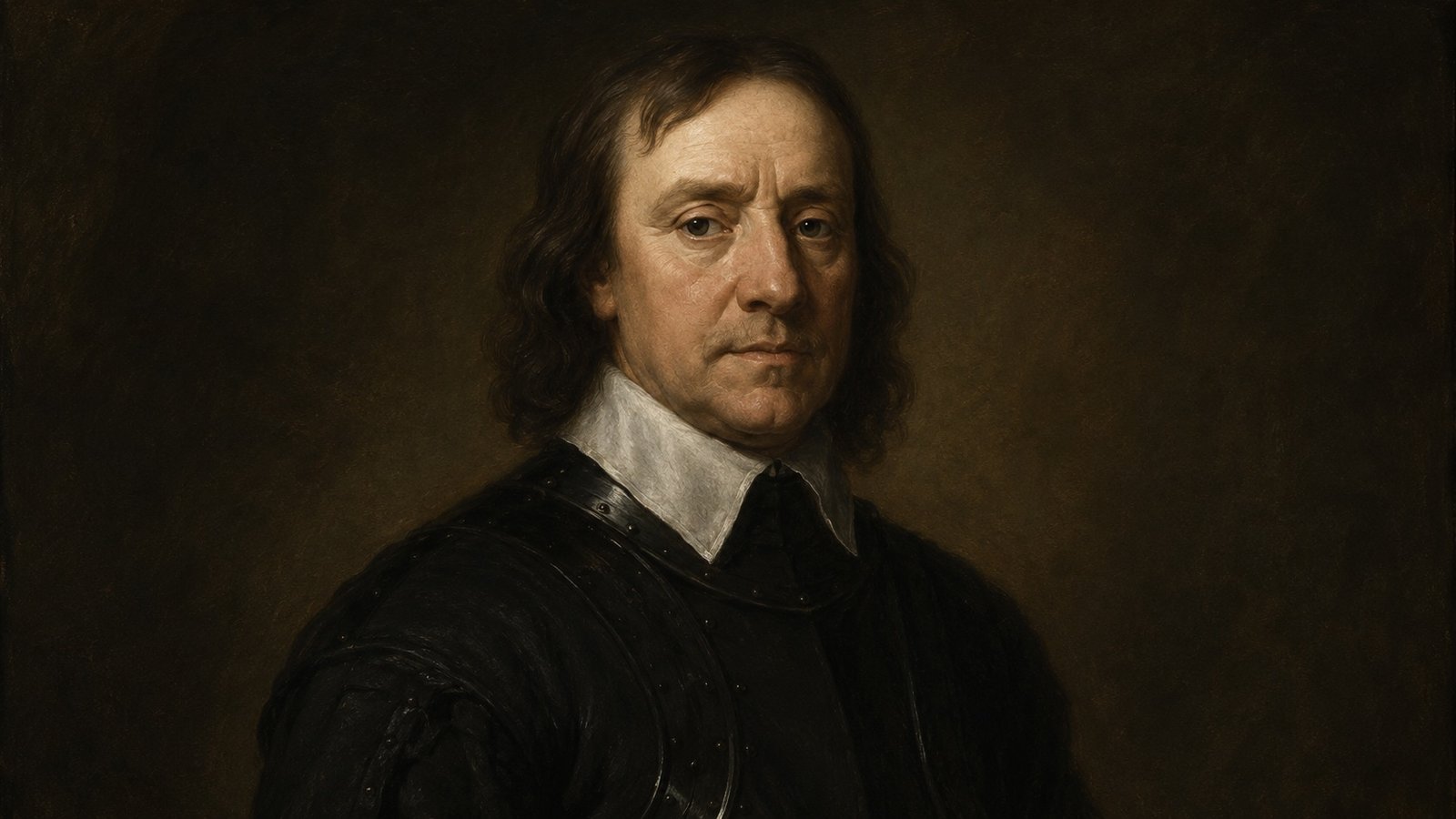
Born in Huntingdon in 1599, Cromwell did not arrive in the world looking like destiny’s favourite weapon. He came from the gentry, not the grandest tier of society, and spent much of his early life as a fairly obscure landowner. He studied at Sidney Sussex College, Cambridge, then returned to local politics, family responsibilities and the kind of provincial respectability that rarely screams “future head of state”. Yet the seventeenth century had other plans. England, Scotland and Ireland entered a crisis over monarchy, religion, taxation and power, and Cromwell found himself in the middle of it with a sword, a Bible and a terrifying amount of certainty.
The English Civil War did not begin because everyone suddenly became bored of Charles I. It grew from years of conflict over the king’s authority, Parliament’s rights, money, religious reform and deep suspicion of anything that looked too Catholic for Protestant comfort. Charles believed deeply in royal authority. Many of his opponents believed just as deeply that he had pushed that authority beyond reasonable limits. Cromwell entered Parliament’s side as a relatively inexperienced soldier, which makes his rise even more annoying for anyone who has ever spent years trying to get promoted.
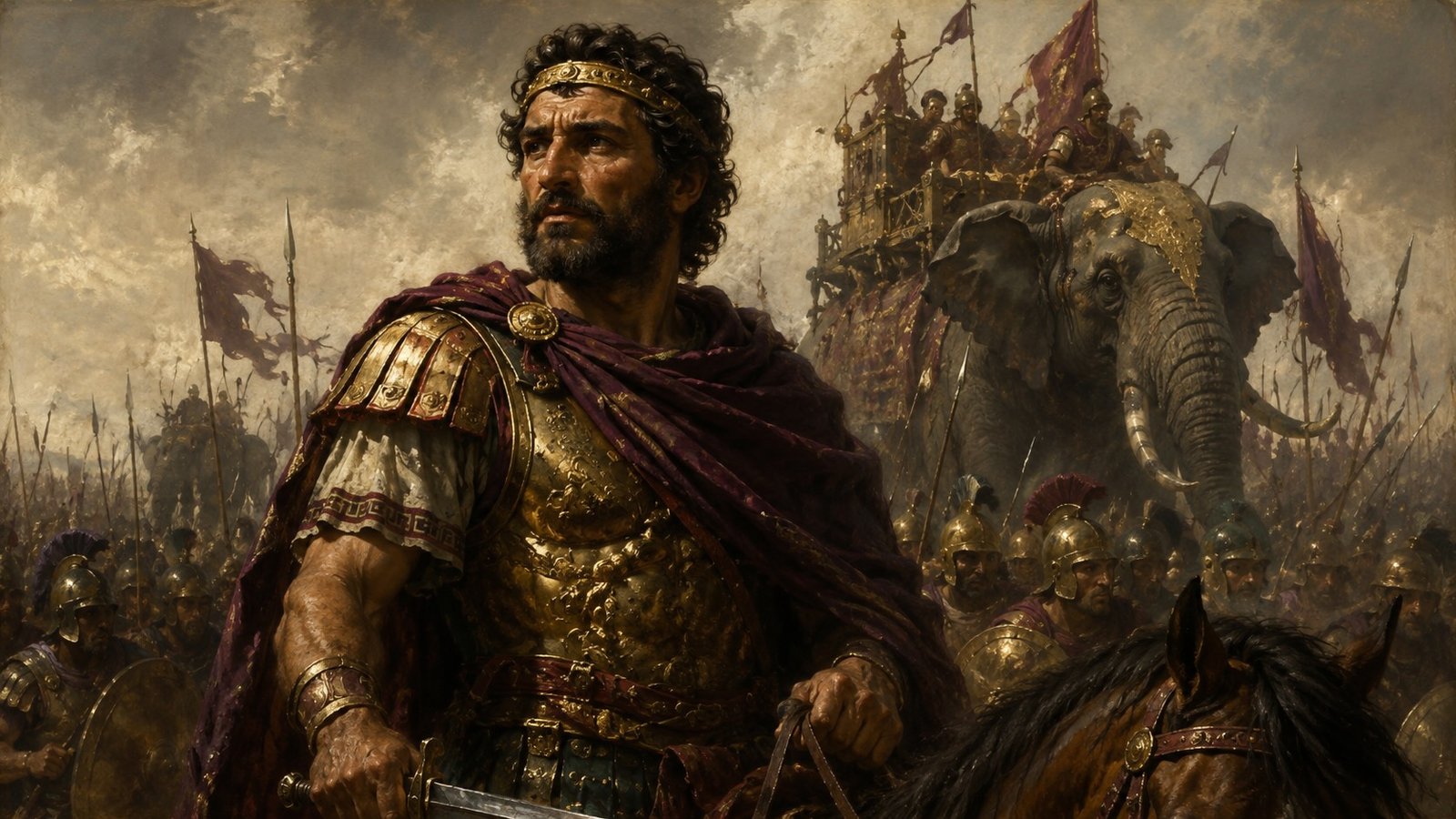
He turned out to be very good at war. Not decorative war, not parade-ground war, but hard, disciplined, cavalry-charging, morale-breaking war. Cromwell helped shape the Parliamentarian cavalry into a force that could stand against Royalist horsemen, and he played a major role in Parliament’s victories at Marston Moor in 1644 and Naseby in 1645. The New Model Army changed everything. It was better organised, more professional and more ideologically charged than many earlier forces. Its soldiers did not merely fight for pay; many believed they fought for God’s cause. That belief gave them discipline, courage and, at times, a chilling confidence that violence came with divine approval.
Cromwell fitted perfectly into that world. He saw politics through providence. Victories looked like signs. Defeats looked like lessons. Compromise often looked like moral failure wearing a nice coat. Then came the unthinkable: the trial and execution of Charles I in 1649. England killed its king in public, which remains one of the most astonishing political moments in European history. It did not simply remove a monarch; it shattered the idea that kings lived above earthly judgement. Cromwell supported the trial and signed Charles’s death warrant. For monarchists, that made him a regicide. For radicals, it made him an agent of liberty. And for future constitutional historians, it created an almighty mess with excellent footnotes.
After the king’s execution, England became a republic, though not the smooth, coffee-drinking, constitution-loving kind. It called itself the Commonwealth, but power soon clustered around the army and its leaders. Parliament argued. Factions quarrelled. Religious groups multiplied. Nobody could agree what the revolution had actually been for, which is a common problem after revolutions and a strong argument for writing the agenda down before removing the head of state.
Cromwell’s darkest legacy came in Ireland. In 1649, he led a campaign to crush Royalist and Catholic resistance. Drogheda and Wexford became names loaded with horror. At Drogheda, Cromwell’s troops stormed the town after it refused to surrender, killing many defenders and civilians. At Wexford, his forces also carried out widespread slaughter. Cromwell justified such violence as consistent with the laws of war and claimed it would encourage quicker surrender elsewhere.
That justification has not aged well. Historians still debate details, numbers and context, but the Irish memory of Cromwell remains brutal, and for good reason. His campaign became linked not only with massacre, but also with conquest, confiscation and the deepening of Protestant English domination over Catholic Ireland. The name “Cromwell” became synonymous in Ireland with the actions of the New Model Army at Drogheda and Wexford, as well as later Cromwellian policies imposed on the country.
Scotland also felt Cromwell’s force. After Charles II was proclaimed king in Scotland, Cromwell marched north and defeated Scottish forces at Dunbar in 1650 and Worcester in 1651. The result brought Scotland under the control of the English Commonwealth. From one angle, Cromwell helped create a more integrated British state. From another, he imposed military rule by conquest. History, inconveniently, allows both sentences to exist in the same room.
In 1653, Cromwell lost patience with the Rump Parliament and removed it by force. This is where the champion of Parliament starts to look rather awkward. He had fought against royal overreach, yet now he dismissed elected representatives when they irritated him. Later that year, he became Lord Protector under the Instrument of Government, often described as England’s first written constitution.
The title “Lord Protector” sounds modest until you notice the job came with enormous executive power. Cromwell refused the crown when offered it in 1657, which looks principled at first glance. Yet he lived in royal palaces, received ceremonial honours and ruled in a style that often looked suspiciously monarchical. He rejected the title of king but accepted something uncomfortably close to it, complete with the trappings of power.
Still, Cromwell’s rule was not simply monarchy with worse branding. He supported some degree of religious toleration, particularly for Protestant groups outside the established Church. Jews were allowed to return to England in the 1650s after centuries of exclusion, although the process involved legal ambiguity rather than one grand, tidy decree. Catholics and Anglicans, however, faced restrictions. Cromwell believed in liberty of conscience, but mostly for the kinds of consciences he could tolerate without grinding his teeth.
He also tried moral reform. The Protectorate became associated with Puritan seriousness, which later legend inflated into the idea that Cromwell personally banned every scrap of fun in England. The famous claim that he banned Christmas needs care. Parliamentarian and Puritan authorities had already targeted Christmas festivities before Cromwell became Lord Protector. They saw the holiday as too Catholic, too rowdy and too full of eating, drinking and general merriment, which, to be fair, was partly the point. Cromwell became the face of the killjoy myth because history prefers one recognisable villain to a committee.
Theatres had already been closed by Parliament in 1642, before Cromwell’s personal rule, yet he still gets blamed for killing drama, dancing, feasting and possibly smiling in public. The caricature works because there was enough truth behind it. Puritan culture did distrust excess, ceremony and popular festivity. Yet Cromwell enjoyed music, hunting and family life. He was not a cardboard sourpuss. He was worse than that: a complicated man with power.
His face also became part of the legend. The phrase “warts and all” comes from the story that Cromwell told the painter Samuel Cooper to portray him honestly, blemishes included. Whether the exact wording survives perfectly or not, the image stuck because it captures something true about his public persona. He did not possess royal glamour. He looked like a stern, tired, practical man who had spent too long arguing with God and Parliament. Royalist satire mocked his red nose and rough appearance, turning his body into political propaganda. Even his face became a battlefield.
Cromwell died on 3 September 1658, the anniversary of his victories at Dunbar and Worcester. That coincidence would have pleased him. His son Richard succeeded him as Lord Protector, but Richard lacked his father’s authority over the army and Parliament. Political chaos followed, and by 1660 the monarchy returned under Charles II. Richard Cromwell could not manage the Parliament he summoned or the army leaders on whom he depended. He resigned in 1659, effectively ending the Protectorate.
Then came the final indignity. After the Restoration, Cromwell’s body was exhumed from Westminster Abbey. His corpse was posthumously executed, and his head was displayed above Westminster Hall. It later passed through various hands before eventual burial at Sidney Sussex College, Cambridge. The dead Cromwell became a warning: this is what happens to men who kill kings and then lose control of the story.
So what was Oliver Cromwell? A liberator, a dictator, a religious visionary, a military thug, a failed republican, or a necessary revolutionary? The answer depends partly on where you stand. For some strands of English political memory, he represents resistance to tyranny and the idea that rulers answer to the governed. Across much of Irish memory, his name still evokes conquest, massacre and trauma. Constitutional history treats him as something even more awkward: both proof that revolutionary power can challenge monarchy and evidence that it can become dangerously authoritarian. Cromwell helped prove that monarchy could fall. Yet he also showed that removing a monarch does not automatically create freedom.
That may be the most uncomfortable part of Cromwell’s story. His failure did not come from a lack of conviction. In many ways, it came from an excess of it. Cromwell believed so strongly in divine purpose that opposition could look like sin. After fighting tyranny, he used military force to manage politics. Having refused the crown, he then behaved enough like a king to make people wonder why England had gone through all the bloodshed in the first place.
Oliver Cromwell still matters because he sits at the centre of a question Britain has never entirely stopped asking: where does legitimate power come from? From a crown, a parliament, an army, a constitution, God, the people, or whoever can keep order when everyone else starts shouting? Cromwell gave several answers in one lifetime, and not all of them got along. That is why he remains fascinating. Not because he was pure, but because he was not. He was revolution in human form: brave, severe, brilliant, brutal, idealistic, hypocritical and impossible to ignore.