Why John Coltrane Still Sounds Radical at 100
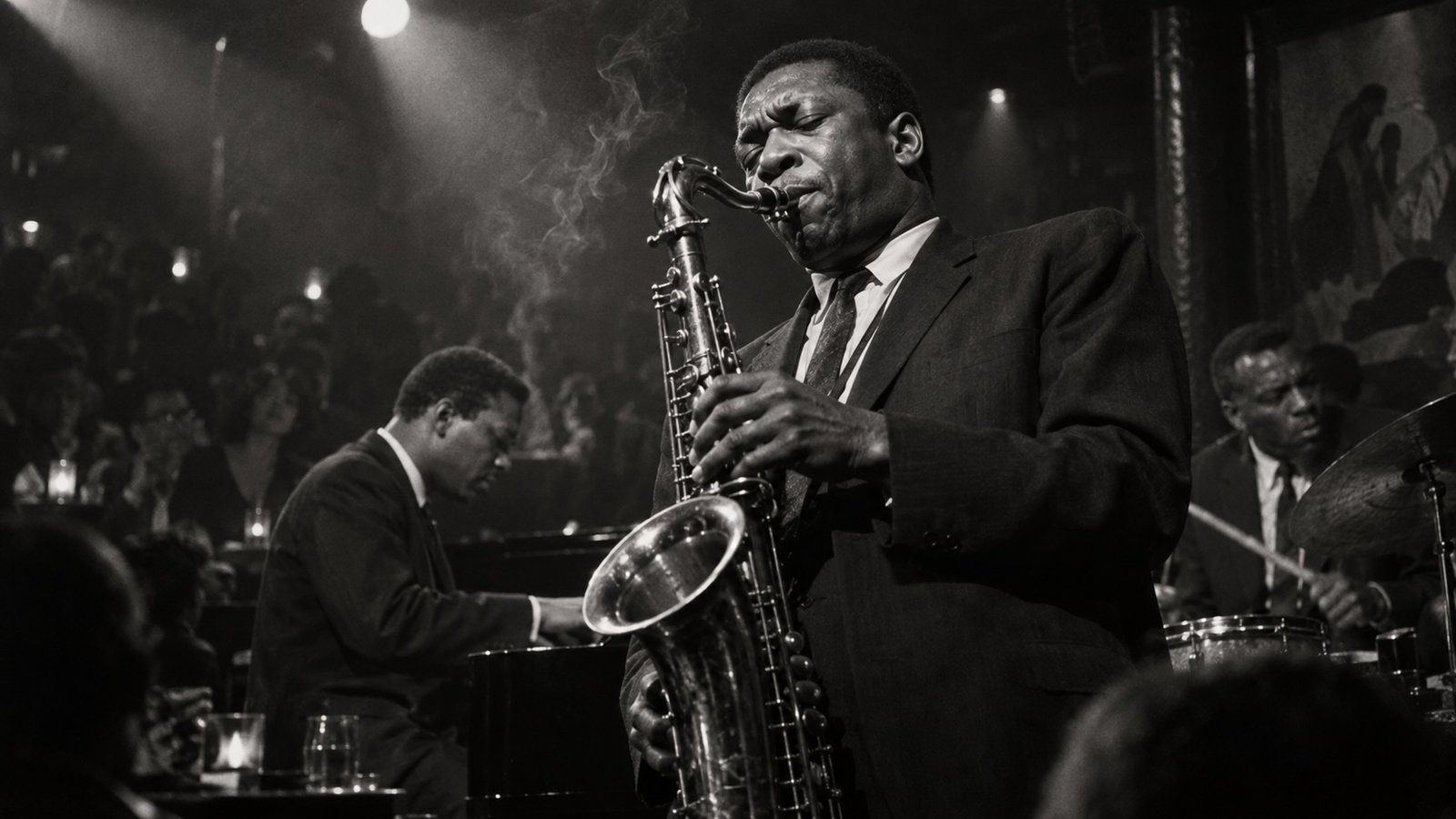
On 23 September 2026, John Coltrane would have turned 100. This feels slightly improbable, because Coltrane belongs to that peculiar category of artist who seems permanently suspended outside ordinary time. He died in 1967 at only 40, yet during roughly a decade of extraordinary creative acceleration he managed to transform the saxophone, challenge the rules of jazz harmony, help redefine improvisation and eventually treat music as something somewhere between mathematics, prayer and controlled combustion. A century after his birth, musicians across Britain, America and beyond are marking the occasion with concerts and festivals, including major centenary programmes in Scotland, Birmingham, Philadelphia, New York and later this year at the London Jazz Festival.
John William Coltrane was born in Hamlet, North Carolina, in 1926 and grew up in High Point. Music surrounded him early: his father played several instruments, while young John began with clarinet and alto horn before gravitating towards the saxophone. Then childhood became considerably less gentle. Within a relatively short period around 1938–39, his father and several other close relatives died. After finishing school, Coltrane moved to Philadelphia in 1943, worked at a sugar refinery and studied music. His mother bought him an alto saxophone for his seventeenth birthday, which, with hindsight, ranks fairly high among successful birthday presents.
Military service followed. Coltrane joined the US Navy during the Second World War, served in Hawaii and played in a Navy band. After the war he entered the hard, competitive apprenticeship system of professional jazz, playing with musicians including Dizzy Gillespie and eventually switching mainly to tenor saxophone. By the mid-1950s he had joined Miles Davis, placing him inside one of the most important groups in modern jazz. He later worked with Thelonious Monk, returned to Davis and appeared on Kind of Blue in 1959, an album that appears with suspicious regularity whenever somebody attempts to make a list of records civilisation should preserve after an asteroid strike.
Yet the Coltrane story nearly went in a much less glamorous direction. During the 1950s he developed serious problems with heroin and alcohol. Miles Davis dismissed him more than once, and his career could easily have dissolved into the familiar jazz tragedy of talent overwhelmed by addiction. Instead, in 1957 Coltrane stopped using drugs and underwent what he later described as a spiritual awakening. From that point onwards, music increasingly became inseparable from a personal search for meaning. The man who emerged from the crisis practised obsessively, investigated harmony with almost scientific concentration and seemed increasingly uninterested in simply becoming a successful saxophonist. He wanted to know how far music could go.
The answer, initially, involved an alarming number of notes. Critic Ira Gitler famously described Coltrane’s rapid cascades as “sheets of sound”. His solos could pour across chord changes at such speed that the normal distinction between melody and harmony seemed to disappear. Then came Giant Steps. Recorded in 1959 and released the following year, its title track became one of jazz’s most notorious examinations. Coltrane organised its harmony around three tonal centres separated by major thirds, producing the sequence now known as “Coltrane changes”. At speed, the chords move so quickly that improvising over them can feel rather like being asked to complete simultaneous equations while someone pushes your chair down a staircase.
The irony is that Coltrane soon began moving away from the harmonic complexity he had mastered. Having demonstrated that he could negotiate a musical obstacle course, he increasingly became interested in open, modal structures that allowed him to remain on a musical idea for longer and examine it from every possible angle. His celebrated recording of My Favorite Things transformed a Rodgers and Hammerstein show tune into a hypnotic, circling performance driven by soprano saxophone. This became typical Coltrane behaviour: take something familiar, stare at it for long enough, and eventually reveal that it contained an entirely different universe.
Not everyone enjoyed the journey. By 1961 Coltrane was playing increasingly adventurous music with multi-instrumentalist Eric Dolphy. A DownBeat critic attacked their work as “anti-jazz”, accusing them of abandoning swing for something anarchic. Readers divided sharply, and Coltrane and Dolphy later answered the criticism in the magazine. Coltrane’s response was characteristically calm rather than theatrical. His performances became long, he explained, because the musicians tried to explore all the possibilities within a piece. What critics heard as excessive, he heard as unfinished investigation. Yesterday’s dangerous avant-garde has an inconvenient habit of becoming tomorrow’s conservatoire curriculum.
Then, in December 1964, came A Love Supreme. Coltrane recorded the four-part suite with pianist McCoy Tyner, bassist Jimmy Garrison and drummer Elvin Jones, the quartet that many listeners still regard as his definitive group. The work lasts only about 33 minutes, but it feels larger because Coltrane intended it as an expression of gratitude to God following his spiritual awakening. Its opening section includes the repeated vocal phrase “a love supreme”, while the final movement, Psalm, effectively turns a written devotional poem into saxophone music, with Coltrane shaping notes according to the syllables of the text. Jazz had moved surprisingly close to liturgy.
One persistent Coltrane myth claimed that A Love Supreme received only one complete live performance, at Antibes in France in July 1965. For decades that appeared to be true. Then another recording surfaced. Saxophonist Joe Brazil had taped a performance in Seattle on 2 October 1965, but the recording remained unknown for years and finally appeared commercially in 2021. Suddenly historians had evidence of a second live A Love Supreme, radically expanded and running far longer than the studio version. Even half a century after Coltrane died, his biography was apparently still capable of improvisation.
His final years went further still. Records such as Ascension, Meditations and Expression abandoned much of the comfortable architecture of conventional jazz. Some listeners hear liberation, ecstasy and spiritual intensity; others hear several highly accomplished musicians apparently arguing during an earthquake. Both reactions help explain Coltrane’s importance. He refused to remain inside the style that had already made him famous. McCoy Tyner and Elvin Jones eventually left the group as the music changed, while Coltrane pushed deeper into free improvisation, African and Asian musical ideas, unusual scales and increasingly ecstatic performance.
His spirituality produced perhaps the strangest piece of his afterlife. In San Francisco there is an African Orthodox congregation devoted to Saint John Will-I-Am Coltrane. Its origins reach back to 1965, when Franzo and Marina King attended a Coltrane performance and later described the experience as a “sound baptism”. The community eventually incorporated Coltrane’s music into worship and still treats his work as a route towards spiritual understanding. Few jazz musicians achieve sainthood. Fewer still acquire a church in which the saxophone functions rather more convincingly than an organ.
Coltrane himself never seemed comfortable with the idea of celebrity. Accounts from musicians and friends repeatedly describe a quiet, serious man obsessed with practising and learning. His ambition sounded almost embarrassingly sincere: he wanted his music to become a positive force. That helps explain why A Love Supreme avoids the feel of a performance designed to impress. For all its technical sophistication, it reaches towards something remarkably simple — gratitude.
Recognition continued long after his death from liver cancer in July 1967. The Pulitzer Prize Board awarded him a posthumous Special Citation in 2007 for his improvisation, musicianship and central importance to jazz. In 2015, the Library of Congress added A Love Supreme to the US National Recording Registry. His saxophone and original manuscript material entered the Smithsonian’s collections. Somewhere along the way, the musician once accused of helping to destroy jazz became one of the people used to explain what jazz can be.
His centenary makes that transformation unusually visible. On 23 September 2026, the Coltrane estate’s global Coltrane 100 programme reaches his hundredth birthday, while orchestras, saxophonists and improvisers around the world revisit his music. The interesting point is that they are not merely recreating it. The strongest tributes explicitly treat Coltrane’s compositions as starting points for further exploration, which seems entirely appropriate. A musician who spent his life moving forward would probably find embalming his music in respectful nostalgia rather missing the point.
Perhaps that is why John Coltrane still sounds unusually modern. Giant Steps remains frighteningly difficult. A Love Supreme remains strangely intimate. The late recordings can still start arguments. Most importantly, the music never gives the impression that Coltrane believed he had finally worked everything out. He sounds like a man searching. One hundred years after his birth, the search continues — and several generations of musicians are still trying to keep up.
Post Comment
You must be logged in to post a comment.