Michael Faraday: From Binding Books to Rewriting Physics
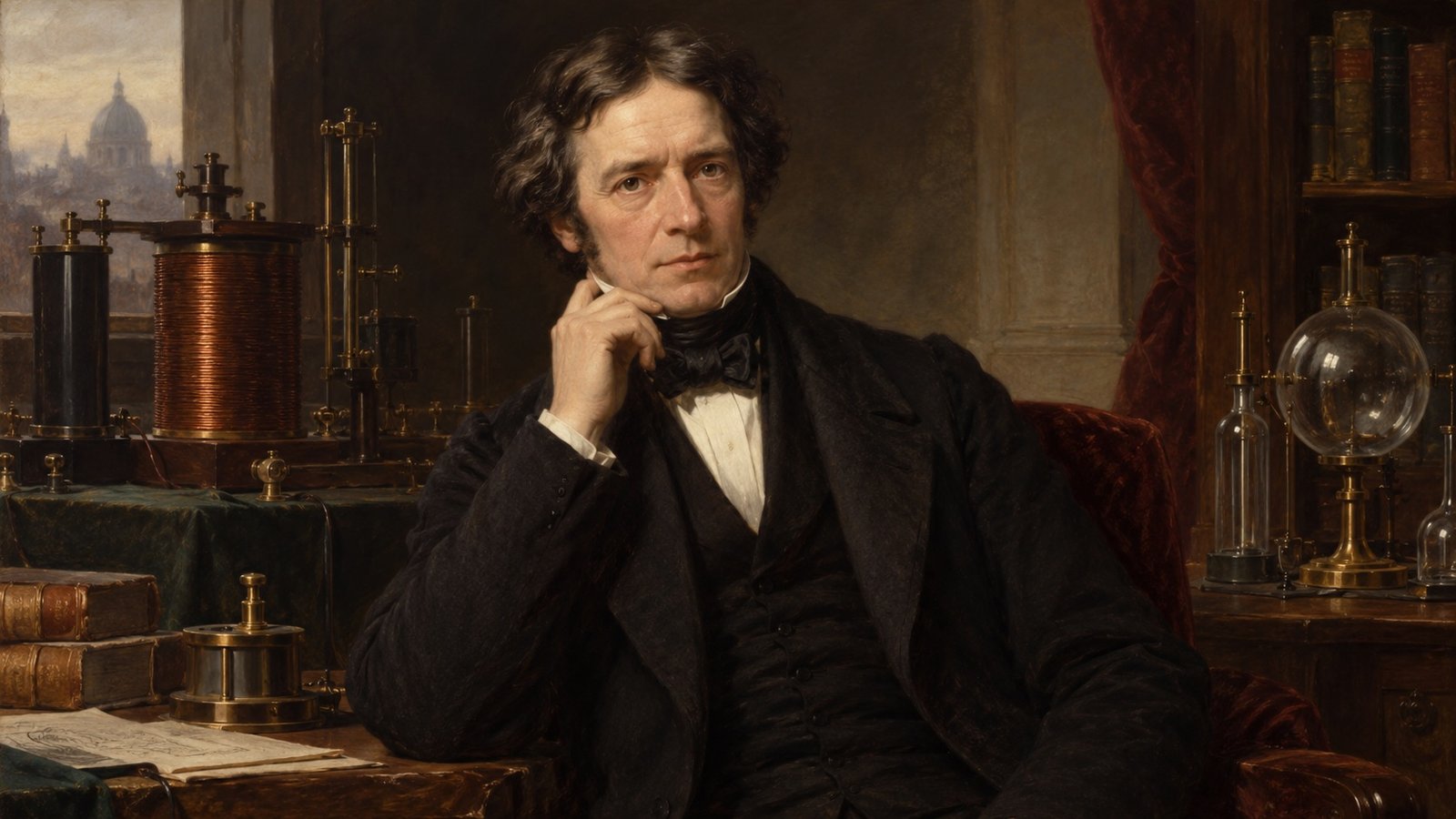
Michael Faraday never went to university, struggled with advanced mathematics and began adult life binding other people’s books. By the end of his career, he had laid much of the experimental foundation for the electrical world we now inhabit. Electric motors, generators, transformers and electromagnetic fields all lead, in one way or another, back to experiments conducted by a man who started with remarkably little formal education.
Faraday was born in 1791 in Newington Butts, an area of south London that now sounds more like somewhere an estate agent might rebrand than the birthplace of modern electromagnetism. His father worked as a blacksmith, the family had little money, and Faraday later described his schooling as little more than basic reading, writing and arithmetic. At fourteen, he became an apprentice to the bookbinder George Riebau. That could easily have been the end of the story: respectable trade, competent craftsman, no equations troubling anyone.
Instead, Faraday read the books he was supposed to bind. Scientific works especially fascinated him. He copied diagrams, made notes and attended lectures whenever he could. One customer eventually gave him tickets to hear Humphry Davy, Britain’s glamorous chemical celebrity, lecture at the Royal Institution. Faraday produced beautifully organised notes of Davy’s talks, bound them into a volume and sent them to the great man while asking for work. It was an unusually elaborate nineteenth-century job application, but it worked. In 1813 Davy hired him as a laboratory assistant.
The social difference between them soon became rather obvious. Davy came from modest origins himself but had climbed into fashionable society and married a wealthy widow. When Faraday accompanied the Davys on a European scientific tour, Lady Davy sometimes treated him more like a servant than a fellow scientific traveller. The young assistant nevertheless met leading European scientists and saw laboratories that would otherwise have remained inaccessible to a London bookbinder. One suspects he learnt almost as much about class as chemistry.
Faraday’s breakthrough came in 1821. Hans Christian Ørsted had shown that electric current could affect a magnetic needle. Faraday began experimenting with the relationship between electricity and magnetism and produced continuous electromagnetic rotation: essentially the principle behind the electric motor. The apparatus looked almost comically simple, involving wire, a magnet and mercury. Yet electricity had now produced continuous mechanical movement. A modern world full of fans, pumps, washing machines, industrial machinery and electric vehicles had acquired one of its fundamental ideas.
Even this triumph came with trouble. Some contemporaries suggested that Faraday had made improper use of ideas associated with William Hyde Wollaston. Faraday wrote to Wollaston to explain himself, and Wollaston declined to pursue the accusation. Relations with Davy also deteriorated as the former assistant became increasingly prominent. Scientific history occasionally prefers its geniuses standing alone beneath dramatic shafts of light; actual laboratories contain priority disputes, professional jealousies and arguments over who thought of what first. Faraday’s career supplied all three.
Nor was he merely an electrical experimenter. In 1825 Faraday isolated benzene, one of the most important compounds in industrial chemistry. He conducted pioneering work on electrochemistry and helped establish terminology that still fills science textbooks: electrode, anode, cathode and ion. Several of those terms emerged through discussions with William Whewell, a Cambridge scholar with the linguistic background to provide suitable Greek-derived names. Even scientific vocabulary, it turns out, occasionally requires calling someone who knows the classics.
Then came 1831 and the experiment that changed almost everything. Faraday demonstrated electromagnetic induction: a changing magnetic environment could generate an electric current. He constructed devices that embodied the principles of the transformer and generator. The distinction matters. His earlier motor experiment showed how electricity could create movement; induction helped show how movement and magnetism could create electricity. Together, the ideas sit close to the heart of modern electrical technology.
Power stations today may use nuclear reactors, gas turbines, wind, water or steam, but somewhere in the process rotation and electromagnetic induction usually become acquainted. We tend to notice the enormous cooling towers, offshore turbines and power lines. Yet underneath the engineering scale lies a principle Faraday demonstrated with remarkably modest equipment.
Faraday kept going. In 1836 he demonstrated what became known as the Faraday cage, showing how a conducting enclosure can shield its interior from external electric fields. In 1845 he demonstrated a relationship between magnetism and light, now known as the Faraday effect, and investigated diamagnetism. These experiments pushed him towards an extraordinarily important way of thinking about nature: forces did not merely act mysteriously across empty space; they could exist as fields extending through space.
Here we meet one of the most repeated Faraday myths. According to it, he was a mathematical ignoramus who relied almost entirely on intuition. There is some truth behind the exaggeration. Faraday lacked the advanced mathematical training of later theoretical physicists. He also struggled to express his ideas about fields in sophisticated equations. Yet he still thought with great rigour.
His experiments, diagrams and concept of lines of force gave James Clerk Maxwell the physical ideas that Maxwell later translated into mathematics. Faraday saw the landscape; Maxwell produced the map. Their combined legacy eventually became central to modern electromagnetic theory.
Faraday also understood something surprisingly modern: science needs explaining. He helped establish the Royal Institution’s Friday Evening Discourses and became inseparable from its Christmas Lectures. His famous lectures on the chemistry of a candle took an everyday object and used it to lead audiences through combustion, gases, matter and energy.
Rather than simplifying science into trivia, he started with something familiar and travelled gradually towards something profound. Science communicators have spent the subsequent century and a half attempting the same trick, sometimes with considerably larger PowerPoint files.
His private life adds another dimension. Faraday belonged to the Sandemanians, a small Christian denomination whose emphasis on simplicity and humility deeply influenced him. He showed little appetite for the elaborate honours available to Victorian scientific celebrities. He twice declined the presidency of the Royal Society.
Faraday also stated that he would not accept a knighthood, although the often-repeated claim that he actually rejected one lacks firm evidence that anyone formally offered it. Victorian Britain, which generally enjoyed titles almost as enthusiastically as electricity, had encountered an inconvenient customer.
Faraday died in 1867 at Hampton Court, where Queen Victoria had granted him a grace-and-favour house. His old magnetic laboratory still survives in the basement of the Royal Institution in London. It had once been a servants’ hall, had relatively little natural light and contained equipment that looks astonishingly modest beside what emerged from it.
There is something fitting about that room. Modern electrical civilisation did not begin inside a futuristic laboratory filled with screens. It grew partly from coils of wire, magnets, glass, mercury, notebooks and one man’s almost unreasonable determination to find out what happened when he changed the arrangement.
Faraday’s great talent may therefore have been something broader than experimental skill. He could look at phenomena that other scientists already knew and ask the next awkward question. If electricity affects magnetism, can it create movement? If magnetism and electricity connect, can movement generate electricity? Could magnetism affect light? What exactly occupies the apparently empty space around a magnet?
Each answer created another question. That habit matters as much as any particular invention. Faraday did not simply give us devices; he helped change the way scientists imagined invisible forces.
Almost two centuries later, we live surrounded by the consequences. Switch on a light, charge a phone, board an electric train or listen to the quiet hum of a motor and Faraday’s nineteenth-century experiments remain somewhere in the machinery. Not bad for a bookbinder who kept reading the merchandise.
Post Comment
You must be logged in to post a comment.