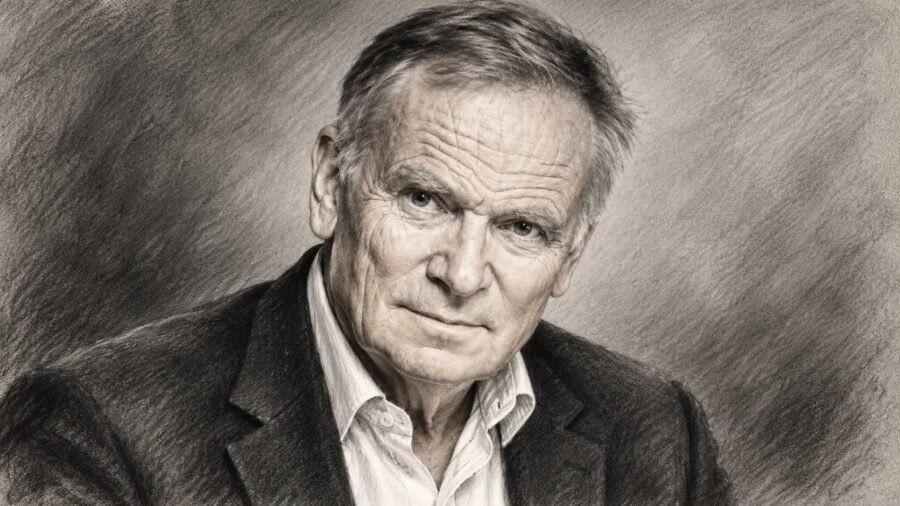
In 1831, a 25-year-old French aristocrat travelled to America to inspect its prisons. He returned with something rather more ambitious: a theory explaining how democracy might eventually undermine the very freedoms it promised to protect. Alexis de Tocqueville had gone looking for improvements to the penal system and found an entire civilisation conducting a political experiment. What troubled him was not that democracy might fail, but that it might succeed so thoroughly that people would willingly surrender their independence in exchange for equality, security and a reasonably comfortable life.
Alexis de Tocqueville was born in Paris in 1805 into a Norman aristocratic family with good reasons to distrust political upheaval. His parents had been imprisoned during the French Revolution’s Reign of Terror, and several relatives had gone to the guillotine. The family survived, but the experience left a lasting shadow. Tocqueville grew up in a society where monarchy, revolution and constitutional government competed for supremacy, sometimes within the same decade. Unlike many fellow aristocrats, he recognised that the movement towards greater social equality was unlikely to reverse. Rather than dreaming of restoring the old order, he wanted to understand what would replace it.
His opportunity came when he and his friend Gustave de Beaumont received permission to study American prisons. They spent approximately nine months travelling through the United States, visiting institutions, interviewing people and observing everyday life. Their official report appeared in 1833, but Tocqueville had become absorbed in a much larger question: how could a society function when inherited rank no longer determined everyone’s place? His observations became Democracy in America, published in two parts in 1835 and 1840. The book examined elections and institutions, but its most original insights concerned habits, social relationships, ambition and the peculiar psychology of democratic citizens.
America impressed him. He admired its local government, voluntary associations, energetic public life and willingness to let ordinary people manage their own affairs. Citizens formed organisations to solve problems that Europeans might have handed to officials. Religious communities, civic groups and town meetings created networks of cooperation without requiring instructions from a central authority. Tocqueville believed these habits helped protect liberty. Democracy, in his view, needed citizens who did something between elections, preferably something beyond complaining about the result.
Yet he noticed a contradiction. Democratic equality encouraged people to think of themselves as independent individuals, free from inherited obligations and traditional hierarchies. That sounded excellent, until independence became isolation. Tocqueville distinguished individualism from ordinary selfishness. Selfishness was an ancient human failing, while individualism was a distinctly modern tendency to withdraw into a small circle of family and friends, leaving the wider community to look after itself. People might become so occupied with private happiness that public affairs seemed an unnecessary inconvenience. The state would then have a wonderful opportunity to become indispensable.
His most unsettling idea concerned what later commentators call soft despotism. Traditional tyrants relied on intimidation, imprisonment and spectacular demonstrations of force. Tocqueville imagined something quieter: an immense administrative power that managed citizens’ needs, anticipated their difficulties and gradually relieved them of the burden of making collective decisions. It would not necessarily be cruel. On the contrary, its appeal would lie in its apparent kindness. People could continue working, shopping, raising families and enjoying themselves, provided they accepted that increasingly important decisions belonged elsewhere. Political dependence might arrive disguised as efficient public administration.
This was not an argument against government services or social protection. Tocqueville’s concern was the gradual disappearance of meaningful civic independence. A government could offer security while leaving citizens politically active, or it could use administration to replace their participation. The difference lay partly in whether people retained the institutions, knowledge and confidence to govern aspects of their own lives. His ideal citizen was not someone abandoned by the state, but someone capable of acting alongside other citizens without waiting for official permission.
Tocqueville also worried about the tyranny of the majority. Elections could legitimise governments, but they did not automatically protect dissenting opinions. A majority might use its political strength to restrict minorities, while social pressure could discourage people from expressing unpopular ideas. He believed democratic societies risked developing a powerful intellectual conformity, precisely because everyone was theoretically entitled to an opinion. When public opinion became the supreme authority, disagreeing with it could demand considerable courage. There was a delicious irony here: a society celebrating individual freedom might produce citizens who were terrified of appearing different.
His observations were not universally flattering to America. Tocqueville examined slavery and the dispossession of Native Americans, recognising the profound contradictions between democratic ideals and the treatment of people excluded from their benefits. He understood that equality among some citizens could coexist with severe injustice towards others. Yet his own political record exposed an equally serious contradiction. During his parliamentary career, he supported French colonisation in Algeria and defended coercive military measures, including the destruction of crops. The philosopher who feared concentrated power at home could accept its brutal exercise abroad. His arguments for liberty had boundaries that deserve as much scrutiny as his warnings about democracy.
Tocqueville eventually entered French politics, serving in the Chamber of Deputies and later the National Assembly. He briefly became foreign minister in 1849. His political career unfolded amid the revolution of 1848 and the rise of Louis-Napoléon Bonaparte, whose coup in December 1851 ended the Second Republic. Tocqueville opposed the coup and was briefly detained. Having spent years examining how democratic institutions could lose their substance, he witnessed a republic give way to authoritarian rule. The experience strengthened his interest in the historical roots of centralised power, which he explored in his 1856 book The Old Regime and the Revolution.
That later work contained another uncomfortable observation. The French Revolution had promised a dramatic break with the past, yet the centralised administrative machinery of the monarchy largely survived. The rulers changed, the political language changed, and some institutions changed, but the habit of governing everything from the centre proved remarkably durable. Tocqueville suggested that revolutions could accelerate tendencies already developing under the regimes they overthrew. A government might be overthrown without changing the underlying relationship between citizens and authority. Replacing the people in charge was considerably easier than changing the political habits of an entire country.
It is tempting to recruit Tocqueville into every contemporary argument about bureaucracy, political correctness, individualism or the welfare state. Such comparisons can illuminate modern problems, but they can also flatten his thinking. He was neither a prophet of the internet nor a straightforward advocate of minimal government. He admired equality while fearing its possible consequences, supported democratic participation while doubting the wisdom of majorities, and defended liberty while accepting colonial domination. His value lies partly in these contradictions. He understood that political ideals could collide with one another, and that good intentions offered no guarantee against undesirable results.
Tocqueville died of tuberculosis in Cannes in 1859, aged 53. His central concern has survived the particular institutions he studied. How much responsibility will people exchange for convenience? Can a society preserve independence when its citizens prefer private comfort to public involvement? And what happens when everyone possesses political rights but increasingly few people want the trouble of exercising them? Nearly two centuries after his American journey, the French aristocrat’s most disturbing possibility remains that freedom might disappear without anyone formally abolishing it. There might be no dramatic announcement, no soldiers in the streets and no obvious villain. Just a population quietly delighted that somebody else has agreed to take care of everything.