The Origins of the Burqa: What the History of Veiling Really Tells Us
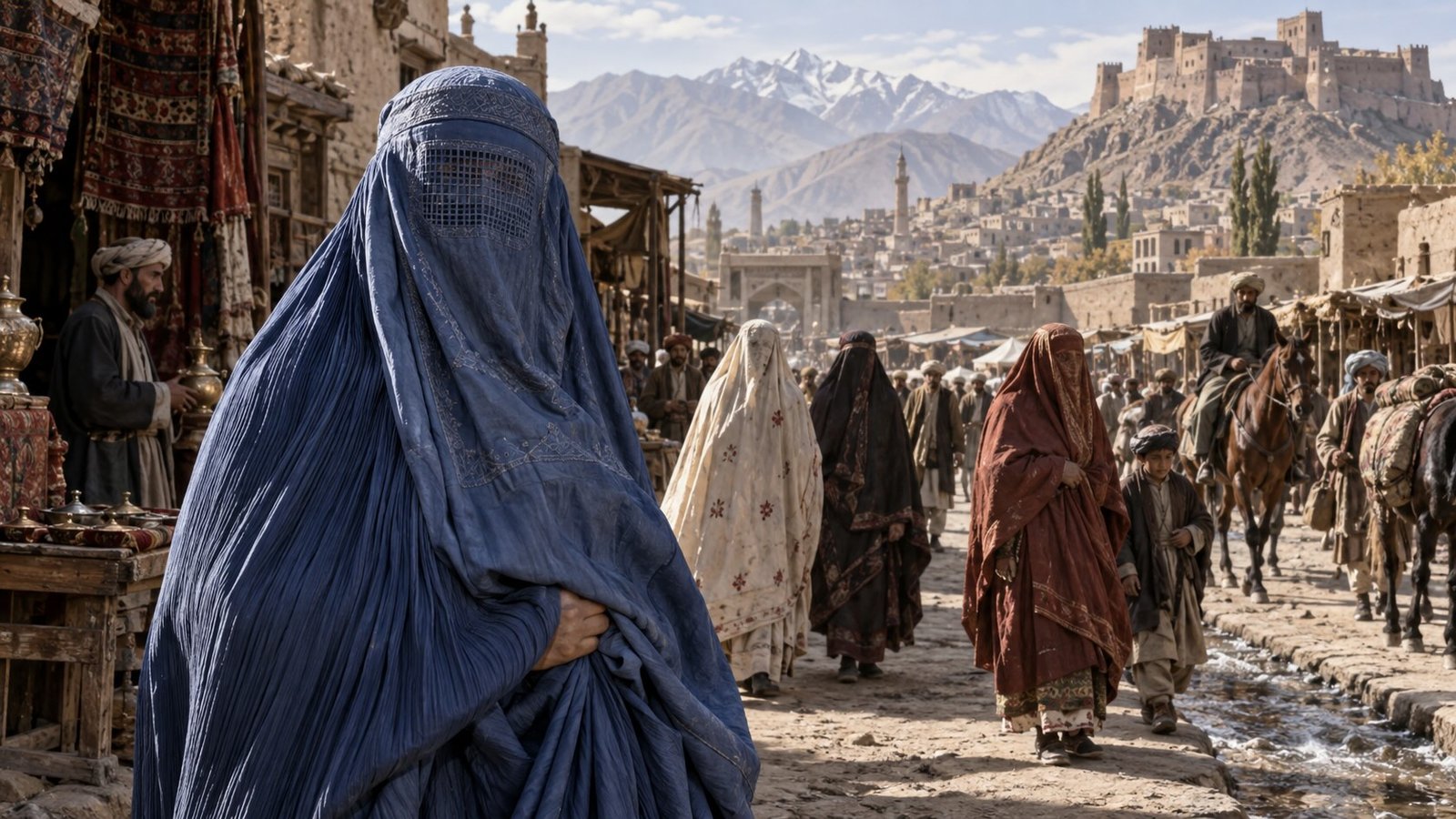
Ask most Europeans where the burqa came from and there is a reasonable chance that the answer will contain two words: Afghanistan and Taliban. The association has become so strong that the three seem almost inseparable. Yet the Taliban no more invented the burqa than Victorian gentlemen invented trousers. They inherited an existing garment, imposed their own rules upon it and turned it into one of the most recognisable political symbols of the modern age.
Even the word creates trouble. What English speakers generally call the Afghan burqa is usually called a chadari or chadri in Afghanistan. It covers the entire body from the top of the head to the feet, while a small embroidered mesh allows the wearer to see. A niqab, by contrast, normally covers the face but leaves the eyes visible. A hijab usually means a head covering rather than a full-body garment. Western newspapers have spent decades happily putting all three into roughly the same linguistic cupboard.
The story becomes stranger when we travel backwards, because veiling did not begin with Islam at all. More than two thousand years before Muhammad, women in ancient Mesopotamia already wore veils. Middle Assyrian laws from the second millennium BC even regulated who could wear one. Wives, widows and certain high-status women could appear veiled in public, while female slaves and prostitutes could not. A veil therefore communicated something rather different from what many people assume today: privilege, respectability and social rank.
This matters because clothing rarely begins as pure theology. Clothes tell strangers who we are, what group we belong to and how much money or status we possess. Europe once had elaborate rules about which colours and fabrics different social classes could wear. Medieval aristocrats dressed differently from peasants for precisely the same reason that a businessman today might choose an expensive watch. Clothing talks even when the person wearing it says nothing.
When Islam emerged in Arabia during the seventh century, it entered a world where veiling already existed in Byzantine, Persian, Jewish, Christian and Arabian societies. The Qur’an contains passages concerning modest clothing, including references to the khimar and jilbab, but it never supplies a sewing pattern for the Afghan burqa. Nor does it describe the pleated garment with the little mesh window that later became so visually associated with Afghanistan. Muslim scholars subsequently developed different interpretations about how much of a woman’s body should remain covered.
So the familiar Afghan burqa developed through culture as much as scripture. Similar enveloping garments appeared across Central and South Asia, although styles varied enormously. Historical images from the nineteenth century already show women in Afghanistan and neighbouring regions wearing full coverings long before anyone had heard of the Taliban. The garment that became the Afghan chadari probably evolved gradually rather than appearing one morning because some forgotten tailor had a particularly dramatic idea.
There was another ingredient: class. Full veiling could signify that a family possessed enough money for its women not to perform agricultural or manual labour outside the home. In that sense the garment could work almost like a nineteenth-century European lady’s pale complexion. If your skin remained pale, perhaps you did not labour in the fields. If a woman could remain secluded and heavily covered outside the household, perhaps her family enjoyed sufficient status to make that possible.
Afghanistan itself never had one universal dress culture. Kabul differed from Kandahar; rural communities differed from urban families; ethnic groups maintained their own textiles, colours and customs. The blue chadari that later became the international shorthand for “Afghan woman” represented only part of a much richer wardrobe. In Kabul blue became common, while other regions used white, brown, green and other colours. The supposedly timeless national costume was neither completely national nor particularly timeless.
Then came the twentieth century, when Afghan governments discovered that women’s clothing offered an excellent surface on which to conduct arguments about modernity. King Amanullah and Queen Soraya promoted women’s education and challenged strict veiling conventions during the 1920s. Soraya publicly appeared unveiled, an extraordinarily provocative gesture in Afghanistan at the time. Conservative opposition helped undermine Amanullah’s reforms, demonstrating a lesson that governments repeatedly forget: changing somebody’s wardrobe by decree rarely remains merely about clothing.
Another major change came in 1959, when the Afghan government again encouraged women to appear unveiled. Urban women increasingly entered universities, professions and government employment. Photographs of Kabul from subsequent decades can surprise modern viewers because they show women wearing skirts, Western-style dresses and uncovered hair. Those photographs, however, can also mislead. They mostly show urban Afghanistan rather than the entire country, where conservative dress traditions continued.
The Taliban therefore did not bring the burqa into existence when they seized Kabul in 1996. What they did was far more consequential: they converted a garment that women might wear because of custom, family expectations, class, modesty or personal choice into something backed by state coercion. Women faced severe restrictions on movement, employment and education, and the chadari became compulsory public clothing under Taliban rule. Suddenly a complicated piece of social history acquired a brutally simple international meaning.
After the Taliban lost power in 2001, some Afghan women stopped wearing the chadari while others continued. That alone should warn us against easy interpretations. A garment can represent coercion to one woman, faith to another, anonymity to another and ordinary habit to someone who has worn it since adolescence. Clothes gain meaning from the circumstances in which people wear them. Choice and compulsion may produce exactly the same photograph while representing completely different human experiences.
Since returning to power in August 2021, the Taliban have again tightened restrictions on women’s appearance and public life. Their 2024 morality law requires extensive covering and face covering in public, while enforcement has varied between provinces. In Herat, authorities even pushed women towards burqa use during periods of intensified enforcement. Five years after the Taliban returned, arguments about clothing therefore remain arguments about something much larger: whether women themselves or political and religious authorities decide how women may appear in public.
Perhaps that is the most revealing part of the burqa’s history. It began neither with the Taliban nor neatly with Islam, and no single moment can explain it. Behind the blue folds lie ancient ideas about status, centuries of regional fashion, religious interpretation, family honour, economic class, empire, reform and political power.
The garment looks remarkably simple from a distance. Its history is anything but.
Post Comment
You must be logged in to post a comment.