George Gershwin: The Man Who Made America Sound Like America
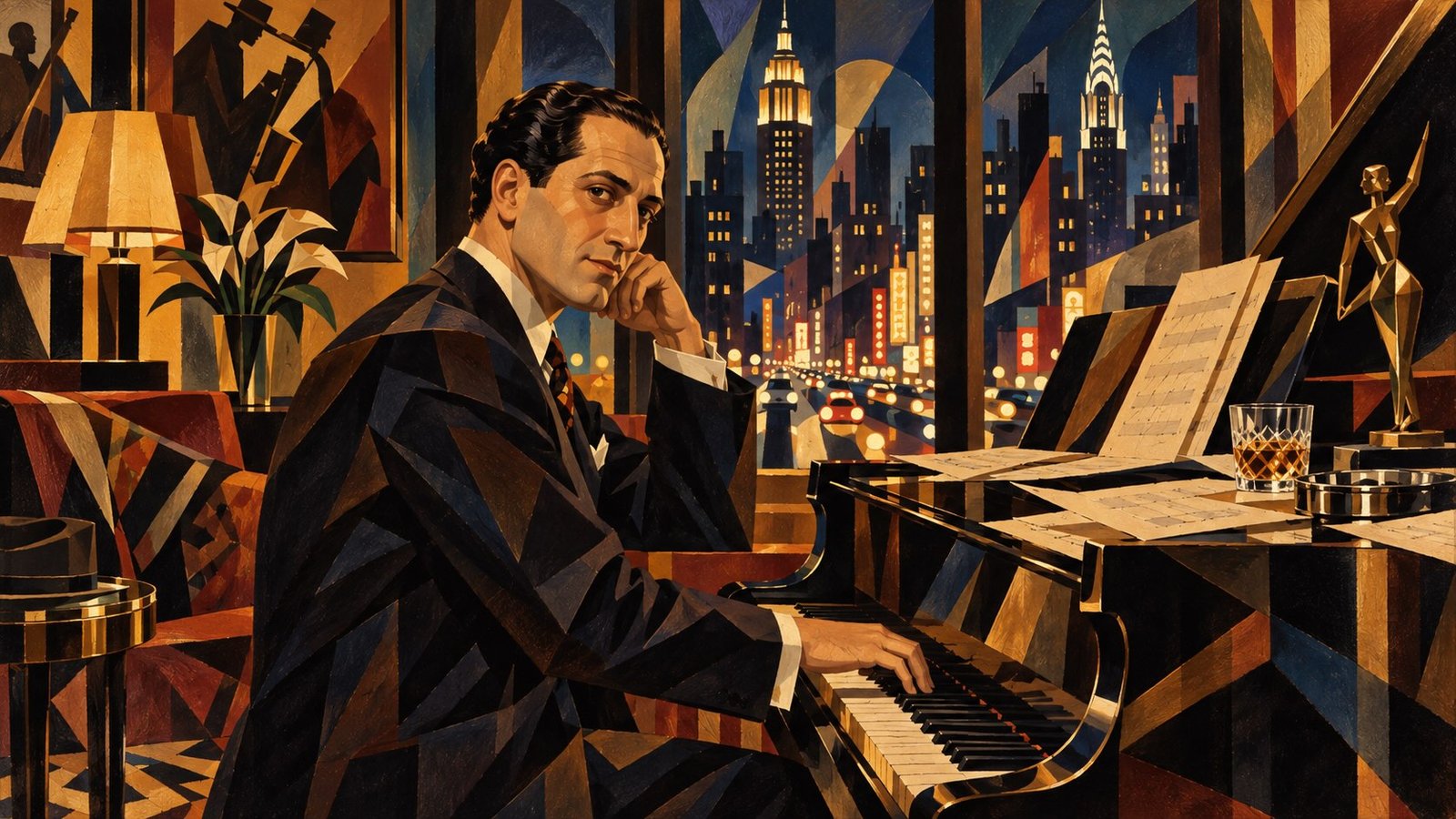
In February 1924, a 25-year-old New Yorker sat down at a piano in Aeolian Hall and helped create one of those rare moments when music seems to announce that the world has changed. George Gershwin played the solo part in Rhapsody in Blue, while Paul Whiteman conducted an orchestra playing an arrangement by Ferde Grofé. The concert carried the magnificently ambitious title An Experiment in Modern Music. Nobody involved suffered from an excess of modesty. Yet the experiment worked.
The famous opening clarinet slide still sounds like Manhattan stretching after a late night. Classical concert music suddenly acquired jazz rhythms, urban swagger and the nervous energy of traffic. Gershwin had managed something composers spend careers attempting: he produced music that seemed instantly connected to a particular place and time, while somehow refusing to stay there.
That achievement looks even stranger when you consider where he came from. Gershwin grew up in New York, one of the children of Russian-Jewish immigrants. His elder brother Ira was the bookish one; George was energetic, restless and hardly an obvious candidate for musical immortality. Yet after encountering music seriously as a boy, he became obsessed with the piano. Before long he entered Tin Pan Alley, the wonderfully unromantic New York music industry where composers essentially manufactured songs for public consumption.
His first published song earned him five dollars. A less optimistic teenager might have considered another profession. Gershwin continued. In 1919, Swanee, popularised by Al Jolson, turned him into a successful songwriter. Broadway followed, along with an extraordinary partnership with Ira. Together the brothers worked on 15 Broadway musicals, four films and Porgy and Bess, while producing songs that eventually became part of the American musical vocabulary.
What makes Gershwin unusual, however, is that popular success never satisfied him. He could have spent his life writing lucrative Broadway songs and attending excellent parties. Instead, he kept looking towards the concert hall. The resulting tension became his greatest strength. Classical musicians sometimes regarded him as suspiciously commercial, while the popular-music world occasionally wondered why he insisted on complicating perfectly good tunes with symphony orchestras.
Rhapsody in Blue emerged from precisely this borderland. One popular version of the story suggests Gershwin casually dashed it off almost at the last minute. Reality was frantic but more interesting. Paul Whiteman commissioned the piece for his February concert, leaving Gershwin only about six weeks while he was already occupied with Broadway work. Gershwin wrote the music, but Grofé orchestrated the original version for Whiteman’s unusual ensemble. Surviving manuscripts show just how collaborative and improvised the process could become. At one point the orchestral score simply tells Whiteman to wait for Gershwin’s nod while the composer improvises at the piano.
This matters because another myth quietly turns Gershwin into a solitary genius who somehow produced the entire orchestral masterpiece in one feverish burst. He did not. Grofé’s orchestration formed an essential part of the work’s original sound. Giving Grofé his due hardly diminishes Gershwin. If anything, it makes the episode more recognisably modern: a brilliant composer, an expert arranger, an ambitious bandleader, a deadline and a considerable amount of controlled panic.
Then there are the stories about Gershwin seeking lessons from Europe’s great composers. In one famous anecdote, he approached Maurice Ravel, who supposedly asked how much Gershwin earned and replied that Gershwin should teach him instead. Another version gives the punchline to Igor Stravinsky. The tale has circulated so widely that it has practically become part of Gershwin’s biography, although its precise history remains disputed. The safest interpretation is to treat it as a magnificent story rather than stenographic evidence.
Gershwin certainly admired European modernists. Yet he gradually realised that copying them would defeat the point. Works such as the Concerto in F and An American in Paris absorb European influences but never disguise their nationality. Taxi horns famously entered An American in Paris. Beethoven might have raised an eyebrow, although New Yorkers probably recognised the instrumentation immediately.
Gershwin was also more visually minded than his image as a permanently piano-bound composer suggests. He painted and drew, photographed friends and produced portraits, including one of Arnold Schoenberg. His surviving artworks even include a self-portrait. Apparently writing I Got Rhythm was insufficient creative activity for one lifetime.
His most ambitious project created his most complicated legacy. Gershwin regarded Porgy and Bess as an opera, although he called it a “folk opera”, and spent time near Charleston in 1934 while working with DuBose Heyward. He listened to Gullah music and religious practices and tried to absorb aspects of that musical environment. When the work reached New York in 1935, its all-Black cast was itself remarkable in American theatre. The original production ran for 124 performances, impressive for an opera but insufficient to recover its considerable costs.
The controversy has never disappeared. Porgy and Bess created major opportunities for Black classical performers and Gershwin insisted on Black casting rather than performers appearing in blackface. Members of the company later challenged segregation; during a Washington engagement, original Porgy Todd Duncan and the cast refused to perform unless the National Theatre allowed an integrated audience.
At the same time, Black artists and critics have long questioned a story about African-American life created principally by white writers and composers. Critics have objected to dialect, poverty, drugs, violence and characters they considered stereotypical. Others have defended the opera’s humanity, musical importance and opportunities it provided to generations of Black singers. That contradiction cannot be tidied away without damaging the history. Porgy and Bess can represent an artistic breakthrough and remain culturally uncomfortable at the same time.
Gershwin never lived long enough to see those arguments develop. In 1937, while working in Hollywood, he became seriously ill and died from a brain tumour after surgery. He was only 38. His career had effectively lasted less than two decades, yet it produced Rhapsody in Blue, An American in Paris, the Concerto in F, Porgy and Bess and songs including Someone to Watch Over Me, Fascinating Rhythm and I Got Rhythm.
Nearly ninety years later, his archive keeps expanding rather than retreating into respectable museum silence. Manuscripts, lyric sheets, programmes, artwork and other surviving documents continue to reveal how much of his work emerged from collaboration, speed, instinct and a remarkably porous boundary between popular and classical music.
Perhaps that explains Gershwin’s durability. He never quite fitted anywhere. He was too jazzy for some classical purists, too ambitious for Tin Pan Alley, too commercial for certain critics and too musically sophisticated to dismiss as merely a songwriter. Even Porgy and Bess refuses to sit quietly inside a convenient category.
America in the 1920s and 1930s had exactly the same problem. Immigrant, ambitious, wealthy, unequal, noisy and fascinated by novelty, it was still inventing its cultural identity. Gershwin did not simply provide that America with a soundtrack. For a few remarkable years, he made its contradictions audible.
Post Comment
You must be logged in to post a comment.