British Art Fair 2026: From Hockney to the Digital Frontier
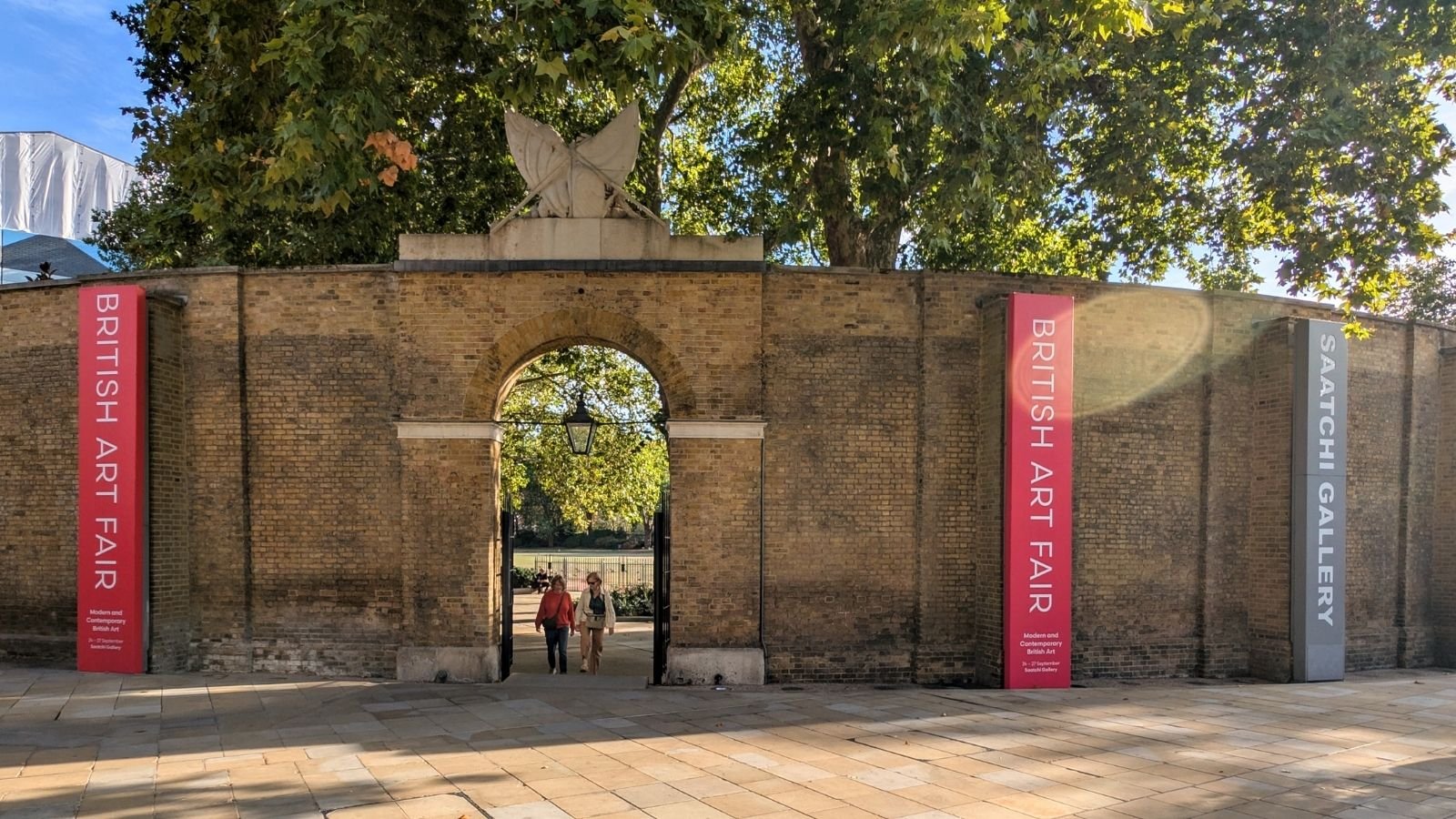
There is something reassuringly British about putting Henry Moore, David Hockney and artificial intelligence under the same roof and behaving as though this is perfectly normal. At British Art Fair 2026, it almost is. Across three floors of London’s Saatchi Gallery, a century of British art meets a generation of artists for whom a camera, computer or algorithm can feel as natural as a paintbrush.
Running from 24 to 27 September, British Art Fair remains the only fair devoted exclusively to Modern and Contemporary British art. It brings together more than 70 galleries and dealers, with prices ranging from relatively approachable territory to six figures. The setting helps. Saatchi Gallery in Chelsea feels grand enough for serious collecting, yet it lacks some of the intimidating atmosphere that can make an art fair resemble a luxury goods convention where nobody admits to looking at the price tags.
The fair has been around since 1988, although it began life as The 20th Century British Art Fair. Its first edition took place at the Cumberland Hotel before moving to the Royal College of Art in 1991. It eventually arrived at Saatchi Gallery in 2018. That history matters because the fair grew alongside a dramatic reassessment of British twentieth-century art. Artists once considered rather local gradually acquired international reputations and, inevitably, international prices.
The 2026 line-up offers plenty of familiar names. Frank Auerbach, Barbara Hepworth, Henry Moore, Bridget Riley, Paula Rego, Tracey Emin, Damien Hirst and Stanley Spencer all appear. So does David Hockney, whose career receives a special presentation curated by Eleanor Ekserdjian. It is difficult to imagine a British art event today without Hockney somewhere in the building. He has become almost an institution in his own right.
Yet treating British Art Fair simply as a gathering of expensive twentieth-century names misses what makes the 2026 edition interesting. The fair increasingly asks what ‘British art’ actually means. Does the artist need to have been born in Britain? Must the work use traditional materials? Can something created partly through digital technology belong beside Hepworth or Moore?
The answer offered here appears to be refreshingly uncomplicated: why not? That attitude becomes most obvious on the second floor, where Spotlight: Digitalism returns. The project began at British Art Fair in 2024 and has grown into an increasingly ambitious platform for art involving AI, augmented and virtual reality, digital sculpture, moving images, photography and painting. Rather grandly, its organisers have proposed ‘Digitalism’ as a new artistic ‘ism’. Art history may eventually decide whether that claim survives. For the moment, however, the name provides a useful umbrella for artists who refuse to treat digital technology merely as an office tool with better graphics.
Fiona Mompean is among the artists included in Digitalism this year, with Manosphere providing a particularly contemporary counterpoint to the Modern British works elsewhere in the building. Even its title carries baggage. The ‘manosphere’ has become shorthand for a sprawling online world of male-oriented communities, identities and arguments, shaped by the peculiar psychology of digital life.
In an art fair filled with objects that may have existed for decades, Manosphere points towards a different landscape. Here, culture forms through screens, networks and digital identities at extraordinary speed. The work therefore belongs to a wider question running through Digitalism: when technology changes how people see themselves and each other, how should artists respond? Mompean’s inclusion also demonstrates how far British Art Fair has travelled from its original twentieth-century remit. She appears in the official 2026 Digitalism selection alongside dozens of artists working across new technological forms.
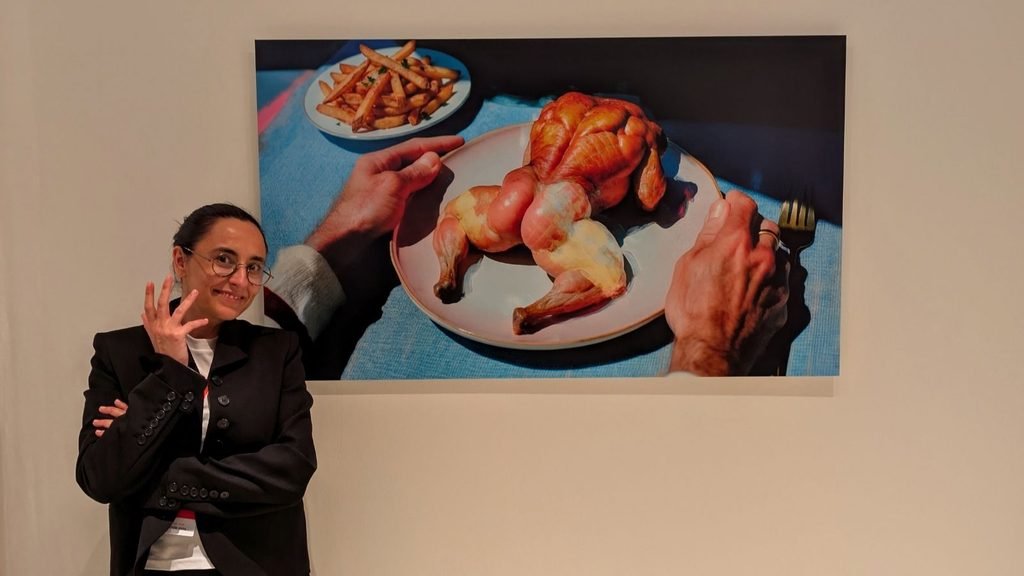
Cristina Schek offers another route into this territory. The Transylvanian-born, London-based artist combines photography and digital montage with an unmistakably Surrealist imagination. Her pictures can initially appear polished and almost dreamily beautiful. Then the visual logic starts misbehaving.
Bubbles, The Fish (Waterline Dreams Series), 2025 captures that quality beautifully. Schek constructs an image that feels simultaneously photographic and impossible. The work exists as an archival pigment print, produced in an edition of five plus three artist’s proofs. Rather than using digital manipulation to disguise reality, Schek uses it to make reality less dependable. That places her surprisingly close to the Surrealists, who were doing much the same thing long before Photoshop offered an Undo button.
Schek has become closely associated with Digitalism. Her work appeared in the 2025 edition, when the fair highlighted Bubbles and described her compositions as drawing inspiration from both the Surrealists and Old Masters. She returns in 2026 and appears in two parts of the fair: with Cynthia Corbett Gallery on the ground floor and in Digitalism upstairs. It creates a neat physical metaphor. Her work literally connects the conventional gallery market downstairs with the experimental digital world above.
That distinction between ‘traditional’ and ‘digital’ art is becoming increasingly awkward anyway. Hockney himself embraced fax machines, photocopiers, iPhones and iPads without apparently worrying that technology might confiscate his membership of the art world. Photography faced similar suspicion in the nineteenth century. Screen printing once looked mechanical. Video art once seemed technologically exotic. Yesterday’s threatening new medium has an irritating habit of becoming tomorrow’s respectable museum department.
Artificial intelligence has simply reopened the argument with considerably more noise. Digitalism includes AI alongside photography, painting, moving images, AR and VR rather than presenting it as a replacement for them. That feels important. The interesting question is not whether a computer touched an artwork. It is whether an artist had something interesting to say with it.
Indeed, one of the more ironic exhibits at this year’s fair turns the anxiety about AI into art itself. London studio Electric Dreama has created CH(AI)MERA, an intentionally grotesque sculpture conceived as a criticism of generic AI-generated imagery. The studio describes the creature as a commitment to use AI as a tool rather than a substitute for human creativity. Even the digital revolution, it seems, has already developed an anti-digital faction.
Elsewhere, the fair looks in the opposite direction: not towards the future, but towards age. Born To, curated by Jo McLaughlin, presents five artists who came to serious creative practice later in life. More than 500 people applied. The selected artists challenge one of the art world’s more persistent obsessions — the idea that an ‘emerging artist’ should ideally emerge before developing grey hair.
That mixture of established masters, late starters and digital experimenters may be the strongest feature of British Art Fair 2026. A Moore sculpture does not suddenly become less important because an AI-assisted artwork sits two floors above it. Nor does a digital image become culturally significant simply because somebody used clever software to make it.
Instead, the fair creates an unusual conversation between different moments in British art. One generation carved stone. Another experimented with abstraction, photography or conceptual art. Today’s artists manipulate pixels, construct virtual spaces and interrogate online culture. The tools keep changing, while the basic human urge remains suspiciously familiar: make something, put it in front of strangers and see whether they stop walking. And at an art fair, of course, hope that one of them also reaches for a credit card.
Post Comment
You must be logged in to post a comment.