The Norman Conquest: When England Got New Management
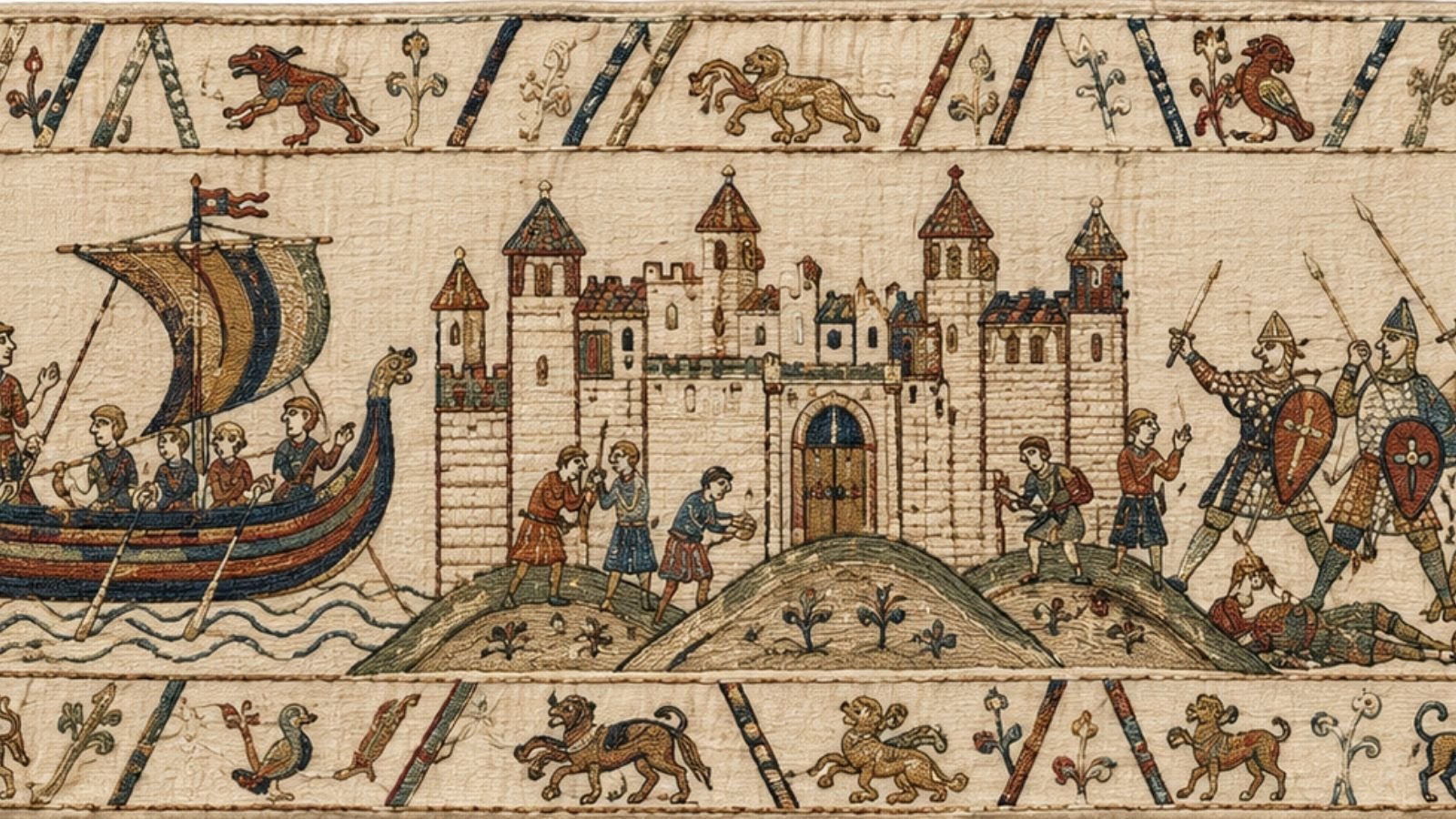
There are historical dates, and then there is 1066. British schoolchildren once learnt it almost before learning their own birthdays: William the Conqueror, Harold Godwinson, the Battle of Hastings and, inevitably, an arrow in somebody’s eye. Yet the Norman Conquest makes much more sense when we stop treating it as a single battle and start seeing it as something closer to a hostile corporate takeover of an entire country. The new management did not merely replace the chief executive. It replaced much of the board, redistributed the assets, changed the language of senior management and erected enormous stone security systems in case the employees objected.
England entered 1066 with a succession problem. Edward the Confessor died on 5 January without a child, and Harold Godwinson took the crown the following day. William, Duke of Normandy, believed Edward had promised the throne to him and also claimed that Harold had previously sworn to support his succession. Harald Hardrada of Norway had another claim altogether. Medieval constitutional law, it turns out, offered roughly the clarity one might expect when several armed men each produced a different version of the paperwork.
Harold first had to deal with Hardrada. The Norwegian king invaded northern England with Harold’s troublesome brother Tostig, defeated an English army at Fulford and occupied York. Harold reacted with astonishing speed, moved north and crushed the invaders at Stamford Bridge on 25 September. Hardrada and Tostig died in the fighting. One later story even claimed that a gigantic Norwegian warrior held Stamford Bridge single-handedly until an English soldier crawled beneath it and stabbed him from below, which proves that medieval chroniclers understood the value of a good action sequence. Historians treat that particular detail with considerable caution.
Then William landed in Sussex. Harold hurried south again, although the familiar story that his exhausted army simply marched the entire distance from Yorkshire may exaggerate matters. Harold could have transported some troops by sea, while his mounted household forces could move quickly over land. Either way, within three weeks of defeating one invasion, Harold had to face another. He gathered new forces in London but apparently moved against William before he had assembled everything available to him.
On 14 October the two armies met near Hastings, on ground around present-day Battle. Harold positioned his men along a ridge and formed the famous shield wall. His elite housecarls fought on foot with large two-handed axes; William combined infantry, archers and mounted warriors. The battle lasted virtually the entire day, unusually long for medieval warfare, which rather spoils the convenient idea that Norman military sophistication made the result inevitable. For hours, the English line held.
The Normans eventually exploited breaks in the English formation. Some Norman troops fled during the fighting, English warriors pursued them downhill, and William’s forces counter-attacked. Later accounts describe deliberate feigned retreats using the same trick again. Eventually Harold died and the English army collapsed. William had won the battle, although he had not yet won England.
And here we encounter perhaps the most famous piece of medieval misinformation: Harold and the arrow in the eye. The Bayeux Tapestry appears to show a figure near Harold receiving an arrow in the face, but historians cannot confidently say that this figure represents Harold or that the arrow killed him. Another early tradition describes Norman warriors attacking Harold directly and mutilating his body. The neat arrow story survived because history has always preferred a memorable image to an inconvenient footnote.
William reached London and received the crown at Westminster on Christmas Day 1066. Even that ceremony reportedly produced confusion when acclamation inside the abbey frightened Norman guards outside, who thought a revolt had begun. Coronations normally aim for slightly less arson and panic. More importantly, William’s coronation did not end English resistance. Rebellions continued, and the Normans spent years imposing control through military campaigns, confiscations and castles.
The most brutal chapter came in northern England. Repeated rebellions and Danish intervention convinced William that ordinary suppression had failed. During the winter of 1069–70 his army devastated parts of Yorkshire and neighbouring areas, destroying food stores, settlements and agricultural resources in what became known as the Harrying of the North. Contemporary and later accounts describe famine and depopulation, while historians continue to debate the exact scale and death toll. The evidence nevertheless points to deliberate devastation on an extraordinary scale.
At the same time, William transformed the geography of power. Norman rulers erected castles across England, initially often as earth-and-timber motte-and-bailey structures and increasingly in stone. These were not picturesque heritage attractions awaiting a National Trust café. They allowed relatively small groups of armed newcomers to dominate towns, roads and surrounding territory. Norman bishops and abbots also took control of much of the Church, while enormous Romanesque cathedrals and abbeys proclaimed the new order in stone.
Perhaps the greatest revolution occurred in land ownership. William redistributed estates among his followers, creating a new aristocracy with continental roots and drastically reducing the position of the old English landholding elite. Domesday research lets historians trace this dispossession estate by estate. The conquest therefore did something invasions rarely achieve so completely: it changed not merely the monarch but the people who controlled much of the country’s wealth.
Then came Domesday Book. In 1085 William ordered a huge survey, and officials gathered information about estates, owners, resources and values across most of England. Scholars now emphasise just how sophisticated the operation was. The system processed information through regional circuits before scribes condensed it into the surviving Domesday texts. Eleven centuries before spreadsheets, the Norman state had already discovered that power improves considerably when accompanied by an enormous database.
The conquest also reshaped English culture, though not as simply as people sometimes imagine. The Normans did not make everyone start speaking French overnight. Most ordinary people continued speaking English. Norman French dominated the royal court and much of the aristocracy. Latin remained important in government and the Church. Over time, the languages mixed. Modern English still shows the result. We often use an Anglo-Saxon word for the animal and a French-derived word for the meat. A peasant tended the cow; a wealthy household ate beef.
Nor did William create England from scratch. Anglo-Saxon England already possessed sophisticated government, taxation, coinage, shires and royal administration. In fact, the Normans often exploited those existing systems precisely because they worked so well. Many English county structures survived the conquest, and Domesday itself depended upon a remarkably organised kingdom that already existed before William crossed the Channel.
That mixture of rupture and continuity explains why historians still argue about 1066. Older accounts sometimes portrayed the Normans as energetic modernisers. They supposedly brought castles, continental culture and stronger institutions to a backward country. Another tradition presents the conquest mainly as foreign occupation and dispossession. Current scholarship paints a more complicated picture. England already had an advanced state. The Normans kept useful institutions but transformed land ownership, elite culture, architecture and political power.
Even the Bayeux Tapestry refuses to behave like a simple historical photograph. Despite its name, it is embroidery rather than tapestry, and scholars still debate exactly where it was made and how audiences should interpret its imagery. It tells the story largely from the Norman political perspective, yet its details contain ambiguities that continue to fuel arguments about Harold, William and the events of 1066. The object survives because medieval propaganda occasionally possesses considerably better workmanship than modern advertising.
The strangest thing about the Norman Conquest may therefore be how thoroughly a violent eleventh-century power struggle still surrounds modern Britain. Walk through Durham, Winchester, Norwich or the Tower of London and Norman architecture remains part of the landscape. Speak English and fragments of the linguistic collision remain in everyday vocabulary. Look at the development of aristocratic estates, royal authority or land law and 1066 appears again. William won at Hastings in a single day, but the real conquest took years, and its consequences have lasted for nearly a millennium.
Post Comment
You must be logged in to post a comment.