In the history of British politics, powerful men have traditionally carried briefcases, red despatch boxes or occasionally nothing more intimidating than a rolled-up newspaper. Winston Churchill had his cigar, Harold Wilson his pipe, and Margaret Thatcher had something altogether more dangerous: a handbag. Not a particularly unusual handbag, either. It was generally a structured leather affair, the sort of accessory that might accompany a respectable middle-class woman to lunch. Yet somehow, in Thatcher’s hands, it acquired the psychological properties of a medieval mace.
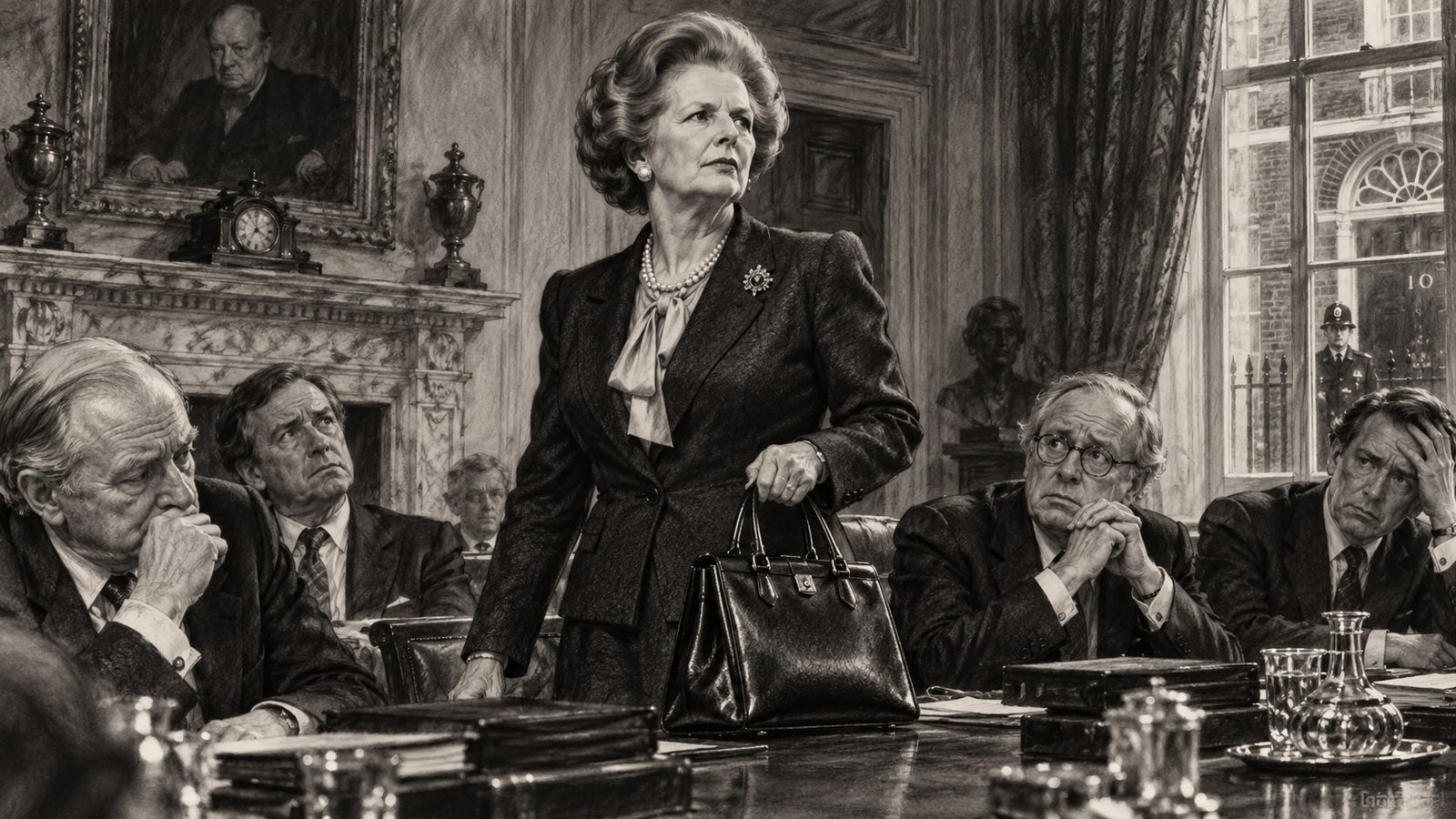
By the 1980s, senior ministers reportedly regarded the sight of her handbag opening during a cabinet meeting as an unfortunate development. The prime minister might produce a carefully prepared argument, an inconvenient statistic or a document that demolished whatever excuse somebody had just offered. No physical violence occurred, at least as far as the historical record suggests. Nevertheless, her handbag became so closely associated with political intimidation that the English language acquired a new verb: to handbag. Few accessories have enjoyed such an extraordinary promotion.
The story began long before Margaret Thatcher entered Downing Street in May 1979. As the daughter of a Grantham grocer, she had grown up in a world where respectable appearance, personal discipline and careful preparation mattered enormously. When she entered Parliament in 1959, the House of Commons remained overwhelmingly male, and women politicians faced considerable scrutiny over their appearance. Thatcher understood that clothes could communicate authority, although the rules differed considerably for women. A male politician could look formidable in a dark suit. A female politician needed to negotiate an elaborate collection of expectations involving femininity, respectability and the unfortunate possibility that someone might comment on her hairstyle instead of her economic programme.
Thatcher gradually developed a recognisable uniform: tailored suits, carefully arranged blonde hair, pearls, neat blouses and, almost invariably, a handbag. She favoured structured designs from British luxury houses including Asprey and Launer. These were not fashionable little evening bags designed to hold a lipstick and a theatre ticket. They were practical, relatively spacious and sufficiently rigid to suggest that their owner had organised her life into clearly labelled compartments. The image worked particularly well because the handbag looked conventionally feminine while its owner exercised an authority that few women had previously enjoyed in British public life.
The transformation from accessory to political weapon owes much to Julian Critchley, a Conservative MP who regularly criticised his party leader. In 1982, he observed that Thatcher seemed incapable of encountering an institution without attacking it with her handbag. The remark captured something that lengthy political analysis could not. Suddenly, her government became imaginable as a formidable woman marching through Britain’s established institutions, handbag raised, determined to rearrange everything in sight. The joke spread, and the verb handbagging eventually entered the Oxford English Dictionary. Usually, words emerge because society needs to describe some recurring activity. Britain apparently needed a special expression for being verbally demolished by its prime minister.
There was, however, a practical reason for the handbag’s reputation. Thatcher liked to arrive thoroughly prepared. Her speeches could be printed on paper small enough to fit inside her bag, while briefing notes and supporting documents remained close at hand. Kenneth Baker, who served in her cabinet, recalled ministers becoming distinctly uncomfortable when she began searching through its contents. The threat wasn’t the handbag itself but whatever devastating piece of information might emerge from it. In an era before politicians could consult smartphones beneath the cabinet table, a leather bag full of carefully organised arguments represented a formidable technological advantage.
The handbag also solved a problem familiar to anyone who has worked in a large organisation: how to keep confidential information confidential. Thatcher considered her bag an unusually secure place for sensitive documents, partly because she rarely let it out of her possession. After the IRA bombed Brighton’s Grand Hotel during the Conservative Party conference in October 1984, her staff placed her forthcoming conference speech inside it for safekeeping. The handbag survived its transformation from fashion accessory to filing cabinet, security system and portable political arsenal. One suspects that the manufacturers had never included such responsibilities in their product descriptions.
Meanwhile, her political opponents and colleagues contributed enthusiastically to the mythology. The handbag began to appear in cartoons and television sketches as an instrument of physical destruction. Satirists could show Thatcher striking opponents with it, while audiences immediately understood the metaphor. In the television programme Spitting Image, her exaggerated personality became almost inseparable from her accessories and commanding manner. The real Thatcher did not need to swing a handbag around Westminster to inspire fear. Her caricature could do it for her, and often with considerably less paperwork.
The handbag’s fame eventually crossed the Atlantic. In November 1988, American Secretary of State George Shultz hosted a luncheon for Thatcher in Washington and presented her with a new handbag. Inside, he had placed quotations from her speeches, turning the gift into a diplomatic joke about her formidable negotiating methods. He even invented a ceremonial Order of the Handbag. Thatcher enjoyed the gesture and later recalled the occasion with obvious affection. It was a remarkable moment: the government of the United States had effectively acknowledged a British prime minister’s handbag as an instrument of international diplomacy.
There was another interesting aspect to this unusual arrangement. Queen Elizabeth II also favoured structured handbags, particularly those made by Launer. The two most powerful women in Britain could therefore appear remarkably similar in photographs, with carefully arranged hair, immaculate clothes and elegant leather bags. Yet the symbolism differed. The Queen’s handbag belonged to the theatre of monarchy, representing continuity, discretion and ceremonial composure. Thatcher’s suggested confrontation, preparation and the possibility of an extremely uncomfortable conversation. One handbag reassured the establishment; the other occasionally appeared determined to dismantle it.
Not everyone considered the handbag mythology flattering. Critics pointed out that the language carried distinctly sexist undertones. Male politicians could be aggressive, ruthless or uncompromising without anyone imagining them attacking colleagues with their briefcases. Thatcher’s forcefulness, however, became inseparable from an exaggerated version of a traditionally feminine accessory. The joke simultaneously acknowledged her power and trivialised it. Nevertheless, Thatcher appeared perfectly capable of turning the stereotype to her advantage. The more her opponents talked about the handbag, the more recognisable her image became. She had achieved something that modern political image consultants might envy: an instantly identifiable symbol that required no explanation.
In fact, Thatcher herself disputed the suggestion that she went around handbagging people. In a 1990 television interview, she described the expression as a journalistic invention. She was happy, however, to acknowledge the bag’s usefulness for keeping sensitive papers away from prying eyes. Her distinction was wonderfully characteristic. She did not accept the accusation of intimidating people, but she certainly appreciated the advantages of having confidential documents permanently within reach. The handbag was a perfectly innocent accessory, provided nobody asked too many questions about its contents.
The ultimate transformation came after her political career. In June 2011, Christie’s auctioned one of her black Asprey handbags for charity. Estimates had suggested that it might raise as much as £100,000, but the eventual price was £25,000. The buyer acquired considerably more than a second-hand leather accessory. He purchased a piece of British political history, complete with decades of associations involving cabinet disputes, international summits and the formidable reputation of its former owner. Thatcher’s daughter Carol joked that the new owner would possess a weapon with an impressive record. By then, the distinction between the actual handbag and its fictional powers had become almost irrelevant.
Other examples found their way into collections and exhibitions. The Victoria and Albert Museum included a grey Asprey handbag associated with Thatcher in its exhibition Bags: Inside Out. Her possessions had entered the same cultural territory as royal jewellery, military uniforms and other objects that help explain how power presents itself. Charles Moore, her authorised biographer, described the handbag as the sceptre of her rule. It was an elegant comparison, although a sceptre generally belongs to someone whose authority nobody expects to challenge. Thatcher’s handbag often seemed to suggest precisely the opposite: somebody was about to challenge her, and they were unlikely to enjoy the experience.
Perhaps the most peculiar feature of the whole story is how little the physical handbag mattered. Thatcher could have carried the same documents in a briefcase, an ordinary folder or a cardboard box. The political substance would have remained unchanged. Yet none of those objects would have produced the same cultural phenomenon. The handbag combined femininity with authority, domestic familiarity with political confrontation and an everyday object with the extraordinary power of a prime minister. Britain did not simply acquire a new political expression. It acquired a memorable image of power that reversed expectations about who could exercise it and how.
Margaret Thatcher left Downing Street in November 1990, but her handbag continued its political career long afterwards. It appeared in exhibitions, auctions, memoirs, newspaper cartoons and conversations about leadership. The expression handbagging survived its original inspiration, becoming shorthand for an uncompromising verbal attack. Churchill needed a cigar to become instantly recognisable; Thatcher needed a handbag. The difference was that nobody ever seriously suggested Churchill had been using his cigar to beat the Cabinet into submission.