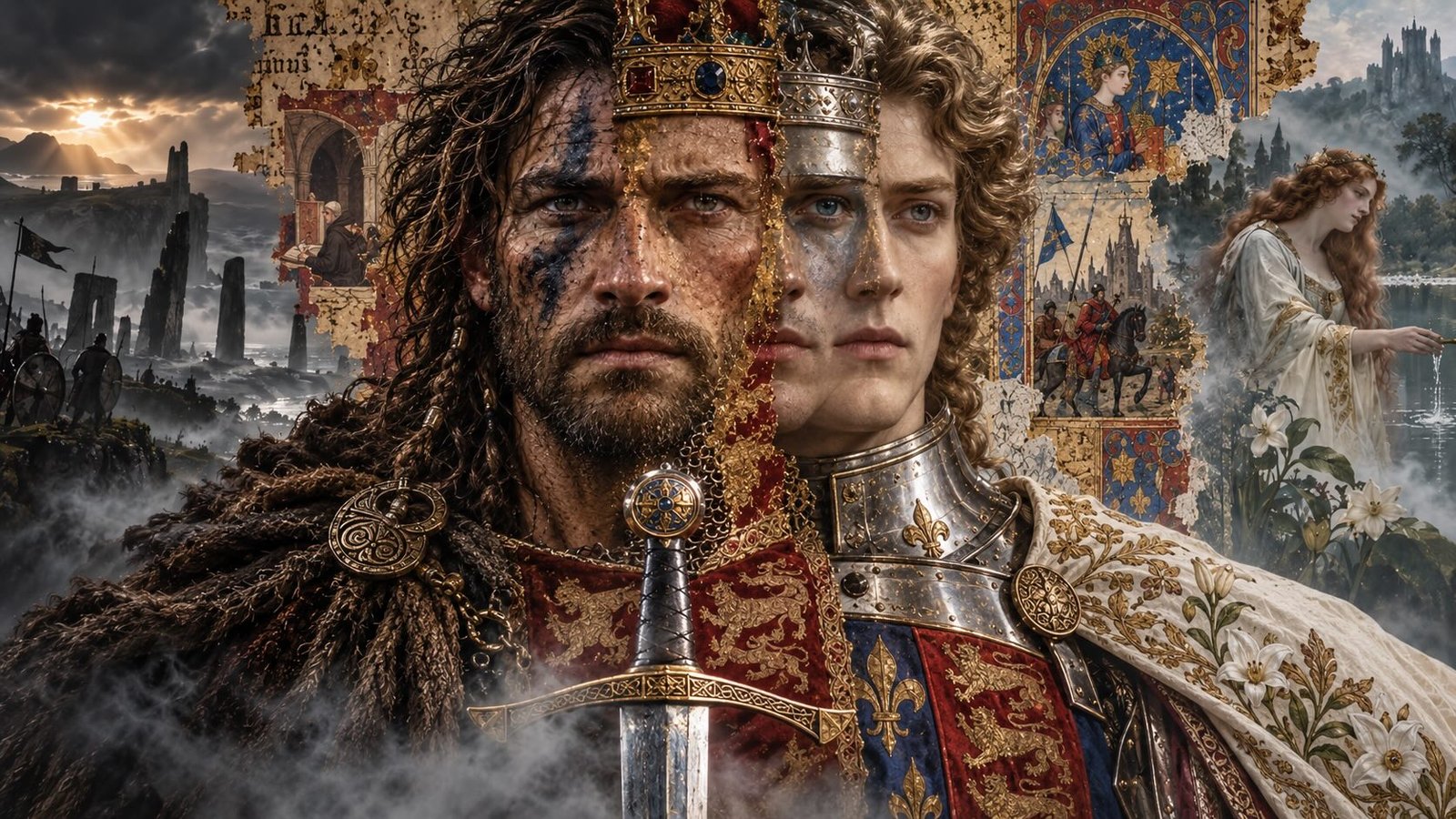
Imagine trying to find the real King Arthur by walking backwards through time. At first, everything looks reassuringly familiar. There is Camelot, the Round Table, Excalibur, Merlin, Guinevere, Lancelot and the Holy Grail. Knights ride around looking noble, ladies gaze meaningfully from towers, and somebody inevitably makes a disastrous romantic decision. Yet the further back you go, the more this familiar world starts to disappear. Victorian Britain loses some of its moral grandeur. Thomas Malory’s great fifteenth-century synthesis begins to break apart. The French romances take Lancelot and the Grail in different directions. Geoffrey of Monmouth’s majestic king becomes less secure. Eventually, even Camelot itself starts to dissolve, until all that remains are fragments of Welsh poetry, heroic legend and chronicle traditions about a formidable warrior called Arthur. So who invented King Arthur? Rather inconveniently, almost everybody did.
The Victorians certainly had a good attempt. By the nineteenth century, medievalism had become enormously fashionable in Britain. Gothic architecture returned, the Pre-Raphaelite painters rediscovered knights and doomed maidens, and writers found in Arthurian legend a perfect stage on which to explore morality, loyalty, sexuality and social order. Alfred, Lord Tennyson transformed the legend through Idylls of the King, where Arthur became less a rough medieval warlord and more a moral ideal presiding over an ambitious but fragile civilisation. The Round Table represented order, fellowship and self-discipline, while its collapse exposed betrayal, desire and human weakness. William Morris, Edward Burne-Jones and other artists did something similar in visual form, creating an Arthurian world of beauty, melancholy and elaborate medieval decoration. Victorian Britain looked into the Middle Ages and, with impressive confidence, found Victorian Britain staring back.
Yet the Victorians inherited much of their Arthur from Sir Thomas Malory. Writing in the fifteenth century, Malory gathered generations of Arthurian stories into Le Morte Darthur, completed around 1469–70 and printed by William Caxton in 1485. Malory did not invent Arthur, Lancelot, Guinevere or the Grail. Instead, he performed something closer to a heroic editorial rescue operation. By his time, Arthurian literature had accumulated for centuries across Britain and continental Europe, with different writers adding new characters, adventures and theological ideas. Malory drew these traditions together and gave them a powerful narrative shape. In his hands, Arthur’s rise, the fellowship of the Round Table, knightly adventure, the Grail quest, Lancelot and Guinevere’s affair, betrayal and final civil war became parts of one vast tragedy. For later English readers, this version became so influential that it often feels like the original story. It was anything but original.
Move backwards another three centuries and Arthur becomes noticeably more French. During the twelfth and thirteenth centuries, writers working in French transformed a British heroic figure into the centre of a sophisticated universe of chivalry, romance and spiritual adventure. Chrétien de Troyes played an especially important role. His works helped develop Lancelot as a major character, gave literary shape to the relationship between Lancelot and Guinevere, and introduced early versions of the Grail tradition.
Other writers expanded this fictional universe even further, adding quests, family connections, rivalries and increasingly complicated ideas about honour and Christian virtue. Wace introduced the Round Table into the written tradition in the twelfth century, while later romances turned Arthur’s court into the glamorous headquarters from which knights could depart towards monsters, mysterious castles, forbidden loves and morally inconvenient adventures. One of the great ironies of Britain’s supposedly national legend is therefore that some of its most recognisable features were developed in France.
Arthur himself sometimes became almost secondary to the world built around him. Lancelot, Gawain, Perceval, Galahad and Tristan could dominate individual stories while Arthur remained at court, presiding over an ever-expanding medieval narrative franchise. The Grail changed too. What may initially have been a mysterious serving object in early romance gradually became one of Christianity’s most potent legendary relics. Courtly love entered the story, creating tensions between loyalty to one’s king and loyalty to one’s beloved. Chivalry became both glamorous and impossible, because the knights repeatedly failed to live up to the ideals the romances celebrated. Long before Malory assembled his great version, Arthurian literature had already become a shared fictional universe in which each writer inherited earlier material and felt perfectly entitled to improve it.
Go backwards again, however, and we meet the man who arguably performed the most important Arthurian transformation of all. Around 1136–38, Geoffrey of Monmouth produced his History of the Kings of Britain, presenting Arthur not merely as a legendary warrior but as one of the great rulers of Britain’s ancient past. Geoffrey gave him something approaching a full biography. Arthur becomes a magnificent king and conqueror, defeating enemies at home and campaigning across Europe. His reign sits within an enormous pseudo-historical narrative tracing Britain’s rulers back into fabulous antiquity. Geoffrey’s book became extraordinarily successful, surviving in more than two hundred manuscripts and influencing writers across medieval Europe. If later generations built Camelot, Geoffrey supplied much of the foundation.
There is a delicious problem, however. Geoffrey presented his work as history. He claimed to have translated an ancient British book given to him by Walter, Archdeacon of Oxford. Unfortunately, nobody has ever managed to locate this extremely useful source. Modern scholars generally regard much of Geoffrey’s narrative as a mixture of earlier traditions, chronicles, folklore and imaginative invention. Even medieval writers sometimes doubted him. William of Newburgh, writing later in the twelfth century, accused Geoffrey of effectively making things up. Yet historical accuracy mattered less than narrative power. Geoffrey gave medieval Europe an Arthur worth remembering: imperial, heroic and grand enough to compete with the legendary rulers of Greece and Rome. His Arthur was already an act of reinvention, but one so successful that later writers treated it as raw material.
And yet Geoffrey did not invent Arthur from nothing. Before his History of the Kings of Britain, Arthur already appears in earlier Welsh and British traditions. The ninth-century Historia Brittonum describes him as a military leader associated with twelve battles against the Saxons. Interestingly, it does not straightforwardly present him as a king. Instead, Arthur appears as a dux bellorum, usually interpreted as a battle leader or military commander. The famous list culminates in the Battle of Badon, where Arthur supposedly kills an extraordinary number of enemies. Whether this preserves a historical memory or heroic exaggeration remains impossible to establish, but it shows that the Arthur tradition existed centuries before Geoffrey.
Earlier Welsh poetry and legend make Arthur stranger still. He inhabits a world populated by heroic companions, monstrous creatures, enchanted landscapes and journeys towards the Otherworld. In Culhwch and Olwen, one of the great medieval Welsh tales, Arthur presides over an extraordinary court of heroes who undertake a bizarre and wonderful sequence of challenges. Other Welsh traditions connect him with supernatural hunts, giant boars and magical geography. A famous early poetic reference praises another warrior by saying that, impressive though he was, “he was no Arthur”. The dating and transmission of some of these texts remain debated, but the underlying point is important: Arthur functioned as a benchmark of heroic greatness before he became Geoffrey’s imperial king or Malory’s tragic monarch.
This raises the unavoidable question: was there originally a real man behind all this? Possibly, although the evidence refuses to cooperate. Britain after the collapse of Roman rule in the fifth century was fragmented, violent and poorly documented. British rulers and war leaders fought against expanding Anglo-Saxon kingdoms, and a successful commander could easily have generated stories that grew through generations of oral transmission. Arthur might therefore preserve the memory of one particularly effective British war leader. Alternatively, several historical figures may have merged into a single legendary personality. It is equally possible that Arthur began mainly as a mythological or folkloric hero and only later acquired historical clothing. The earliest surviving evidence comes too late and mixes plausible warfare with clearly legendary material, making the reconstruction of a “real Arthur” extraordinarily difficult.
That difficulty may actually tell us something more interesting than any archaeological identification ever could. Arthur survived because he was flexible. Welsh storytellers could imagine a supernatural hero. Geoffrey could turn him into a great British monarch. French poets could surround him with courtly knights, forbidden love and spiritual quests. Malory could transform centuries of material into a tragedy about loyalty, ambition and collapse. The Victorians could remake Camelot as a moral civilisation doomed by human weakness. Modern writers, filmmakers and television producers continue the same process, turning Arthur into a historical warlord, fantasy hero, political symbol, tragic husband, reluctant king or occasionally a man wandering around Britain while somebody bangs coconut shells together.
That is why the familiar question “Did King Arthur really exist?” can feel less interesting than it first appears. There may once have been a historical warrior behind the stories. Several different men may also have contributed fragments to the legend, while another possibility is that no single historical Arthur ever existed at all. The surviving evidence cannot settle the matter. What we can trace, however, is something much more visible: the manufacture of a legend across more than a thousand years. Strip away Tennyson and you find Malory. Behind Malory sits the world of French romance. Go further back and Geoffrey appears, followed by the earlier Welsh traditions that preceded him. Keep moving backwards and eventually the documentary record becomes silent.
There is no single King Arthur waiting underneath all those layers. There are Arthurs. Each generation inherited the previous version, kept what it liked, changed what it needed and quietly invented the rest. That is probably why the legend has survived for so long. Arthur never belonged entirely to the sixth century, the twelfth century, the fifteenth century or the nineteenth century. He belongs to whichever age happens to be telling the story. And whenever Britain and Europe needed another King Arthur, somebody obligingly invented him.