Who Were the Huguenots? Faith, Exile and the Price of Intolerance
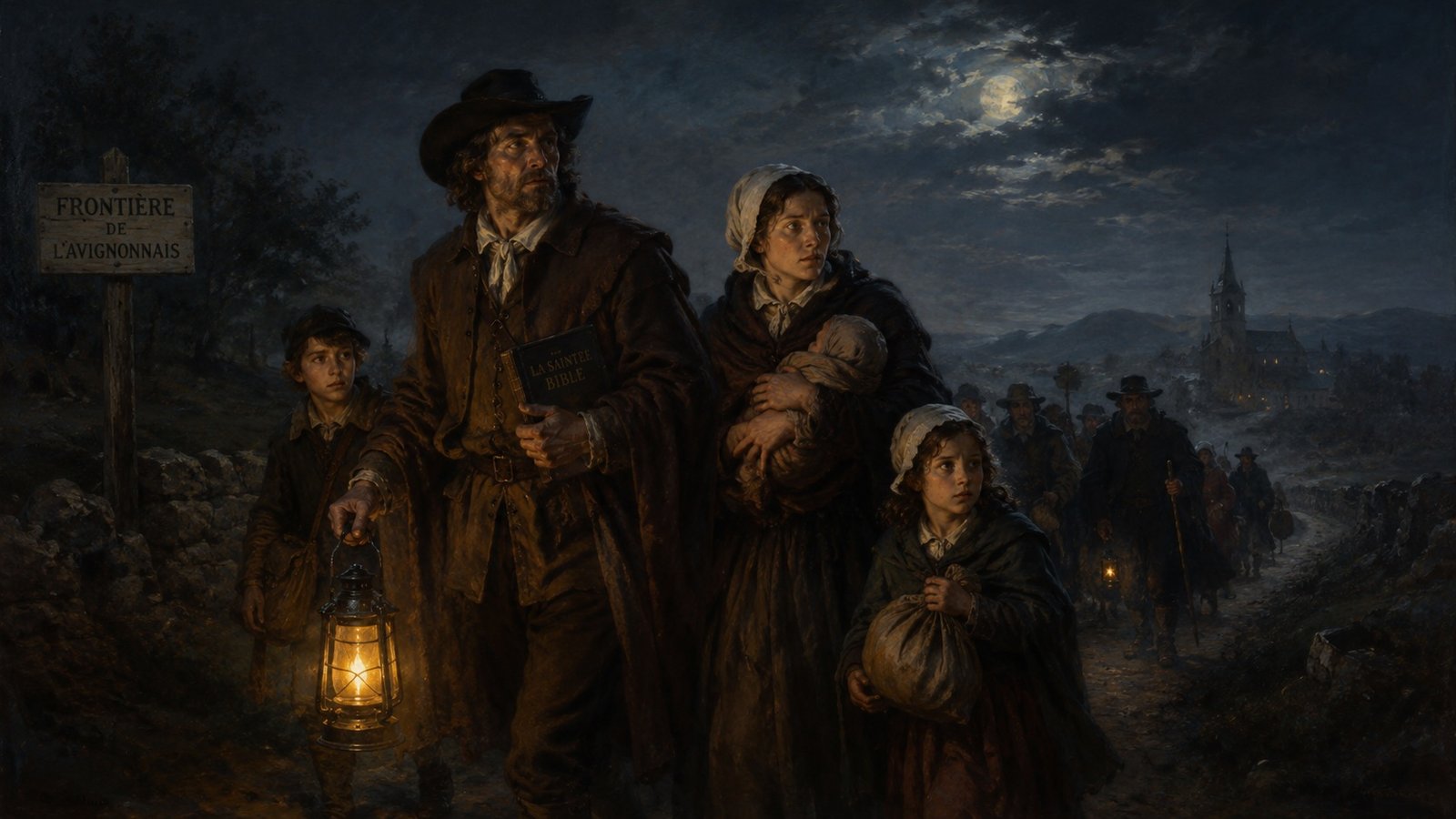
The Huguenots were French Protestants, mainly Calvinists. They became one of the most important minority groups in early modern Europe. This was impressive, because they lived in a kingdom that often treated religious difference like a plumbing leak: annoying, suspicious, and best sealed immediately.
Their story begins during the Reformation. New Protestant ideas moved through France and attracted nobles, merchants, craftsmen, printers, scholars, and ordinary believers. Many thought Rome had grown far too fond of ceremony, hierarchy, and expensive habits. France remained overwhelmingly Catholic. Even so, Protestant communities spread quickly. They frightened the crown, the Church, and ambitious noble families who could smell political opportunity from three provinces away. By the mid-sixteenth century, the Huguenots were no longer just a religious group. They had become a political problem with excellent literacy, strong networks, and a worrying ability to organise.
Nobody fully agrees where the name “Huguenot” came from. That feels appropriate for a group surrounded by myth, propaganda, exile, and family legends involving dramatic escapes in barrels. Some explanations connect the name to Swiss-German words. Others link it to French political slang. A few wander off into the fog with great confidence and very little evidence.
What matters more is what the label came to mean. To Catholic hardliners, it meant heresy, rebellion, and a threat to the sacred unity of France. To the Huguenots, it meant conscience, scripture, discipline, and the right to worship freely. They did not want to be bullied by priests, mobs, magistrates, or monarchs with extremely large wigs.
The trouble turned violent because sixteenth-century France had too many tensions packed into one unstable box. Religion, politics, dynastic insecurity, and noble rivalry all collided. The French Wars of Religion began in 1562. They dragged on, with pauses, betrayals, peace deals, assassinations, and renewed fighting, until 1598.
The Huguenots gained powerful protectors. These included Jeanne d’Albret and her son Henry of Navarre, the future Henry IV. They also faced fierce Catholic opposition, especially from the Guise family and the Catholic League. In theory, everyone wanted peace. In practice, many leaders preferred peace after their enemies had been properly humiliated, ruined, or buried.
The darkest episode came in 1572. It became known as the St Bartholomew’s Day Massacre. What should have been a moment of reconciliation turned into mass killing. The occasion was the marriage of Protestant Henry of Navarre to Margaret of Valois, sister of King Charles IX. The match was meant to calm France. Instead, it helped set the stage for horror.
Admiral Gaspard de Coligny, a leading Huguenot figure, was murdered. Violence then spread through Paris. It soon reached several provincial cities. Estimates vary, but thousands died. The massacre became one of the most infamous episodes in European religious history. It also gave future propagandists exactly the kind of horror story they needed. Depending on one’s side, it proved either Catholic cruelty or Protestant danger.
Henry of Navarre survived the massacre. That was partly because survival in French politics often required flexibility bordering on theatrical genius. He later converted to Catholicism to secure the throne. He became Henry IV.
The famous line “Paris is well worth a Mass” may or may not be his exact wording. Still, it captures the bargain nicely. Faith, power, and practicality sat around the same table, pretending not to know each other. In 1598, Henry issued the Edict of Nantes. It gave the Huguenots substantial rights. These included limited freedom of worship, civil protections, and access to certain fortified places. It did not create modern religious freedom. It did, however, create a workable compromise in a kingdom exhausted by decades of bloodshed.
For a while, the arrangement worked. Of course, “worked” in early modern Europe usually means “people stopped killing each other quite so often”. The Huguenots built communities, ran workshops, traded, printed, farmed, preached, and contributed to French economic life.
Many became associated with skilled crafts. These included silk weaving, watchmaking, printing, metalwork, finance, and fine textiles. They were awkwardly useful talents for a state that would later decide it could do without them.
Yet their political privileges worried royal ministers. Cardinal Richelieu had little patience for semi-independent religious strongholds. After the fall of La Rochelle and the Peace of Alès in 1629, he stripped away much of their military and political autonomy. The crown allowed Protestant worship to survive. However, it made one point very clear. No minority group would be allowed to look like a state within the state.
Then came Louis XIV. He liked unity almost as much as mirrors, ballet, and being obeyed. By the 1680s, French Protestants faced growing pressure to convert. The state used legal restrictions, church closures, intimidation, and the infamous dragonnades. Soldiers were billeted in Protestant homes to make life unbearable. It was persuasion with boots on the furniture.
In 1685, Louis revoked the Edict of Nantes through the Edict of Fontainebleau. Protestant worship became illegal. Pastors had to convert or leave. Ordinary Huguenots were officially forbidden to emigrate. Naturally, many emigrated anyway. When a government bans both your religion and your escape, it has rather helped clarify the agenda.
The scale of the Huguenot diaspora remains debated. Some historians give a figure of more than 400,000 people leaving France after the revocation. Other estimates suggest about 200,000. Roughly 50,000 may have reached England, with about 10,000 moving on to Ireland.
The exact number depends on definitions, periods, and records. Still, the broader point stands. France lost a significant number of skilled, mobile, highly networked people. They went to England, the Dutch Republic, Prussia, Switzerland, Ireland, North America, South Africa, and beyond. Louis XIV wanted a more uniform kingdom. He got one. He also gave several rival countries a rather generous human capital transfer.
In England, the Huguenots became one of the country’s earliest large refugee communities. They settled in London, Canterbury, Norwich, Southampton, and Spitalfields. In Spitalfields, French Protestant silk weavers left a deep mark. They brought skills, trading links, and new surnames that gradually became woven into British life.
Names such as Le Fèvre, Du Bois, Blanc, Martineau, and Courtauld carried traces of exile. Later generations might have sounded perfectly English over breakfast, but the history remained. In London, the French Hospital was founded in 1718 to support Huguenot refugees. That tells us something important. Exile did not end when people crossed the Channel. Refugees still needed money, housing, networks, care, and time to turn survival into belonging.
The Huguenot story also travelled across the Atlantic. French-speaking Protestants and Walloons helped build communities in parts of North America. One example is New Paltz, in what is now New York State. Historic Huguenot Street preserves early stone houses from the settlement.
Modern interpretation there has widened the story. It now recognises that European refugee history sits alongside Indigenous history and the history of enslaved Africans. That matters because refugee stories can become too tidy. Descendants often polish them into heroic family myth. The Huguenots were victims of persecution. Some later became colonists, landholders, traders, and participants in societies with their own injustices. History rarely lets anyone remain permanently in the role of noble sufferer.
A few myths cling to the Huguenots with impressive persistence. One says nearly every elegant French-sounding surname in Britain must be Huguenot. That flatters genealogy websites but annoys historians. Another myth paints them all as prosperous artisans. In reality, many refugees arrived poor, frightened, displaced, and dependent on charity.
A third myth imagines France instantly collapsed after their departure. It did not. France remained powerful, wealthy, and culturally dominant. Still, the exile damaged certain industries and strengthened competitors. The impact showed up in crafts, finance, military service, and commerce. As strategic errors go, persecuting a productive minority and exporting it to your rivals deserves at least a raised eyebrow. Possibly even a small award for self-inflicted inconvenience.
What makes the Huguenots so fascinating is not only persecution. It is portability. They carried faith, skills, recipes, books, commercial habits, family discipline, and a stubborn sense of identity across borders. They adapted quickly, but not invisibly.
Their churches, charities, workshops, and marriages created communities that were both French and not French. They were local and foreign, grateful and quietly determined. In that sense, their story feels strikingly modern. States still argue about minorities, refugees, assimilation, identity, and the economic value of people they sometimes make unwelcome.
The Huguenots remind us of a simple truth. When a country drives out talent in the name of purity, the talent rarely disappears. It simply packs a bag, crosses a border, and improves someone else’s economy.