The London Beer Flood: When Porter Swept Through the Streets
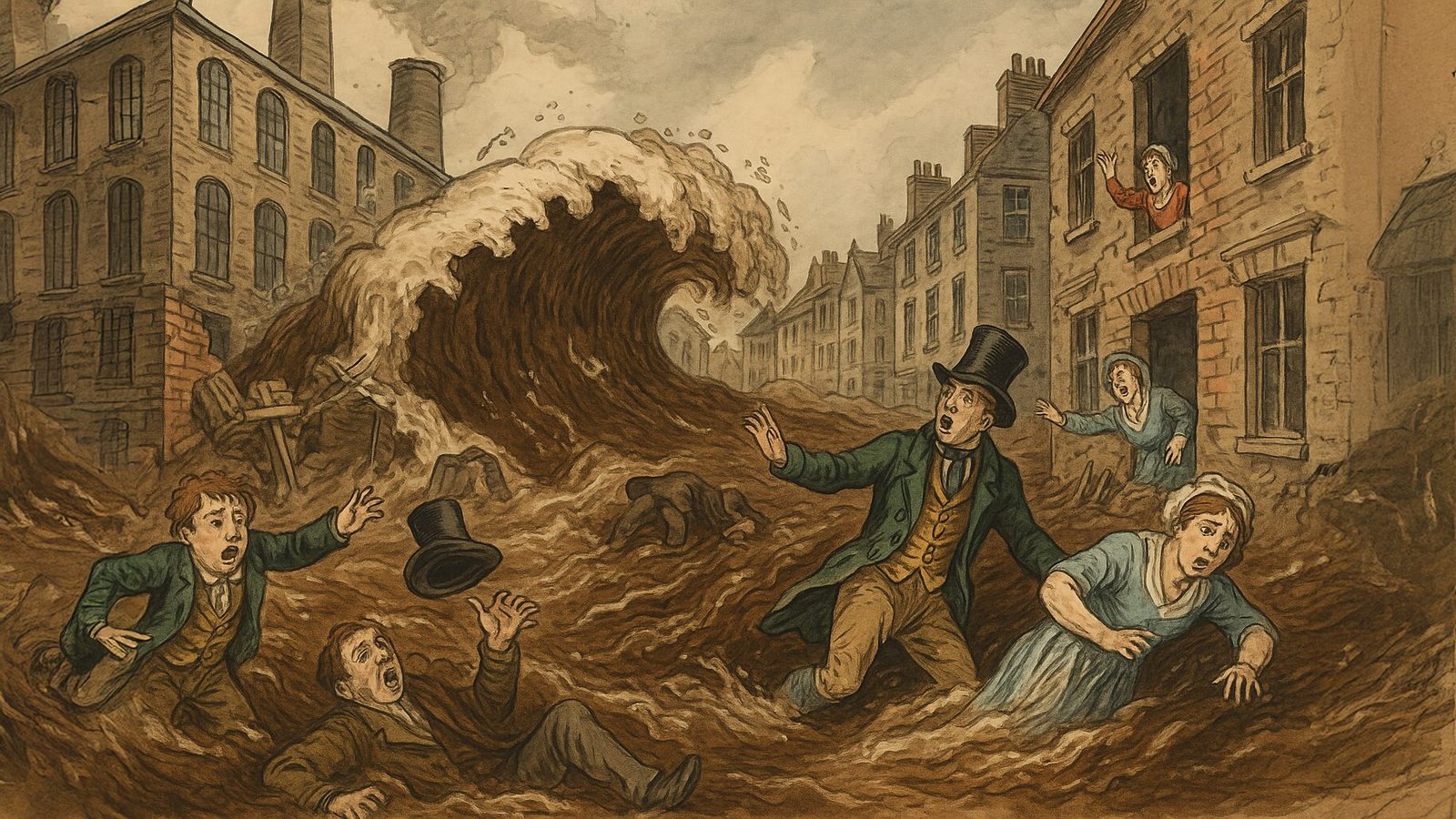
London has endured fires, plagues, riots, bombings and weather that seems personally offended by anyone carrying an umbrella. Yet few disasters sound quite as absurd as the afternoon when a brewery vat burst and sent an enormous flood of porter crashing through the streets. It sounds like a pub anecdote improved by every person who tells it. Unfortunately, the London Beer Flood really happened, and behind the comic name lies a grim story of industrial ambition, urban poverty and eight people who had no chance to escape.
The date was 17 October 1814. Britain was celebrating the defeat of Napoleon and enjoying the early stages of industrial expansion. London’s brewers had also entered a rather masculine competition to see who could construct the largest container of beer. Giant vats impressed visitors, advertised commercial strength and allowed breweries to produce porter on a huge scale. In an age before corporate videos, apparently nothing said “successful enterprise” quite like enough beer to drown a neighbourhood.
One of London’s largest breweries stood beside Tottenham Court Road. Meux and Company’s Horse Shoe Brewery produced porter, the dark beer strongly associated with the city’s working population. Behind its walls stood an enormous wooden vat around 22 feet high, held together by heavy iron hoops. It contained roughly 3,555 barrels of mature porter, amounting to about 128,000 imperial gallons. That was not a large pub cellar. It was a small alcoholic lake held inside timber.
At about half past four that afternoon, storehouse clerk George Crick noticed that one of the vat’s iron hoops had slipped. The hoop reportedly weighed around 700 pounds, which might seem like the sort of detail capable of ruining one’s afternoon. However, hoops had slipped before without causing a catastrophe. Crick informed a superior and received instructions to write a note to one of the brewery’s partners so that repairs could follow later.
Approximately an hour afterwards, the vat burst. The escaping porter struck another vessel, damaged barrels and blew through part of the brewery wall. Estimates of the total volume released vary considerably, ranging from around 128,000 to more than 320,000 imperial gallons. The uncertainty has encouraged increasingly extravagant retellings, but even the lowest figure represents well over half a million litres of beer suddenly moving through a densely populated district.
The liquid surged into St Giles, one of the poorest and most crowded parts of London. This was not the fashionable West End of elegant carriages and beautifully dressed people pretending not to notice poverty. The St Giles rookery contained narrow passages, fragile houses, overcrowded rooms and basement dwellings. Many residents belonged to London’s poor Irish community. The brewery stored its valuable porter behind a strong wall, while families next door lived in structures that could barely resist ordinary rain.
When the wall failed, the porter carried bricks, timber and debris into nearby buildings. The Tavistock Arms suffered serious damage, and 14-year-old servant Eleanor Cooper died beneath the wreckage. Elsewhere, people had gathered in a basement for the wake of a two-year-old boy when the flood entered the room. Several mourners died there. Other victims included young children and women caught inside neighbouring homes.
Official records named eight dead: Eleanor Cooper, Mary Mulvey, Thomas Murry, Hannah Bamfield, Sarah Bates, Ann Saville, Elizabeth Smith and Catherine Butler. Remarkably, nobody working inside the brewery died. Several workers suffered injuries, but the fatal destruction occurred outside, among people who had gained nothing from the brewery’s success except the privilege of living beside its wall.
That imbalance gives the story its real historical weight. A wealthy industrial operation created the danger, while an impoverished community absorbed almost all the human cost. The flood may sound like an eccentric accident, but its victims lived in exactly the kind of neighbourhood where industrial risks could become someone else’s problem.
Later accounts often describe a wave 15 feet high racing through London. Perhaps a towering surge formed close to the ruptured vat, especially as the liquid broke through masonry. However, historians cannot confidently reconstruct a neat, ocean-like wall of porter rolling majestically down the street. The popular phrase “beer tsunami” captures the force and absurdity of the event, but it also encourages cinematic exaggeration.
The reality probably involved a violent rush of liquid, collapsing structures and debris channelled through cramped yards and alleys. In such a tightly packed neighbourhood, even a much lower surge could cause devastating damage. Basement rooms became especially dangerous because residents had little time or space to escape.
Another persistent tale claims that excited Londoners rushed into the streets with pots, buckets and cups, eagerly drinking the free porter. Some versions add that a ninth person later died from alcohol poisoning after consuming too much. Contemporary evidence does not firmly support either story. They appear to have joined the narrative much later, perhaps because audiences prefer a comic disaster populated by cheerful opportunists.
In reality, residents searched through rubble, recovered bodies and tried to rescue trapped neighbours. A lethal industrial accident does not become a street festival merely because the liquid happens to be beer. The image of Londoners happily drinking from the gutters tells us more about later storytellers than it does about the frightened people of St Giles.
The coroner’s inquest heard that hoops had previously slipped from the brewery’s vats without serious consequences. The jury decided that the victims had died “casually, accidentally and by misfortune”. Later writers often summarise this as an “act of God”, although that familiar phrase does not precisely reproduce the recorded verdict.
Either way, the brewery avoided legal responsibility and paid no compensation ordered by the court. The decision reflected the attitudes of an age when industrial accidents often appeared as unfortunate misfortunes rather than preventable failures. Safety standards remained limited, and poor communities had little influence when powerful businesses defended themselves.
Meux and Company nevertheless faced a severe financial shock. The lost beer had already attracted excise duty, while the company also had to repair its buildings and replace equipment. The total loss reportedly reached about £23,000, an enormous amount at the time. After petitioning Parliament, the brewery recovered roughly £7,250 in excise tax, helping it avoid bankruptcy.
The business survived, resumed production and continued operating at the site for more than a century. This creates one of the story’s sharper ironies. The brewery received financial relief, while the bereaved families received no comparable rescue package. Industrial capital recovered more easily than the people living in its shadow.
The Horse Shoe Brewery eventually closed in 1921, and demolition followed. The Dominion Theatre later rose on the site, close to Tottenham Court Road station. Thousands of people now pass through the area carrying coffees, shopping bags and phones, rarely suspecting that an immense reservoir of porter once stood above nearby homes.
The London Beer Flood survives because its title sounds irresistibly funny. A beer tsunami invites cartoons, jokes and images of delighted citizens swimming towards the nearest tankard. Yet the comedy evaporates once we look closely. The disaster exposed a city where industrial scale had advanced faster than safety, legal responsibility or concern for poor neighbours.
That may be the strangest thing about the story. The beer flood feels impossibly eccentric, but the system surrounding it feels painfully familiar. A warning appeared, everyone considered it routine and repairs could wait. The company survived, while local families buried their dead. London did not drown in beer for long, but the pattern behind the flood proved far more difficult to wash away.