
Calvinists are often remembered as the Protestants who looked at the Reformation and thought, “Interesting, but could we make this more disciplined?” That caricature is unfair, of course, but not completely invented. Calvinism, also called the Reformed tradition, grew out of the sixteenth-century Protestant Reformation. It became one of the most influential branches of Protestant Christianity.
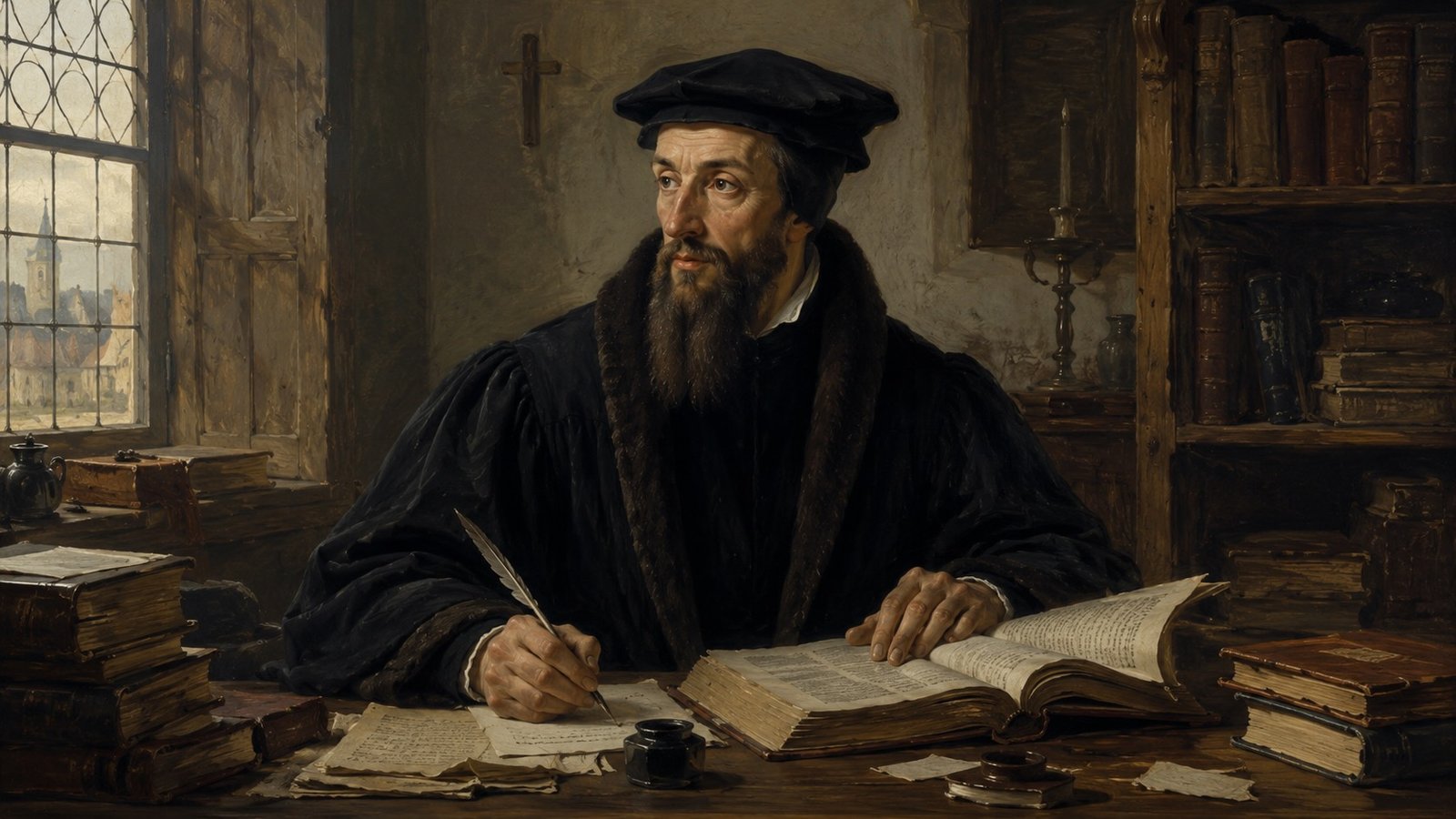
Its influence stretched far beyond church walls. Calvinism shaped politics, education, capitalism, colonial America, Scottish identity, Dutch public life and French religious conflict. It also gave the world centuries of arguments about predestination, which is quite an achievement for a doctrine nobody can explain at a dinner party without frightening someone.
The name comes from John Calvin, although Calvin did not invent the whole movement by himself. Earlier Swiss reformers had already pushed Reformed ideas before him. Huldrych Zwingli led reform in Zürich from 1519. Heinrich Bullinger, Martin Bucer and Peter Martyr Vermigli also helped shape the tradition. Still, Calvin became its most famous organiser, writer and theological heavyweight. That is slightly awkward, because he would probably have hated being treated like a personal brand.
Calvin was born Jean Cauvin in Noyon, France, in 1509. He trained in law and humanist scholarship before becoming one of the great Protestant thinkers of his age. His book, Institutes of the Christian Religion, gave Reformed Protestantism a clear and systematic voice. It explained Christian doctrine with the intensity of a man who did not think theology should wander around in slippers.
For Calvin, God ruled everything. Salvation came by grace, not human effort. Scripture carried authority above church tradition. Worship should avoid anything that looked like decorative nonsense. The result felt bracing, logical and deeply serious. In other words, nobody went to Geneva for the incense.
Geneva became Calvin’s great laboratory. The city had already broken with Catholic authority, but Calvin helped turn it into a disciplined Protestant republic. It had schools, moral supervision, church courts and a reputation for being intellectually dynamic and socially nosy. Geneva printed books, trained ministers and exported Reformed ideas across Europe. It attracted refugees, scholars and reformers. It also made plenty of enemies, because any city that tries to regulate theology, behaviour and public morals will eventually annoy almost everyone.
The central Calvinist idea most people know is predestination. In simple terms, Calvinists argued that God chooses who will be saved. Salvation depends on divine grace rather than human decision, merit or spiritual self-improvement. Critics have often made this sound like a cosmic admissions office with no appeals process. Supporters saw it very differently.
To believers, predestination offered comfort. If salvation rests on God, then faith does not become a spiritual performance review. Nobody has to spend every waking hour measuring their holiness like a nervous accountant checking receipts. Grace, in this view, comes first. Human effort follows, but it does not buy the ticket.
The famous “five points of Calvinism” came later. The tidy TULIP formula stands for total depravity, unconditional election, limited atonement, irresistible grace and perseverance of the saints. It grew out of disputes in the Dutch Reformed world after followers of Jacob Arminius challenged parts of Reformed teaching. The Synod of Dort, held in 1618–1619, responded with the Canons of Dort. Over time, those teachings became closely linked with the five points.
So, no, Calvin did not sit down one afternoon and invent a flower acronym. That would have been far too cheerful.
Calvinism spread because it suited the fears and ambitions of the age. In France, Calvinists became known as Huguenots. They attracted nobles, merchants, printers, artisans and educated urban believers. Unfortunately, they also became trapped in the brutal French Wars of Religion. The St Bartholomew’s Day Massacre of 1572 became one of early modern Europe’s darkest religious bloodbaths.
In Scotland, John Knox helped build a fiercely Reformed church that became Presbyterianism. In the Netherlands, Calvinism became tied to resistance against Spanish Catholic rule. It later helped shape Dutch civic culture. English Puritans carried Reformed ideas into debates over worship, monarchy and church government. Some crossed the Atlantic and brought Calvinist habits to New England, where America inherited town meetings, long sermons and a suspicion that fun might require theological supervision.
One myth says Calvinists hated pleasure. That is too simple. They did not necessarily hate pleasure. They hated disorder, excess and anything that looked as if it might distract people from God. A good meal could pass inspection. Drunken chaos definitely could not.
Calvinists often valued education, literacy, family life, disciplined labour and civic responsibility. They built schools, printed books and encouraged ordinary believers to read Scripture. This gave the movement a powerful democratic edge. Yet its church discipline could also feel less like democracy and more like being monitored by pious neighbours with excellent handwriting.
Another myth says Calvinism created capitalism. This idea owes much to sociologist Max Weber. He argued that Protestant discipline, hard work and anxiety about election helped create a “spirit” of capitalism. The argument still attracts debate.
Calvinists certainly valued work, thrift and responsibility. Reformed societies also developed strong commercial cultures. Yet capitalism had many parents. Trade, banking, empire, urbanisation, legal institutions, technology and plain human appetite for profit all played their parts. Calvinism may have given some people a religious language for disciplined labour. It did not single-handedly invent the invoice.
The greatest controversy around Calvin himself remains Michael Servetus. Servetus was a Spanish thinker and physician who rejected the doctrine of the Trinity and infant baptism. Catholic authorities condemned him in France. When he arrived in Geneva in 1553, the city arrested, tried and executed him for heresy.
Calvin supported action against Servetus, though historians still debate his exact role within Geneva’s civic process. Either way, the episode left a permanent stain. It reminds us that Reformation movements demanding freedom from Rome did not always extend freedom to dissenters in their own cities. Religious liberty, like good plumbing, took time to install properly.
Women also belonged to the Calvinist and Reformed story, although older histories often pushed them politely into the margins. Marie Dentière, a former nun and Reformed writer, argued that women could understand and teach Scripture. That made her controversial even among reformers who considered themselves daring. Marguerite de Navarre protected and encouraged Protestant writers in France. Jeanne de Jussie, a Catholic nun in Geneva, left an eyewitness account from the other side. Her writing shows how reform affected women who did not want to abandon convent life.
Together, these women make the story messier, richer and more human. Calvinism was never only a parade of stern men in black hats.
Today, Calvinism survives in Presbyterian, Reformed, Congregational and some Baptist traditions. Not every church in those families agrees on every point, because Protestants have never treated disagreement as a scarce resource. The World Communion of Reformed Churches represents around 100 million Christians from more than 230 member churches in 109 countries. Calvinism has travelled far beyond Geneva’s narrow streets. It now appears in places Calvin never imagined, from South Korea to South Africa, from Ghana to Brazil, and from Dutch villages to American seminaries with very long doctrinal statements.
Its legacy still provokes mixed reactions. Admirers praise its intellectual seriousness, deep view of grace, respect for Scripture and insistence that faith should shape the whole of life. Critics see rigidity, fatalism, moral surveillance and a theology that sometimes sounds as if God runs the universe like a very selective members’ club.
Both reactions explain why Calvinists remain fascinating. They belong to that rare historical category: people who changed the world not by being charming, but by being organised, convinced and impossible to ignore.