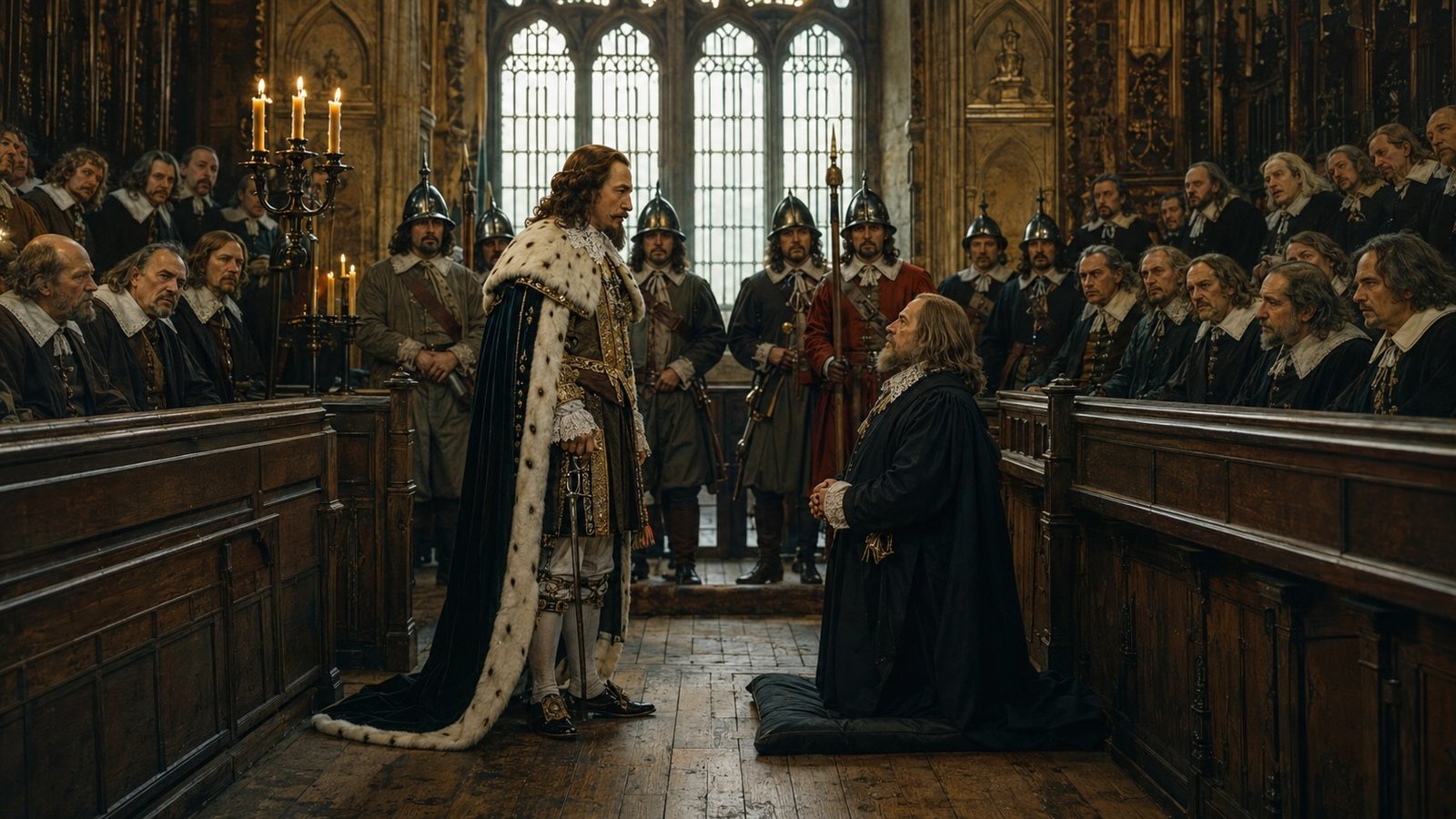
There are institutions that disappear with a bang, and there are institutions that simply stop receiving invitations. The Order of St Patrick belongs firmly to the second category. Created by George III in 1783 as Ireland’s great royal order of chivalry, it once featured princes, dukes, elaborate blue robes, gold harps, heraldic banners and enough diamonds to make discretion seem almost offensive. Today it has no knights at all, yet nobody has actually abolished it.
That peculiar survival tells us rather a lot about the world that created it. In the eighteenth century, monarchies understood something that modern corporations still practise enthusiastically: when an organisation has political problems, create an exclusive membership programme. England had the Order of the Garter, Scotland had the Order of the Thistle, and Ireland therefore received the Most Illustrious Order of Saint Patrick.
The timing was hardly accidental. Ireland had just secured greater legislative independence following the constitutional changes of 1782. The Irish Parliament in Dublin enjoyed new authority, while the Protestant aristocracy that dominated political life expected recognition of its importance. Britain wanted loyalty, the Irish establishment wanted status, and George III supplied medals, robes and ceremonies.
Membership was initially limited to the sovereign and fifteen knights, almost all drawn from the highest levels of the Anglo-Irish aristocracy. The number later rose to twenty-two. Unlike modern honours, this was not recognition for running a brilliant charity, performing heart surgery or quietly improving local libraries. You generally needed the useful preliminary qualification of being extremely grand already.
The Order even came with a wonderfully political motto: Quis separabit? — “Who shall separate us?” The phrase comes from St Paul’s Epistle to the Romans, but placing it on an Irish royal order in 1783 gave it another meaning altogether. Britain and Ireland had spent years discussing precisely how much separation they wanted, while the Crown responded by embroidering the question onto ceremonial objects and hoping everyone would admire the workmanship.
Then there was the colour. Anyone imagining ranks of Irish knights dressed predictably in green would be disappointed, because the Order used a pale celestial blue that became popularly known as St Patrick’s blue. This sometimes generates the myth that green had nothing to do with Ireland until relatively recently, but reality behaves less neatly.
Green already carried Irish associations, particularly through political movements, while blue also had a much older place in Irish heraldry. The Order helped strengthen the connection between St Patrick and blue rather than inventing Ireland’s relationship with the colour from nothing. Even today, the Irish presidential standard features a golden harp on a blue field, a reminder that Irish symbolism has always contained rather more colours than souvenir shops suggest.
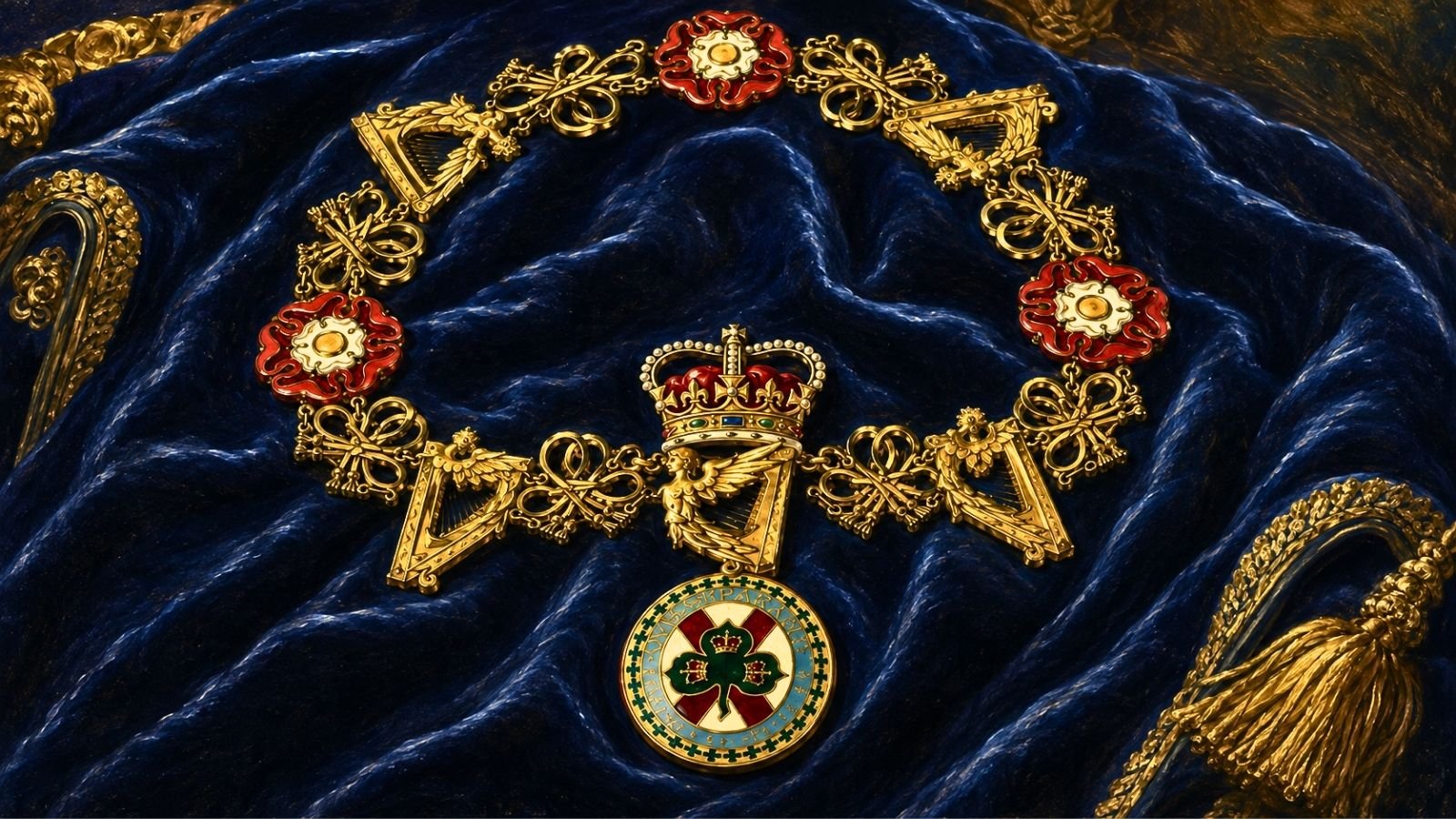
The knights themselves looked magnificent. On major ceremonial occasions they wore celestial-blue mantles lined with white silk, while their gold collars combined Tudor roses, harps and decorative knots. A crowned harp supported the badge, and the star of the Order featured the cross associated with St Patrick and shamrocks. One suspects nobody ever looked at a Knight of St Patrick entering a room and wondered whether he had dressed up enough.
St Patrick’s Cathedral in Dublin became the Order’s chapel. Each knight received a stall adorned with his heraldic devices, while helmets, crests and banners rose above the choir. The result transformed worship into something resembling a medieval corporate directory for exceptionally wealthy people. The surviving banners still offer one of Dublin’s more curious encounters with Ireland’s British past.
The Order also became closely associated with St Patrick’s Hall in Dublin Castle. That creates an exquisite historical reversal because the hall now hosts the inauguration of presidents of Ireland. A room once associated with the ceremonial power of the British Crown now helps install the head of an independent Irish republic. Buildings, unlike politicians, can survive a complete change of ideology simply by keeping the roof in reasonable condition.
However, no story about the Order can compete with what happened in July 1907. The so-called Irish Crown Jewels disappeared from Dublin Castle, creating one of the great unsolved mysteries of modern Irish history. Their name encourages another myth because they were not a separate Irish equivalent of the Crown Jewels kept in the Tower of London. They were ceremonial insignia associated with the Order of St Patrick and worn by its Grand Master, the Lord Lieutenant of Ireland.
Still, calling them jewellery hardly does them justice. The insignia contained 394 precious stones, mostly diamonds but also rubies and emeralds. Some had reportedly come from jewellery belonging to Queen Charlotte, while five gold collars belonging to knights of the Order disappeared as well. The collection represented both enormous financial value and considerable symbolic importance.
The timing could scarcely have been worse. King Edward VII was due in Dublin only days later, and the regalia were supposed to feature in a ceremony admitting a new knight. Instead, officials discovered an empty jewel case. Even better, from the perspective of anyone who enjoys historical incompetence from a safe distance, the jewels vanished from Dublin Castle, the centre of British administration in Ireland.
They had been kept in the Office of Arms in Bedford Tower. The safe showed no dramatic signs of being forced and was reportedly found closed but unlocked. Sir Arthur Vicars, the Ulster King of Arms responsible for the jewels, became the obvious victim of the scandal and eventually lost his position. Investigations produced accusations, rumours and theories involving insiders, aristocratic social circles and possible cover-ups, but none solved the central problem.
The Irish Crown Jewels have never been recovered. Perhaps thieves dismantled them and sold the stones, or perhaps someone concealed them. Stories have occasionally claimed that they disappeared into private collections or became entangled in embarrassing scandals involving prominent figures. Evidence for the more sensational theories remains thin, yet the mystery survives largely because the mundane explanation has never become sufficiently convincing to kill the exciting ones.
Political events soon made missing diamonds the least of the Order’s difficulties. The Easter Rising came in 1916, the War of Independence followed, and in 1922 the Irish Free State emerged while Northern Ireland remained within the United Kingdom. Suddenly an order created to represent the Crown’s relationship with Ireland faced a rather fundamental branding problem. Its entire political context had changed.
Regular appointments effectively ceased after the establishment of the Free State. A few members of the Royal Family joined later, with the final appointments occurring in 1936. Prince Henry, Duke of Gloucester, eventually became the last surviving Knight of St Patrick. When he died in 1974, the Order had no knights left, yet it still did not technically disappear.
The Royal Family continues to list the Order of St Patrick as dormant, and it retains its remarkably senior position among British orders of chivalry. It ranks behind the Garter and the Thistle but ahead of the Order of the Bath. Even the heraldic machinery has left a faint pulse because the Norroy and Ulster King of Arms still nominally holds offices connected with the Order. In practice, those functions mean very little because there are no knights to serve.
Could King Charles III revive it? In constitutional theory, the possibility has never entirely vanished, although political reality makes the idea considerably more entertaining. Revive it as an Irish order and the obvious question becomes what business the British Crown has creating an Irish national honour in the twenty-first century. Make it specifically Northern Irish and its symbolism changes completely.
Another possibility would be to reinvent it as some ingenious British-Irish order of reconciliation. That would require both governments to navigate several centuries of history while deciding who gets the nicest sash. Dormancy suddenly looks very sensible. Sometimes the most successful constitutional solution is simply to leave an awkward institution quietly in the cupboard.
And perhaps that is why the Order of St Patrick remains more interesting than an institution that survived normally. It encapsulates the vanished Anglo-Irish establishment that once governed from Dublin Castle, while its symbols have wandered into completely different political worlds. Its blue still echoes through Irish heraldry, its banners remain in Dublin, its ceremonial hall now welcomes Irish presidents, and its jewels are still missing. Most remarkably, the Order itself continues to exist without actually doing anything.
After more than two centuries of revolutions, independence, partition and political transformation, nobody has quite finished it off. For an institution whose motto asks “Who shall separate us?”, that feels almost suspiciously appropriate.