
Sinbad the Sailor may be literature’s greatest argument against the idea that people learn from experience. He boards a ship, nearly dies, loses everything, survives by a combination of intelligence and outrageous luck, comes home enormously rich and decides that the sensible thing would be to do it all again. Then again. And again. By the seventh voyage, even the reader wants to confiscate his passport.
Yet the familiar Sinbad of childhood books and films hides a much more interesting character. He was not really a swashbuckling captain, and certainly not the pirate that modern cinema occasionally turns him into. In the Arabic stories, Sinbad is essentially a merchant who travels with his goods. Some scholars point out that the Arabic word describing him could mean someone who travelled by sea rather than specifically a professional sailor. In other words, our heroic adventurer begins to look suspiciously like an Abbasid businessman with an unusually catastrophic logistics department.
Even his membership of The Thousand and One Nights is less straightforward than popular culture suggests. The Nights never existed as one definitive ancient book whose contents someone simply translated. Stories accumulated, disappeared, changed and reappeared across centuries. The earliest physical evidence for the collection dates to the early ninth century, while the earliest substantial surviving manuscript comes much later. Sinbad’s voyages do not appear in that old fourteenth-century manuscript and seem to have circulated as a separate cycle before becoming attached to the Nights tradition.
European readers helped make the marriage permanent. Antoine Galland began publishing his hugely influential French version of The Thousand and One Nights in 1704. His translation turned the collection into a European sensation and included Sinbad. English translations followed almost immediately. By the eighteenth century, Sinbad had effectively acquired permanent residency in Scheherazade’s literary universe, whether medieval manuscript history entirely approved or not.
The stories place Sinbad in Baghdad during the reign of Caliph Harun al-Rashid, who ruled from 786 to 809. However, his voyages begin from Basra, the great southern Iraqi port that connected the Abbasid world with the Persian Gulf and the Indian Ocean. Here fantasy suddenly bumps into remarkably solid history.
Ships really did travel from the Gulf across an enormous maritime trading system linking Iraq and Persia with India, Sri Lanka, Southeast Asia and China. Archaeology has supplied spectacular evidence. A ninth-century vessel wrecked near Belitung in modern Indonesia carried around 60,000 objects, including large quantities of Chinese ceramics, apparently heading west towards the Middle East. Excavations at Siraf on the Persian Gulf have likewise revealed the scale of long-distance trade. Sinbad’s geography may contain monsters, but the commercial world beneath them certainly existed.
That changes the way his adventures feel. Sinbad does not inhabit some vague fairy-tale “East”. He belongs to an era of astonishing globalisation long before anyone invented the word. Merchants crossed thousands of miles of dangerous water in search of porcelain, spices, precious stones, ivory, timber and other valuable goods. Information travelled with them, although its reliability presumably declined with every tavern in which the story got retold.
Sinbad’s first voyage demonstrates the problem rather efficiently. His ship stops beside what everyone assumes is an island. The passengers disembark, light fires and start preparing food. Unfortunately, their pleasant picnic spot turns out to be a gigantic sea creature. It wakes up, dives beneath the waves and produces the medieval equivalent of a very negative TripAdvisor review.
The episode sounds ridiculous, yet it captures something genuine about early maritime travel. Sailors entered waters poorly mapped by the standards of later centuries. Whales and other enormous marine animals easily generated stories. Add exhaustion, fear and several generations of enthusiastic storytellers, and a large creature becomes an island without requiring much administrative paperwork.
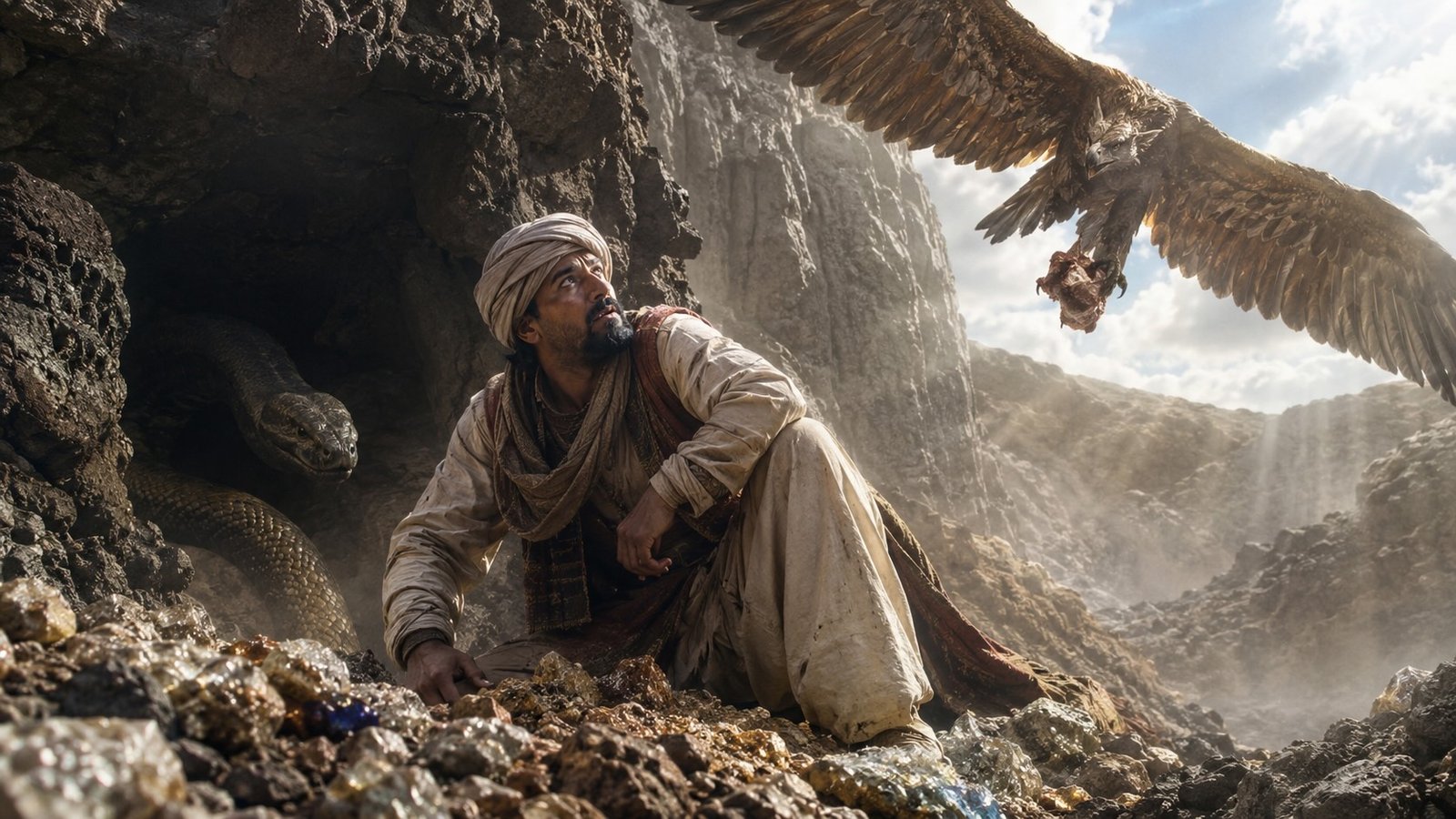
Then there is the roc, the colossal bird that becomes one of Sinbad’s most famous companions in disaster. On his second voyage, Sinbad encounters an enormous white object that turns out to be a roc’s egg. He eventually ties himself to the bird and gets carried away. This might sound like the least advisable aviation strategy ever devised, but it works.
Stories about enormous birds circulated widely through Middle Eastern and Asian geographical literature. Madagascar’s extinct elephant birds have sometimes been suggested as inspiration for roc legends, although nobody can demonstrate a neat historical line from one to the other. The safer explanation involves something more interesting anyway: real animals, travellers’ reports and imagination gradually merging into folklore.
The roc deposits Sinbad in the legendary Valley of Diamonds. Here gemstones lie everywhere, which initially sounds rather fortunate. Unfortunately, enormous snakes also live there. Merchants therefore use an ingenious method. They throw chunks of meat into the valley so diamonds stick to them. Birds carry the meat upwards, where traders frighten them away and collect the stones.
Sinbad attaches himself to the system and escapes with both his life and a fortune. The meat-and-diamonds idea did not originate solely with his tale. Variations appear elsewhere in older geographical and legendary traditions. Medieval audiences apparently enjoyed supply chains with considerably more birds of prey than modern procurement departments usually tolerate.
His third voyage gives us a one-eyed giant who eats members of the crew. The resemblance to Homer’s Cyclops has encouraged plenty of speculation about connections with the Odyssey. Similar motifs can travel astonishing distances through oral storytelling, translation and literary borrowing. Scholars have consequently found possible echoes of Greek, Persian, Indian, Mesopotamian and other traditions within the Sinbad cycle. Proving direct descent, however, remains much harder than noticing resemblance.
The fifth voyage produces perhaps the best character of all: the Old Man of the Sea. Sinbad encounters a seemingly helpless old fellow who asks to be carried across a stream. Being unusually charitable for about thirty seconds, Sinbad agrees. The old man climbs onto his shoulders, wraps his legs tightly around Sinbad’s neck and refuses to get off.
Sinbad now has to carry him everywhere. Eventually he ferments grape juice, gets his passenger drunk and kills or escapes from him, depending on the version. The story proved so memorable that “Old Man of the Sea” became an English expression for a burden that clings to someone and cannot easily be removed. Anyone who has ever agreed to “just help briefly” with a corporate project may recognise the creature immediately.
Behind the monsters sits another recurring theme: money. Sinbad becomes rich, loses wealth, acquires more wealth, trades, bargains and evaluates opportunities. His journeys repeatedly transform geographical danger into financial reward. The tales may therefore preserve something of the psychology of medieval long-distance commerce. Extraordinary profits existed precisely because extraordinary risks existed.
The framing story makes that economic dimension impossible to ignore. A poor porter rests outside the wealthy Sinbad’s magnificent Baghdad house and complains about the unfairness of life. Rich Sinbad hears him and invites him inside. Rather than merely giving him money, he explains how he obtained his fortune by recounting the seven voyages.
It is both generous and slightly insufferable. Imagine complaining about inequality outside a billionaire’s mansion and being invited in for a seven-night PowerPoint presentation entitled “My Journey”.
Still, Sinbad rewards the porter after each story, which softens the performance considerably. His message is also more complicated than simple self-congratulation. Wealth, he suggests, came alongside terror, suffering and repeated proximity to death. Whether that constitutes a convincing theory of social justice is another question entirely.
Modern adaptations usually simplify him. Hollywood particularly likes turning Sinbad into a muscular swordsman, pirate or romantic adventurer. The spectacular stop-motion creatures created by Ray Harryhausen for films such as The 7th Voyage of Sinbad helped cement this version in twentieth-century imagination. The merchant gradually disappeared behind the hero.
That is a pity, because the merchant makes the character more human. Sinbad is greedy enough to leave comfort, frightened enough to regret it and resourceful enough to survive. Each time he returns to Baghdad, prosperity convinces him that travelling was worth the risk. Then prosperity becomes boring, curiosity returns and the harbour starts looking attractive again.
Perhaps that is the real reason Sinbad has survived for centuries. The roc and the giant snakes provide excellent decoration, but underneath them sits an instinct we still recognise perfectly well. Humans complain about uncertainty, dream about security and become restless almost immediately after achieving it.
Sinbad simply takes the habit further than most. Seven voyages further.