You spit into a small plastic tube, put it in the post and wait for science to inspect several hundred years of family history. A few weeks later, your computer may announce that you are 42% English, 21% Eastern European, 14% Scandinavian and, rather intriguingly, 2% something nobody at Christmas dinner has ever mentioned. At this point, either your family tree becomes more interesting or somebody starts asking uncomfortable questions about great-grandmother. DNA ethnicity estimates certainly look impressively precise.
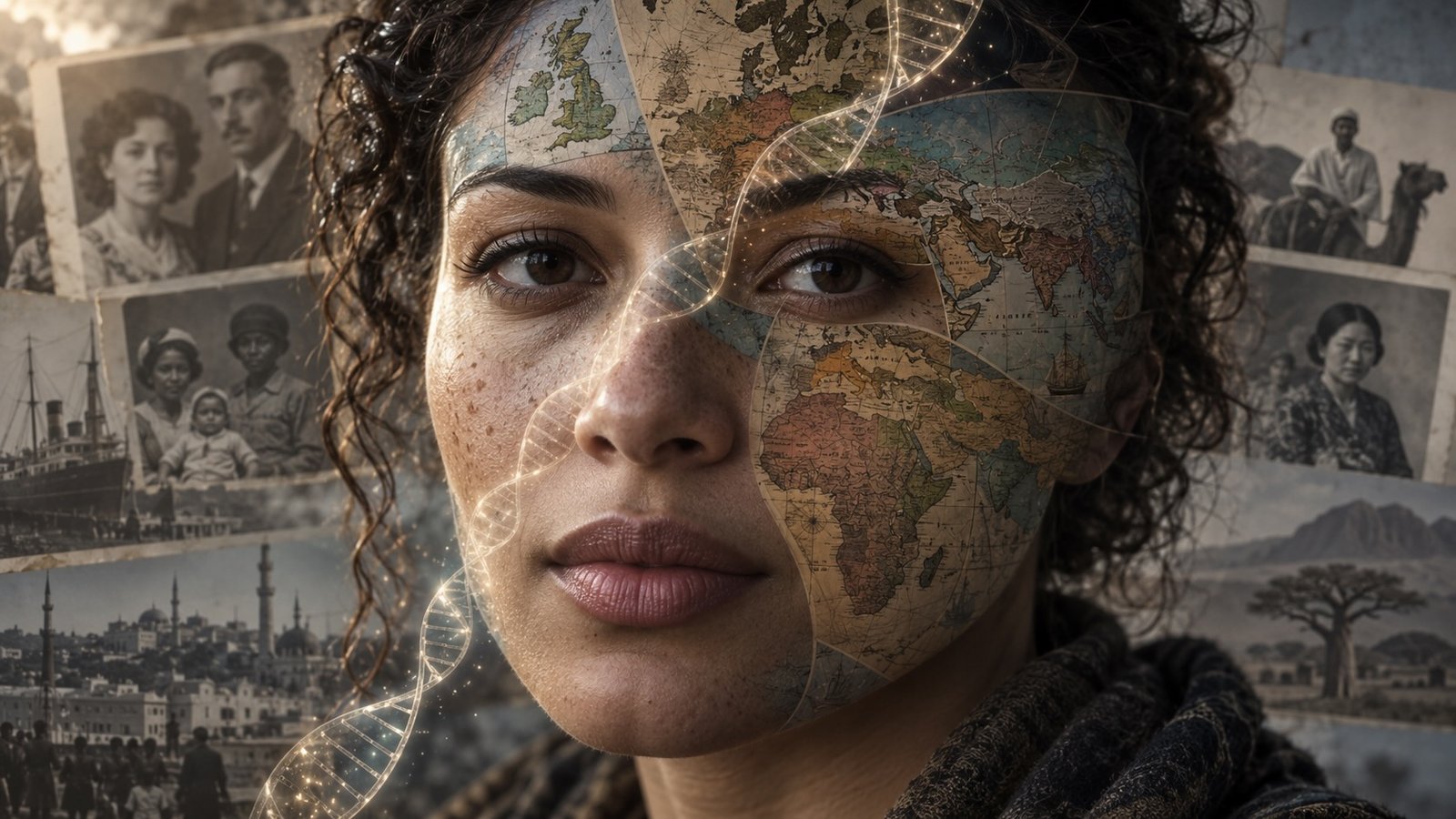
After all, 17.4% sounds much more scientific than “probably somewhere around Northern Europe”. Yet that decimal point can create a misleading impression. The DNA test itself measures real genetic variations very accurately, but turning those variations into ethnic labels requires statistics, reference populations and assumptions. In other words, the DNA is real; the ethnicity percentage is an interpretation.
Most consumer ancestry tests examine hundreds of thousands of genetic markers called SNPs, points where human DNA commonly varies. AncestryDNA says it measures around 700,000 locations, while companies such as 23andMe divide chromosomes into sections and compare them with DNA from reference populations. If one stretch resembles people in a British and Irish reference group more closely than other groups, the algorithm may classify it accordingly.
However, your DNA does not contain labels saying “Irish”, “Italian” or “Polish”. National borders belong to politics and history, not chromosomes. Populations also moved around long before passports appeared. Romans crossed Europe, Vikings travelled enthusiastically in almost every direction, merchants married locals, armies settled down and ordinary people moved whenever food, work or an attractive neighbour provided sufficient motivation.
That creates an obvious problem. The genetics of neighbouring populations often overlap. Someone from northern France may genetically resemble people in southern England or Belgium, while populations around Germany, Denmark and the Netherlands have mixed for centuries. Eastern Europe creates similar difficulties because borders changed repeatedly while people remained inconveniently alive on both sides of them.
Testing companies therefore build reference panels. They look for people whose recent ancestors came from particular areas, establish patterns commonly found within those groups and compare customers against them. 23andMe currently uses dozens of regional reference populations and then adds finer country matches and genetic groups. Ancestry operates an even more geographically detailed system, while MyHeritage says its current ancestry results draw on more than two thousand geographic regions.
Consequently, two companies can analyse exactly the same person and produce different answers. One might call a section “British and Irish”; another might place it under Northwestern Europe. A third could detect Scandinavian similarity. None necessarily made a laboratory mistake. They simply asked different statistical questions using different comparison groups.
Results can also change without your DNA changing at all. Companies periodically enlarge their databases and revise their algorithms. You might therefore go to bed 12% Scottish and wake up 7% Scottish without anyone in Scotland having done anything remotely suspicious overnight. The updated model simply interpreted the same genetic information differently.
Broad percentages generally deserve more confidence than tiny ones. If several companies consistently identify a large proportion of your ancestry with the same broad region, that probably reflects something substantial in your genealogy. A mysterious 1% or 2%, however, deserves restraint. It might represent distant ancestry, statistical uncertainty or overlap between neighbouring populations.
This leads to one of the popular myths surrounding ethnicity tests: that a result can identify precisely where every ancestor came from. It cannot. Genetic ancestry and a genealogical family tree are different things because inheritance involves considerable randomness.
You receive roughly half your autosomal DNA from each parent, roughly a quarter from each grandparent on average, and progressively smaller portions from earlier generations. However, recombination continually shuffles those pieces. Go far enough back and you can have a genuine genealogical ancestor from whom you inherited no identifiable DNA at all.
That means a result showing no detectable ancestry from a particular region does not necessarily prove that nobody in your family came from there. Equally, discovering a small regional component does not automatically tell you which ancestor supplied it. DNA gives clues rather than issuing certificates.
Ironically, the glamorous ethnicity pie chart may not even be the most useful part of the service. Relative matching often provides stronger evidence. If your DNA shares substantial segments with another customer, algorithms can estimate whether that person might be a second cousin, third cousin or another biological relative. Add birth certificates, census records, parish registers and immigration documents, and the exercise becomes proper genealogical detective work.
Sometimes the detective work produces rather more plot than expected. Consumer DNA testing has revealed unknown siblings, mistaken paternity, adoption, donor conception and entire family branches that had remained comfortably undiscovered for decades. The family story that “Grandfather came from France” can turn out to be correct, completely wrong or correct for reasons nobody anticipated.
For someone in Britain who wants an ethnicity estimate, obtaining one is easy. AncestryDNA, MyHeritage and 23andMe are among the major consumer options. You order the kit online, register it to your account, collect saliva or a cheek sample according to the provider’s instructions and return it to the laboratory. The ancestry report then appears online after processing.
Prices move frequently because DNA kits seem to spend almost as much time on sale as sofas. As of September 2026, 23andMe lists its UK Ancestry Service at £89. MyHeritage is advertising a considerably discounted UK DNA kit at £29 against a usual £79 price, although offers and subscription bundles change. Therefore, checking the total price, postage and any optional subscription before buying makes sense.
Choosing a service depends on what you actually want. If the main ambition involves building a family tree and finding relatives, the size and geographical strength of the matching database matter enormously. If you mainly want an attractive ancestry breakdown, compare the geographic regions each provider currently covers. Serious genealogy may eventually justify testing close relatives too, because a parent or older relative carries DNA that you did not inherit.
Before posting your saliva, though, there is another issue considerably less entertaining than discovering a Viking ancestor: privacy. Genetic information cannot be changed like a compromised password, and your DNA also reveals information about biological relatives who never signed up for anything.
The risks became painfully concrete after the 23andMe cyberattack. In June 2025, Britain’s Information Commissioner fined the company £2.31 million after finding that it had failed to implement appropriate security measures. Personal information associated with 155,592 UK residents became exposed in the 2023 incident. The episode provided a useful reminder that a genealogy website may hold something rather more permanent than your grandmother’s maiden name.
That should not automatically stop anyone from taking an ancestry test. It should encourage reading the privacy settings first. Check whether DNA-relative matching is optional, whether research participation requires separate consent, how long the physical sample remains stored, whether you can download your raw data and what happens if you later ask the company to delete your account and sample.
Ultimately, a DNA ethnicity estimate is neither nonsense nor an ancestral oracle. It sits somewhere much more interesting in between. Modern genetics can detect genuine population patterns and biological relationships, while statistical models translate those patterns into geographical categories humans can understand.
Treat “37% Irish” as evidence rather than identity, and the technology becomes much more useful. Combine DNA with documents, family stories and historical context, and you can reconstruct parts of your past with remarkable detail. Just avoid ordering the Viking helmet until that Scandinavian 2% survives the next software update.