Madagascar looks like evolution received an island, several million years and absolutely no adult supervision. Lemurs sing across rainforests, chameleons shrink to the size of a fingernail, and trees store water inside trunks shaped like enormous bottles. Meanwhile, a cat-like predator called the fossa hunts through the canopy with the confidence of an animal that has never read a zoology textbook. Almost everything appears familiar, yet slightly rearranged.
However, evolution did not really break its rules here. It followed them with almost theatrical enthusiasm. Isolation, chance, competition and adaptation worked together for millions of years. The result became one of Earth’s strangest biological experiments, conducted on an island larger than France and separated from mainland Africa by more than 400 kilometres of ocean.
Madagascar began separating from Africa roughly 160 million years ago. Later, it broke away from India and remained isolated for around 88 million years. That sounds as though its modern wildlife simply stayed behind when the continents separated. Unfortunately, the timeline refuses to cooperate. Lemurs, rodents, tenrecs and carnivores evolved after Madagascar had already become an island. Their ancestors therefore had to cross the sea.
The leading explanation involves natural rafts. Storms and floods probably tore mats of vegetation from African riverbanks, carrying small groups of animals into the Mozambique Channel. Ancient ocean currents flowed towards Madagascar more favourably than they do today, making these highly improbable journeys slightly less absurd. A few exhausted survivors reached land, reproduced and founded entire branches of Malagasy life. Evolutionary history occasionally depends on what resembles a very badly organised cruise.
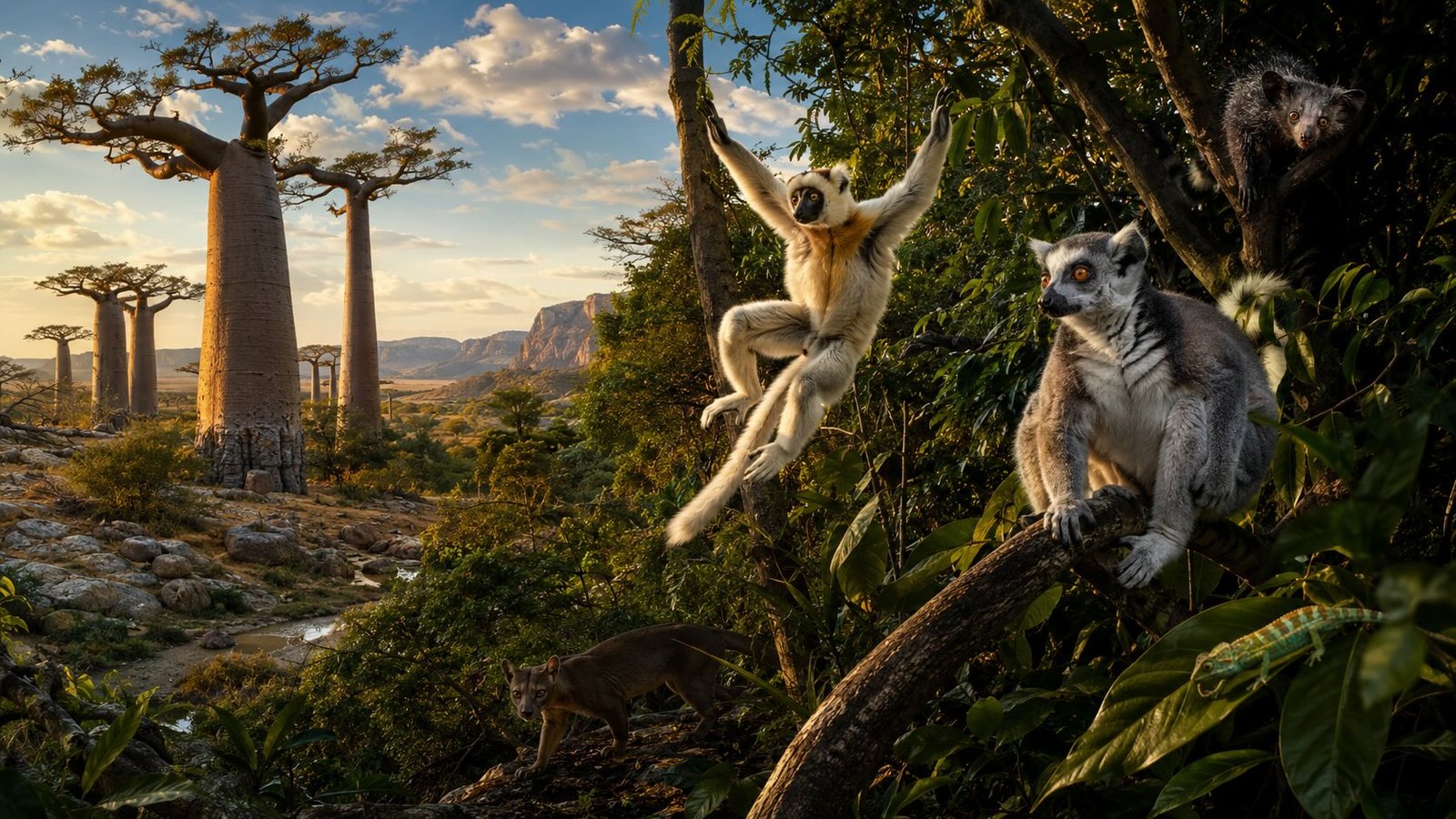
Lemurs offer the most famous example. Their distant ancestors probably reached Madagascar tens of millions of years ago. With monkeys and apes absent, they expanded into ecological roles that primates elsewhere could not occupy. Some became leaf eaters, others specialised in fruit, bamboo, insects or tree sap. Sifakas developed powerful legs for leaping between trunks. Ring-tailed lemurs adapted to dry southern habitats and spend unusual amounts of time on the ground.
The aye-aye took a more eccentric route. This nocturnal lemur has huge ears, continuously growing teeth and an extremely long middle finger. It taps branches, listens for hollow chambers, gnaws through the wood and hooks out insect larvae. In effect, it performs the job of a woodpecker without bothering to become a bird. Researchers have also documented an aye-aye inserting that eight-centimetre finger deeply into its nose, proving that natural selection can produce astonishing engineering without improving table manners.
Tenrecs provide another evolutionary practical joke. They form a family of mostly Malagasy mammals whose ancestors also came from Africa. Some resemble shrews, others look like hedgehogs, moles, mice or miniature otters. These similarities do not make them close relatives of those animals. Instead, different species developed comparable solutions to comparable problems, a process called convergent evolution. Madagascar essentially produced its own alternative collection of familiar mammals.
Even the island’s chief predator defies first impressions. The fossa resembles a stretched, athletic cat crossed with a mongoose, but it belongs to Madagascar’s own carnivore lineage. Genetic evidence suggests that all native Malagasy carnivores descended from one African ancestor. From that single colonising population came fossas, falanoucs and several species commonly called Malagasy mongooses. One ocean crossing generated an entire local predator guild.
Madagascar’s evolutionary extravagance extends far beyond mammals. The island supports hundreds of reptile and amphibian species, including a remarkable variety of chameleons. Some dwarf chameleons rank among the smallest reptiles known. At the opposite end of the design department, baobabs dominate western landscapes with swollen trunks and sparse crowns. Six of the world’s eight recognised baobab species occur naturally only in Madagascar.
Plants may receive less publicity than lemurs, but they tell an equally dramatic story. Scientists have described more than 11,500 native vascular plant species, about 82 per cent of which occur nowhere else. Madagascar also contains roughly 1,000 orchid species, with around 90 per cent considered endemic. Across native terrestrial and freshwater vertebrates, endemism reaches approximately 90 per cent.
Yet this extraordinary richness does not mean the island remained frozen in some untouched prehistoric age. That popular image creates a convenient myth. Madagascar has experienced changing climates, shifting forests, extinctions and human transformation. Its ecosystems have always changed. What makes the present crisis different is the speed and scale of pressure.
The island once supported gorilla-sized lemurs, pygmy hippopotamuses, giant tortoises and elephant birds that stood around three metres tall. Many survived until roughly a thousand years ago, after people had established settlements. Hunting, burning, farming, climate variation and habitat change probably acted together. Scientists still debate the timing of the first human presence. Cut marks reported on ancient elephant-bird bones suggest people may have visited more than 10,000 years ago, while stronger evidence for lasting settlement appears much later.
That controversy matters because simple stories tend to blame either humans or climate. Reality rarely offers such tidy villains. Small human populations may have visited without causing rapid collapse. Later communities changed landscapes more intensively, while vulnerable animals reproduced slowly and struggled with multiple pressures. Recent research links Madagascar’s major megaherbivore losses particularly closely with human-driven landscape transformation during the late Holocene.
Modern conservation presents an equally uncomfortable problem. Madagascar’s rural communities often depend directly on land, wood, charcoal and agriculture. Telling people to protect forests without addressing poverty treats conservation as though hungry families merely need a firmer lecture. Agriculture and overexploitation remain major threats, while studies continue to detect forest loss inside and around protected areas. Some projects now combine habitat protection with local livelihoods, native-tree restoration and better monitoring through drones, satellite data and field surveys.
The danger remains severe. The IUCN reports that 98 per cent of lemur species face extinction risk, with almost a third classified as Critically Endangered. A recent genomic study also found that habitat differences and human alteration have shaped lemur populations in distinct ways, which means conservation cannot rely on one universal formula. Protecting a species requires protecting its genetic diversity, ecological relationships and the landscape that allows populations to connect.
There is one final irony. Madagascar proves that life can perform astonishing feats when given enough time. A handful of accidental colonists generated forests full of new forms. Yet evolution cannot quickly replace what disappears now. Research suggests that recovering the island’s lost mammal diversity through natural evolutionary processes would require millions of years. A forest can receive newly planted trees within a decade, but recreating its vanished relationships, specialisations and evolutionary history remains another matter entirely.
Madagascar never broke evolution’s rules. It revealed what those rules can achieve when isolation meets chance, time and opportunity. The island’s wildlife looks improbable because every surviving species represents an ancient sequence of lucky crossings, narrow escapes and successful experiments. Sadly, one rule still applies with brutal consistency: evolution creates slowly, while extinction can work with alarming speed.