
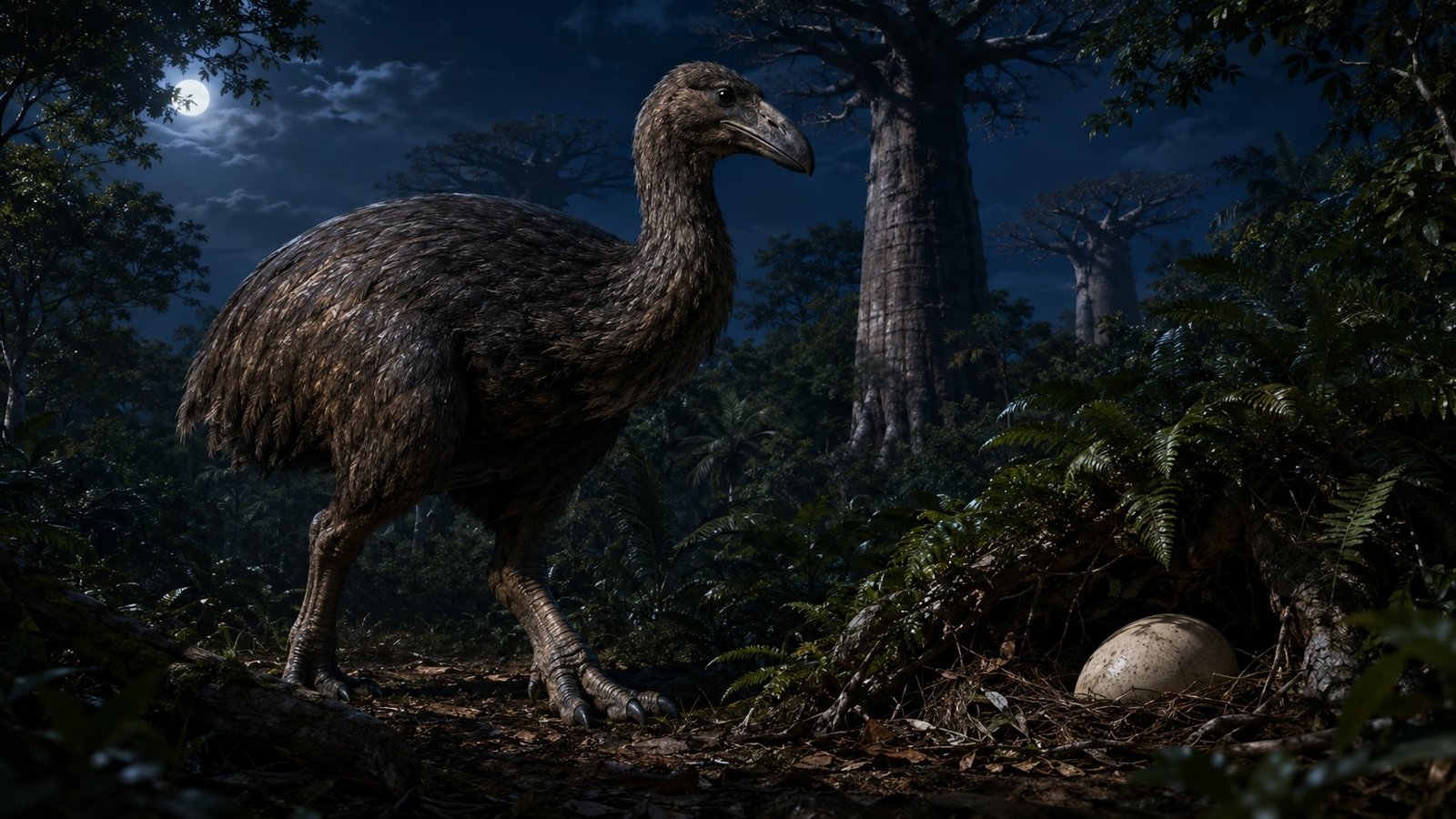
Madagascar has never shown much interest in producing ordinary wildlife. It gave the world lemurs that dance sideways, primates with skeletal fingers, carnivores resembling badly assembled cats and chameleons small enough to sit on a match head. Yet even by the island’s generous standards of biological eccentricity, the elephant bird looked excessive.
These enormous, flightless birds stood up to about three metres tall. The largest individuals may have weighed more than 500 kilograms, making them serious contenders for the title of heaviest birds ever known. Imagine an ostrich enlarged until it weighed as much as a grand piano, then remove its enthusiasm for daylight and give it the social confidence of a kiwi. That brings us reasonably close, although meeting one in a dark Madagascan forest would probably have discouraged careful comparison.
The term “elephant bird” covered several closely related forms rather than one neatly defined species. For years, scientists classified bones of different sizes as numerous species and even separate genera. In 2018, researchers proposed that the very largest specimens belonged to a newly recognised genus and species called Vorombe titan. The name meant “big bird” in Malagasy and sounded satisfyingly monumental. Unfortunately, ancient DNA later complicated the celebration.
Genetic material recovered from fragments of eggshell suggested that some supposedly distinct giants may have belonged to the same broader lineage. The biggest bones could represent unusually large individuals of Aepyornis maximus, perhaps females. Female birds often grow larger than males among flightless species, so the half-tonne champion might have been an exceptionally formidable mother rather than a separate evolutionary invention. Scientists have not settled every detail, which feels appropriate for an animal reconstructed from scattered bones, broken eggs and several centuries of enthusiastic guesswork.
Elephant birds belonged to the palaeognaths, an ancient group that also includes ostriches, emus, cassowaries, rheas, tinamous and kiwis. Their closest living relatives appear to be New Zealand’s kiwis. This relationship sounds absurd at first. One was a gigantic Madagascan heavyweight; the other resembles a nervous, long-beaked football.
However, the connection changed how scientists understood the evolution of flightless birds. They once assumed that such birds inherited flightlessness from a common ancestor stranded on fragments of the ancient supercontinent Gondwana. Genetic evidence instead indicates that their ancestors could fly and dispersed across oceans before different lineages independently abandoned aviation. Evolution apparently invented the flightless bird repeatedly, rather like an engineer independently deciding that wings had become unnecessary paperwork.
For a creature usually illustrated as an oversized ostrich standing dramatically beneath a tropical sun, the elephant bird may have preferred much darker conditions. Digital reconstructions of its brain revealed extremely reduced optic lobes, the areas associated with processing visual information. Its olfactory bulbs, which supported the sense of smell, appear to have played a more important role.
Researchers therefore suspect that at least some elephant birds lived nocturnally or remained active in dim forest environments. Rather than racing across open plains like a giant ostrich, one may have moved slowly among trees after dusk, locating leaves, fruit and other food through smell. A half-tonne bird quietly browsing in the darkness feels much stranger than the roaring monster popular imagination might prefer.
Despite their intimidating scale, elephant birds did not hunt anything. Evidence from anatomy and stable isotopes points towards plant-based diets. Different species or populations probably occupied different ecological niches. Some browsed in forests, while others consumed a substantial amount of grass in more open environments. They may have dispersed seeds, shaped vegetation and filled ecological roles that disappeared with them. Madagascar did not merely lose an impressive bird; it lost a major piece of its environmental machinery.
Then there were the eggs, which made even the birds seem modest. An elephant bird egg could exceed 30 centimetres in length and hold roughly the contents of more than 150 chicken eggs. It ranks among the largest eggs known from any animal, including dinosaurs. One egg could probably have fed a substantial gathering, although cooking it evenly would have demanded either patience or an unusually ambitious saucepan.
Fragments remain abundant in parts of southern Madagascar, and intact examples became prized museum objects. Eggshells now serve as scientific archives. Researchers can extract ancient DNA, proteins and chemical signatures from them, learning about family relationships, diet, climate and geographical variation without relying entirely on bones. A broken shell that once protected a chick can reveal more than an impressive mounted skeleton assembled from several individuals and a certain amount of optimism.
Their extinction presents a less comfortable mystery. Older accounts sometimes claimed that elephant birds survived until the seventeenth century. In 1658, French colonial governor Étienne de Flacourt recorded Malagasy descriptions of an ostrich-like creature called the vorompatra. Yet he may have repeated inherited folklore rather than described a living animal.
Radiocarbon evidence instead places the final disappearance of elephant birds around 800 to 1050 CE. That timing coincided with increasingly intensive human alteration of Madagascar’s environment. People cleared forests with fire, expanded pastoral farming, collected eggs and possibly hunted the birds. No single dramatic slaughter needs to explain the extinction. Slow habitat loss, interrupted breeding and occasional killing could dismantle a population with ruthless efficiency. A species that laid enormous eggs probably did not replace lost adults or nests quickly.
Some much older elephant bird bones contain marks interpreted as cuts made by stone tools. Those specimens have produced claims that humans reached Madagascar more than 10,000 years ago, far earlier than the securely accepted evidence for permanent settlement. Critics argue that natural processes or animal damage could have created the markings. Consequently, the bones sit at the centre of a wider controversy about when people first reached the island. A few scratches on a fossil can apparently start a disagreement lasting longer than many civilisations.
The elephant bird also became entangled with the roc, the gigantic flying predator from Arabic and Persian tales later popularised through stories associated with Sinbad and Marco Polo. The roc supposedly carried elephants through the air, which the actual elephant bird could not do because it could not carry itself through the air.
Nevertheless, travellers may have encountered enormous eggs from Madagascar and attached them to stories about a colossal raptor. European writers later suggested that the elephant bird inspired the legend. The theory remains attractive but unproven. A giant egg could certainly encourage giant storytelling, especially after several months at sea and before anyone demanded peer review.
Another persistent myth describes elephant birds as aggressive, towering predators. Films, illustrations and games often give extinct animals the temperament of unpaid debt collectors. In reality, their herbivorous diet and reduced visual system suggest something less theatrical. They were probably cautious browsers rather than feathered executioners. Of course, a frightened 500-kilogram herbivore could still ruin a person’s afternoon without eating them.
The story of the elephant bird matters because extinction rarely resembles a single cinematic event. More often, a species becomes slightly less common, its habitat shrinks, its breeding repeatedly fails and people continue assuming that plenty remain elsewhere. Eventually, “elsewhere” disappears. Madagascar lost elephant birds alongside giant lemurs, native hippopotamuses, giant tortoises and other remarkable animals after human settlement transformed the island.
Today, an elephant bird egg behind museum glass looks almost fictional. Yet it represents a creature that lived beside people, entered oral tradition and vanished recently enough to remind us that biological giants do not require an asteroid to disappear. Sometimes they need only slow reproduction, changing landscapes and neighbours who consider every enormous egg an excellent breakfast.