Imagine a bird that seals its mate inside a tree for several months, leaving only a narrow opening through which to deliver food. The female cannot go shopping, take a short flight or change her mind about the accommodation without demolishing the entrance. Meanwhile, the male spends his days collecting meals and bringing them home. It sounds like an unusually demanding marriage arrangement, but for many hornbill species, this is perfectly normal family life. Stranger still, the female actively helps build the wall herself. Far from being an eccentric exception, the arrangement is one of the most distinctive breeding strategies in the bird world.
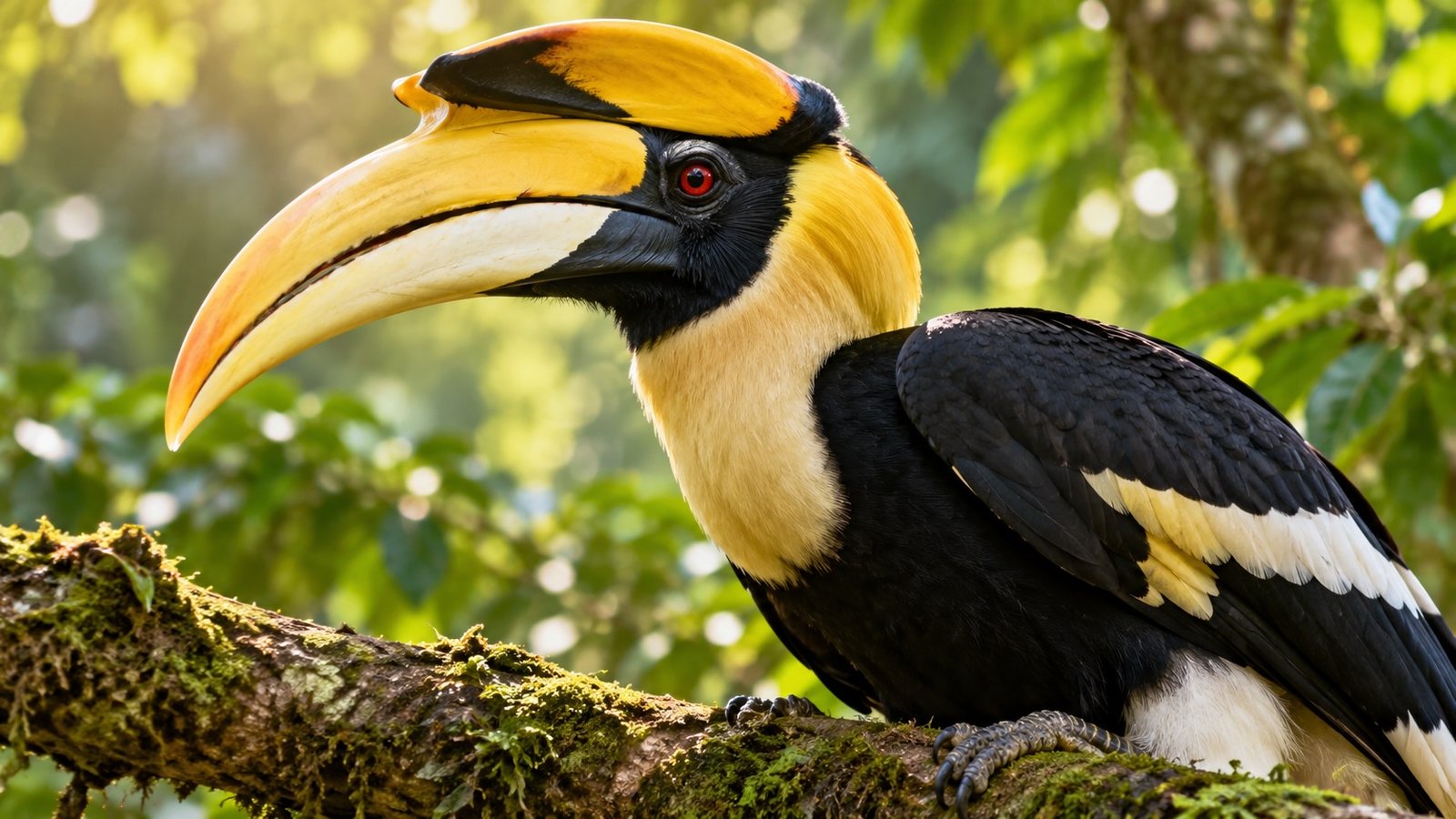
Hornbills inhabit tropical and subtropical regions of Africa and Asia. They range from relatively small, agile birds to imposing forest giants, including the great hornbill, which can reach 1.5 metres in length. Their most conspicuous feature is an enormous, curved bill, often crowned by a structure known as a casque. In some species, this resembles a second beak perched on top of the first. The result looks suspiciously like something designed by a committee that disagreed about where a bird’s head should end. Yet behind the extravagant appearance lies an effective combination of feeding equipment, visual signalling and, in some species, acoustic engineering.
Despite their intimidating dimensions, hornbill bills are generally much lighter than they appear. Their internal structures help keep weight down, allowing the birds to reach fruit at the ends of branches without carrying an impossibly heavy nose. The casque varies considerably between species. It may contribute to visual displays or modify calls, while some hornbills use it during physical contests. The helmeted hornbill of Southeast Asia is particularly unusual. Its casque has a substantial solid component, unlike the largely hollow structures of many relatives. These birds have even been observed colliding casque-first in flight, an airborne disagreement that makes ordinary territorial squabbles look rather restrained.
The hornbill’s most remarkable behaviour begins when breeding season approaches. In many species, a pair finds a natural cavity in a mature tree. Unlike woodpeckers, hornbills cannot simply excavate a convenient hole whenever they need one. They depend on suitable openings created by decay, broken branches or other natural processes. Once the female enters, she helps close the entrance using materials that can include mud, droppings and regurgitated food. Her bill becomes a surprisingly effective plastering tool. Eventually, the opening shrinks to a narrow slit. The female remains inside, protected from many potential predators, while the male assumes responsibility for the household’s entire food supply.
For the great hornbill, this arrangement can last around four months. The male repeatedly travels between fruiting trees and the nest, passing food through the slit to his partner and, eventually, their chick. Figs feature prominently in the diet of many forest hornbills, although species also consume insects, small animals and other fruits. The female may undergo a substantial moult during her confinement, replacing feathers while she incubates and cares for her offspring. In some species, she leaves the cavity before the young bird is ready to fly, after which the entrance is sealed again. In others, she remains until the chick is ready to emerge. Ground hornbills are an important exception to the familiar story: they do not wall themselves into their nests.
Such a system requires considerable cooperation, although describing it as a romantic partnership risks imposing human feelings on bird behaviour. The female provides incubation, shelter and early care. The male supplies the food that makes the arrangement possible. His contribution is not optional. If he disappears through predation, hunting or another accident, the breeding attempt may fail. The female can sometimes break through the wall, but escape may be difficult or dangerous, particularly if her flight feathers have not fully regrown. In the helmeted hornbill, the nesting period can exceed 160 days. That represents months during which a single hunting incident can threaten an entire family.
The nest itself is an impressive example of an evolutionary trade-off. A largely sealed cavity offers protection against predators, including animals capable of entering an ordinary tree hole. Yet it also makes the occupant dependent on an uninterrupted supply of food. The arrangement resembles a fortress with excellent walls but only one delivery service. It works because both birds perform specialised roles and because the surrounding forest can support the male’s repeated foraging journeys. Remove the trees that supply fruit, or the mature trunks that provide nesting cavities, and a carefully balanced strategy becomes a liability. For hornbills, protecting a forest means preserving both the restaurant and the nursery.
Their dependence on forests has another consequence. Hornbills are major seed dispersers, particularly in tropical Asian forests. Large species swallow fruits and transport seeds across considerable distances before depositing or regurgitating them. Some trees produce fruits with seeds too large for smaller birds to handle effectively, making large-bodied fruit eaters especially valuable. Researchers have described hornbills as the farmers of the forest because their movements help maintain plant communities. The comparison is particularly apt: these birds distribute the next generation of trees while searching for their own meals. Even the male’s journeys during nesting contribute to this process, although seeds expelled beneath a nest may face considerable competition and predation.
The relationship between hornbills and forests also extends into human culture. In parts of Borneo, hornbills feature prominently in Indigenous traditions, ceremonial objects and symbolic representations. The rhinoceros hornbill holds particular cultural significance among several Dayak communities and is recognised as the state bird of Sarawak, Malaysia. Its distinctive bill and casque have made it an unmistakable figure in regional art. Yet cultural importance does not automatically guarantee protection. Across parts of their range, hornbills face pressure from habitat loss, hunting and the removal of large nesting trees. Their slow reproductive rates make recovery difficult when breeding adults disappear.
The helmeted hornbill illustrates the problem particularly sharply. Its unusually solid casque has long attracted carvers who value the material sometimes called hornbill ivory. Unlike elephant ivory, it comes from a bird, but the commercial consequences have been similarly destructive. Illegal demand for carved ornaments has contributed to severe hunting pressure, particularly in Southeast Asia. The International Union for Conservation of Nature classifies the helmeted hornbill as Critically Endangered. The great hornbill is listed as Vulnerable. These assessments reflect different circumstances, but both show how a spectacular anatomical feature can become a commercial disadvantage. A structure that evolved for survival and communication has acquired an entirely unintended market value.
Conservationists have responded with approaches that recognise how hornbills actually live. In north-eastern India, the Nature Conservation Foundation’s Hornbill Nest Adoption Programme works with local communities to protect nesting trees and monitor breeding birds. Elsewhere, researchers have experimented with artificial nest cavities where suitable natural sites are scarce. Such efforts address a problem that tree planting alone cannot solve. A young plantation may eventually provide food, but a hornbill needing a spacious hollow in a mature trunk cannot wait several decades for one to develop. Successful conservation must protect old trees as well as encourage new growth, while reducing hunting pressure on adult birds.
There is something wonderfully paradoxical about a creature with such an extravagant appearance leading such a disciplined domestic life. A hornbill may look like the tropical forest’s most flamboyant resident, but its survival depends on patient routines: finding the right tree, maintaining a secure nest and making countless deliveries of fruit. The same bird that carries seeds across the forest may spend months returning to one small opening in one particular trunk. And somewhere behind that carefully plastered wall, the next generation of forest gardeners is growing up, entirely dependent on a father who remembers to bring dinner.