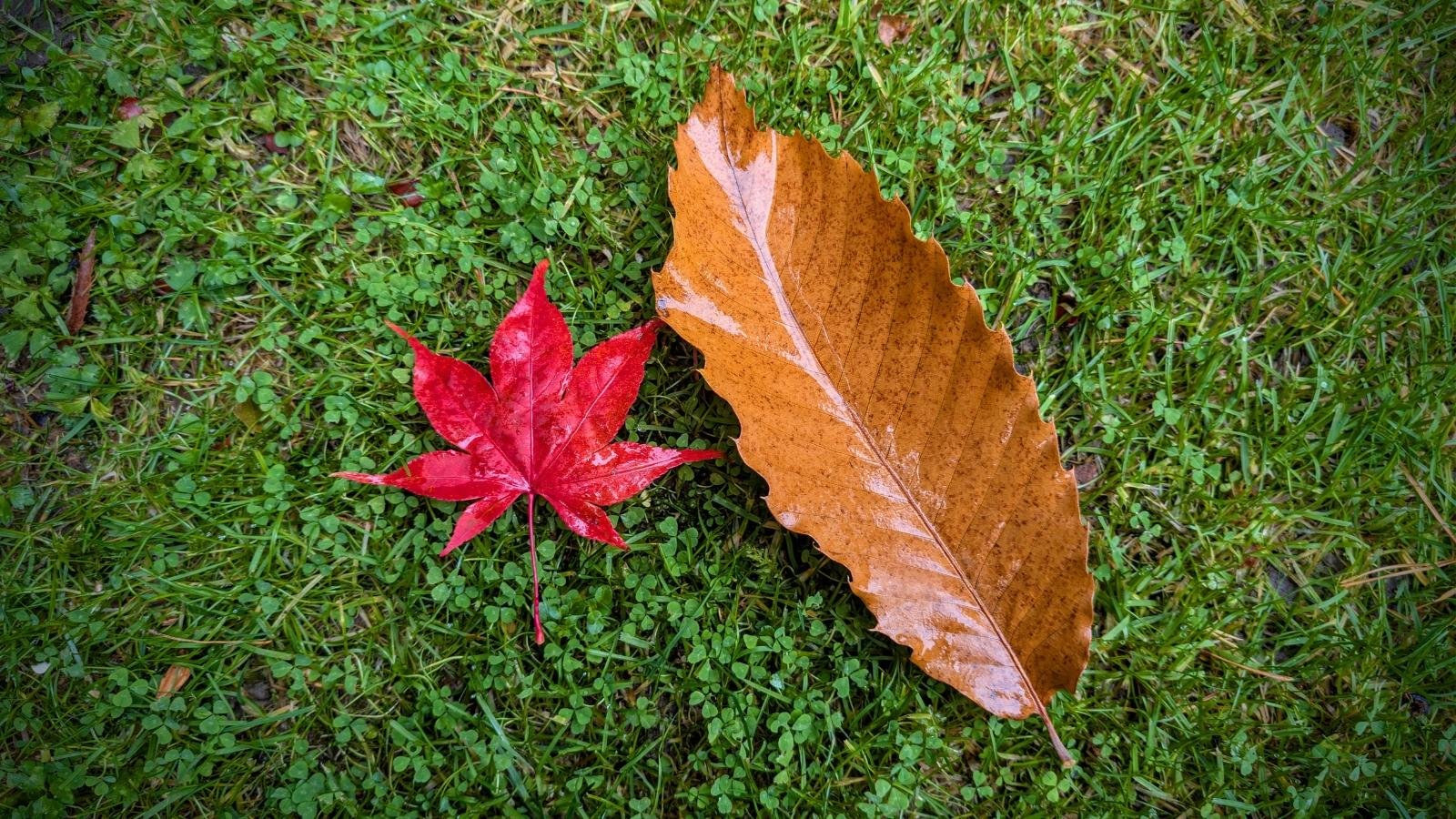
A leaf turning yellow in autumn is revealing a colour it has possessed all summer. A leaf turning red, by contrast, may be manufacturing an entirely new pigment just weeks before it falls to the ground. Both are preparing for the same fate, but their chemistry follows rather different paths. What looks like nature putting on its finest clothes for winter is actually a complicated exercise in recycling, protection and carefully managed retirement. Trees, it seems, are quite practical about dying leaves, even when the results look spectacular.
For most of spring and summer, leaves are green because they contain chlorophyll, the pigment that enables photosynthesis. Chlorophyll absorbs sunlight, helping plants convert water and carbon dioxide into sugars. Without it, forests would look very different, and life on Earth would have taken another course entirely. Yet chlorophyll is not the only pigment inside a leaf. Yellow xanthophylls and orange carotenes are present throughout the growing season, helping with light capture and protecting the photosynthetic machinery from excessive sunlight. They simply remain hidden beneath the overwhelming green. A summer leaf is therefore something like a painting with several layers of colour, only one of which we normally see.
Autumn begins to change the arrangement. As daylight hours shorten, deciduous trees respond to the approaching winter by gradually dismantling their photosynthetic equipment. Chlorophyll production declines, and the existing pigment breaks down. The tree retrieves valuable nutrients, particularly nitrogen, from its ageing leaves and transports them into branches, trunks and roots for storage. There is little point abandoning useful materials when they can help produce fresh leaves next spring. As the green disappears, the yellow and orange pigments become visible. A birch tree turning golden is not necessarily making new yellow pigment. It is simply allowing an existing colour to take centre stage.
Red leaves are a different proposition. In many species, the crimson, scarlet and purple shades come from anthocyanins, pigments that the tree actively produces during autumn. These are related to compounds responsible for the colours of blueberries, blackberries and red grapes. Their manufacture depends partly on sugars accumulating inside the leaf. Bright autumn sunshine allows photosynthesis to continue while sufficient chlorophyll remains, and cool nights can favour the conditions in which anthocyanins develop. Consequently, a period of sunny days and chilly, but not freezing, nights often produces particularly intense reds. The same maple tree may develop brilliant scarlet foliage one year and rather disappointing colours the next.
This raises a curious biological question. Why would a tree invest energy in producing a new pigment for a leaf it is about to discard? Scientists have proposed several explanations, and the matter is not entirely settled. One influential theory suggests that anthocyanins act as a form of sunscreen. As chlorophyll disappears, the remaining photosynthetic machinery becomes vulnerable to damage from strong light, especially during cold weather. Red pigments may help protect those tissues long enough for the tree to recover more nutrients before the leaf falls. The colour, in this interpretation, is not a farewell decoration but a temporary protective measure during an orderly shutdown.
Another explanation brings insects into the picture. Some researchers have suggested that bright autumn colours may signal a tree’s chemical defences to aphids and other insects searching for places to lay eggs. A strongly coloured tree might advertise that it would make an unsuitable host for their offspring. This idea, sometimes called the coevolution hypothesis, remains controversial. Studies have produced mixed results, and the connection between leaf colour and insect behaviour varies among species. The possibility is nevertheless appealing: an autumn forest might be communicating with insects as well as responding to falling temperatures. A red leaf could potentially serve several purposes, none of them intended for human admiration.
Not every tree follows the same colour scheme. Birch leaves usually turn yellow, beeches develop golden and coppery shades, and many oaks fade towards brown. Japanese maples can produce particularly intense reds, while liquidambars may display yellow, orange, red and purple on the same tree. Genetics largely determines which pigments a species can produce, but local conditions influence how strongly they appear. Even individual leaves can behave differently. Those exposed to more sunlight may become redder than leaves growing in shade, creating striking variations within a single crown. The result can look almost deliberate, as though someone has been experimenting with a paintbrush.
Weather adds another level of unpredictability. The ingredients for a colourful autumn generally include a healthy growing season, adequate moisture, bright days and cool nights. Too much drought can cause leaves to dry out, turn brown or fall prematurely. Heavy rain and strong winds may strip trees before their colours reach their peak. Prolonged mild, cloudy weather can make the display less striking, particularly in species capable of producing red anthocyanins. This helps explain why Britain’s autumn colours fluctuate considerably. It also explains the famous displays of New England, where suitable weather often combines with extensive forests containing species capable of brilliant red and orange foliage. The reputation has a botanical foundation, not merely an enthusiastic tourist industry.
There is also a less glamorous side to the process. As autumn progresses, trees form a specialised separation layer near the base of each leaf stalk. This gradually restricts the connection between leaf and branch. Once the tree has recovered what it can, the leaf detaches, often helped by wind or rain. Meanwhile, pigments continue to break down, and brown compounds become increasingly visible. The final colour is therefore not always red or gold but an unremarkable brown. For the tree, that is perfectly satisfactory. Having reclaimed useful nutrients and shed a structure that would consume resources and lose water during winter, it can enter dormancy with fewer demands.
An additional curiosity lies in the autumn colours of different continents. Eastern North America is particularly famous for extensive forests of red foliage, while many European woodlands are dominated by yellows and browns. Scientists have explored whether evolutionary history, including differences in insect communities and the survival of tree lineages through past climatic changes, might help explain these patterns. The hypotheses remain under investigation, but they suggest that autumn colour reflects much longer histories than the weather of a particular October. The scarlet leaf of a maple may carry evidence of evolutionary pressures operating over millions of years.
Perhaps the most surprising part of the whole performance is that trees do not need colourful leaves to survive winter. Evergreen plants follow different strategies, maintaining tougher foliage capable of functioning for several years. Deciduous trees instead sacrifice leaves that would be expensive to maintain through cold, dark months. The striking colours are consequences of that strategy, shaped by chemistry, environmental conditions and evolution. Yellow is often the revelation of something already there; red may be a final investment in protecting what remains. And when a crimson maple leaf eventually lands on a pavement, it has not simply changed colour. It has completed a remarkable sequence of biochemical decisions, all without a brain, a calendar or the slightest interest in being photographed.