Extinction sounds wonderfully final. A species lives, struggles, loses and disappears. Scientists eventually place it in the biological filing cabinet marked “gone”, museums label the remains, textbooks move on, and everyone enjoys the comforting certainty of a closed case. Then, occasionally, somebody walks into a forest, pulls up a fishing net or peers into a remote valley and finds the allegedly extinct creature looking remarkably unconcerned about its scientific status. Biologists and palaeontologists have a name for such awkward survivors: Lazarus taxa.
The term comes, naturally enough, from the biblical Lazarus, whom Jesus raised from the dead. Yet the biological version involves no resurrection. Lazarus taxa never actually died out. Instead, they disappeared from our evidence and later reappeared, exposing an uncomfortable difference between extinction and our ability to prove extinction.
Palaeontologists Karl Flessa and David Jablonski introduced the term in the 1980s. In its strict palaeontological meaning, a Lazarus taxon disappears from the fossil record for a significant period and then appears again. That gap might cover thousands or even millions of years. Conservation biologists also use the expression more loosely for species declared or presumed extinct before somebody finds a surviving population.
The distinction matters. Fossilisation is not nature’s filing system, despite the impression given by museums. Most organisms leave no fossils whatsoever. An animal needs to die in suitable circumstances, escape scavengers and decomposition, become buried, survive geological processes and eventually end up somewhere accessible. Then a human being needs to find it. This makes the fossil record less like a complete encyclopaedia and more like a badly damaged library in which most books have disappeared and several shelves remain underground.
Small populations make the problem worse. Imagine a marine species reduced by environmental catastrophe from millions of individuals to a few thousand living in deep water. Its chances of leaving fossils that humans later discover collapse dramatically. Millions of years afterwards, the population expands again. Suddenly its fossils return. To a palaeontologist reading layers of rock, the animal seems to vanish and reappear. In reality, it may simply have spent several geological chapters keeping a very low profile.
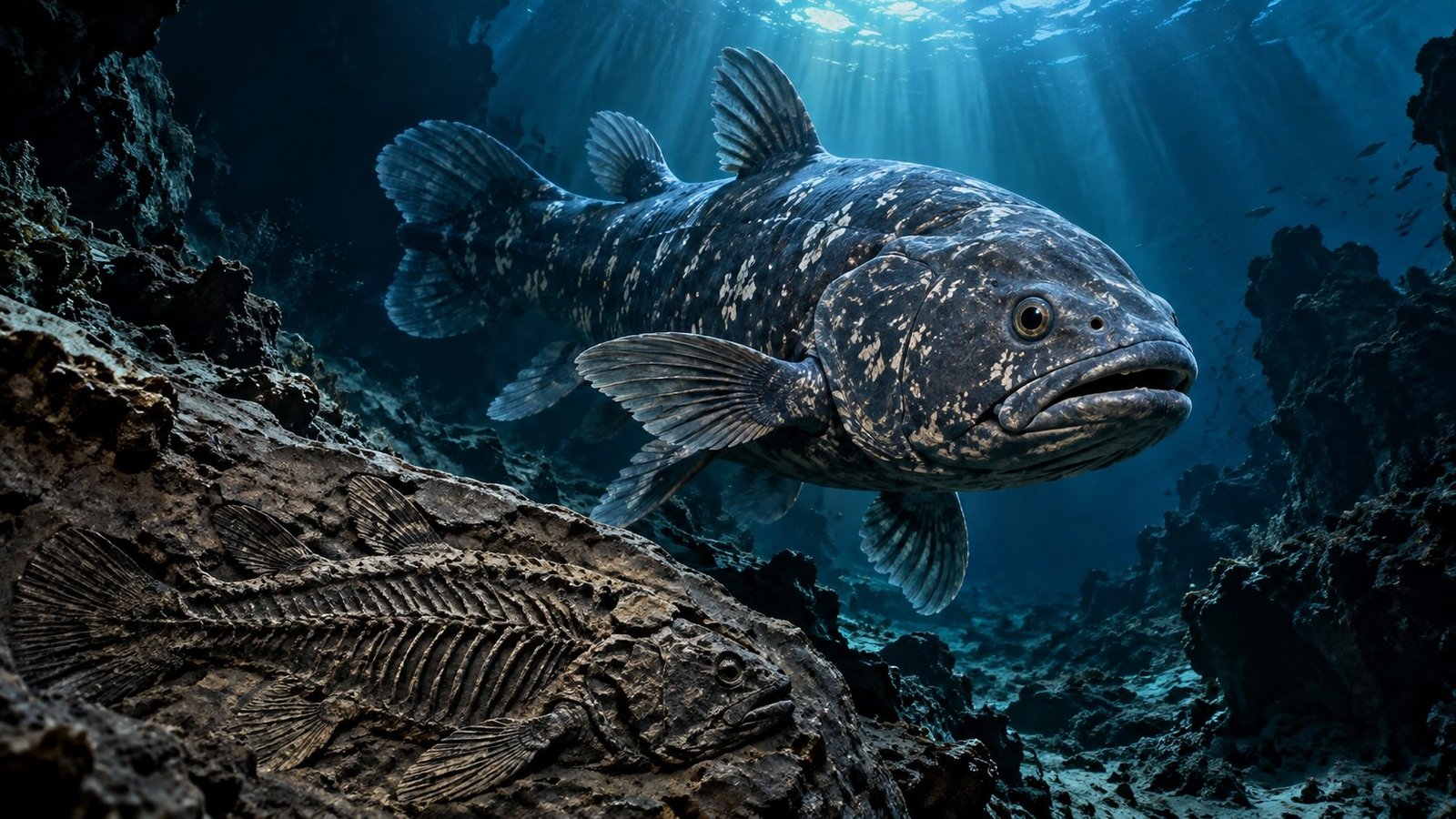
Nothing demonstrates this better than the coelacanth. These extraordinary lobe-finned fish had an extensive fossil history, but their known fossil record appeared to end around the time dinosaurs vanished roughly 66 million years ago. Scientists therefore regarded coelacanths as creatures of the distant past. Then, in 1938, museum curator Marjorie Courtenay-Latimer examined an unusual fish caught off South Africa. It was a coelacanth. Apparently nobody had informed the fish that it had been extinct since the Cretaceous.
The story becomes even better because local fishermen around the western Indian Ocean already knew these animals. Science had “rediscovered” something that people living near its habitat had encountered before. This recurring feature of biological rediscoveries deserves attention. An animal can remain unknown to international science while remaining perfectly familiar to local communities. Sometimes the Lazarus effect tells us as much about the limits of scientific knowledge as it does about the species itself.
Plants can perform the same trick. In 1994, Australian National Parks officer David Noble explored a remote canyon in Wollemi National Park, around 150 kilometres from Sydney. He noticed unfamiliar trees with unusual bark and foliage. They turned out to represent Wollemia nobilis, the Wollemi pine, part of an ancient evolutionary lineage associated with fossils stretching deep into the age of dinosaurs. Fewer than 100 mature trees survive in their secret wild habitat.
The geography makes the story wonderfully ironic. Humanity had built Sydney, filled it with millions of people, aircraft, motorways and botanists, yet an extraordinary tree lineage survived nearby in a difficult canyon. Sometimes a species does not need another planet on which to hide. It merely needs terrain that humans find inconvenient.
New Zealand supplied another celebrated Lazarus story. The takahē, a large flightless bird with magnificent blue and green plumage, seemed to have disappeared by the end of the nineteenth century. Geoffrey Orbell, a doctor and keen outdoorsman, refused to accept the verdict. In 1948, after years of interest in reports, tracks and possible calls, he led a party into the remote Murchison Mountains. There they found living takahē.
That rediscovery did more than embarrass the extinction list. It gave conservationists another chance. New Zealand subsequently developed an intensive recovery programme involving breeding, predator control, translocations and protected habitats. By 2026, the population had risen to just over 500 birds. Lazarus species therefore carry an unusual conservation message: rediscovery represents neither victory nor safety. Finding the last survivors merely changes the problem from “too late” to “perhaps”.
There are stranger cases still. Living monoplacophorans, primitive-looking deep-sea molluscs, surprised zoologists during the twentieth century because scientists had previously known the group from ancient fossils. The mountain pygmy possum of Australia also entered science through fossil material before researchers discovered living animals. Each example reinforces the same lesson. Remote mountains, deep oceans, isolated forests and inaccessible caves can operate as biological hiding places, especially for small populations.
However, popular accounts often turn Lazarus taxa into “living fossils”, and the expressions do not mean the same thing. A Lazarus taxon concerns disappearance from our record followed by reappearance. “Living fossil” usually describes a surviving lineage that seems morphologically similar to very ancient relatives. A creature can qualify for one description without neatly qualifying for the other. Moreover, evolution does not simply stop because an animal looks old-fashioned. Modern coelacanths are not individual fish that somehow swam unchanged out of the Jurassic.
Nor does every dramatic rediscovery prove that palaeontologists made a ridiculous mistake. Scientists work with available evidence, and absence creates genuine statistical problems. If repeated searches across appropriate habitats find nothing, extinction eventually becomes the most reasonable explanation. Yet certainty remains difficult. The famous Signor–Lipps effect describes a related problem in palaeontology: because fossil records remain incomplete, the youngest fossil we find rarely represents the actual final individual of a species.
This makes Lazarus taxa particularly important around mass extinctions. After catastrophic events, some groups disappear from fossil layers before returning much later. Researchers debate whether these gaps reflect extremely small surviving populations, movement into refuges, poor fossil preservation or combinations of all three. A blank stretch of rock therefore does not necessarily represent biological emptiness.
There is also an amusing opposite idea: the “Elvis taxon”. Here the original organism really does disappear, but another evolves a similar appearance and seems to imitate its predecessor. The name refers to Elvis impersonators. Palaeontology, despite dealing extensively with death, occasionally displays an excellent sense of humour.
The deeper appeal of Lazarus taxa comes from what they do to certainty. We like neat categories: living or extinct, known or unknown, present or absent. Nature appears less interested in our administrative preferences. A few organisms survive in remote canyons, deep seas and forgotten valleys while humans confidently write their obituaries.
That does not mean somewhere in the jungle a Tyrannosaurus rex waits to inconvenience science. Large animals need viable populations, consume resources and usually leave evidence. Lazarus taxa tend to succeed when rarity combines with isolation and habitats that humans seldom examine. The smaller, deeper, remoter and less conspicuous the organism, the easier the disappearing act becomes.
Perhaps that is why these stories remain so compelling. Every Lazarus species gives us two stories at once. One concerns an organism remarkably good at surviving. The other concerns humans discovering that the world still contains things we have overlooked. The coelacanth did not return from extinction in 1938. We simply found it again. From the fish’s perspective, presumably, we were the ones who had been missing.