The British campaign for women’s right to vote has acquired a wonderfully convenient cast of characters. On one side stand the suffragists, respectable women carrying petitions, attending meetings and patiently explaining to gentlemen in Parliament that women were, in fact, people. On the other stand the suffragettes, smashing windows, setting fires, going to prison and generally making Edwardian Britain regret inventing plate glass. Both wanted votes for women. Their disagreement concerned a question that political movements still struggle with today: what do you do when asking politely has achieved remarkably little?
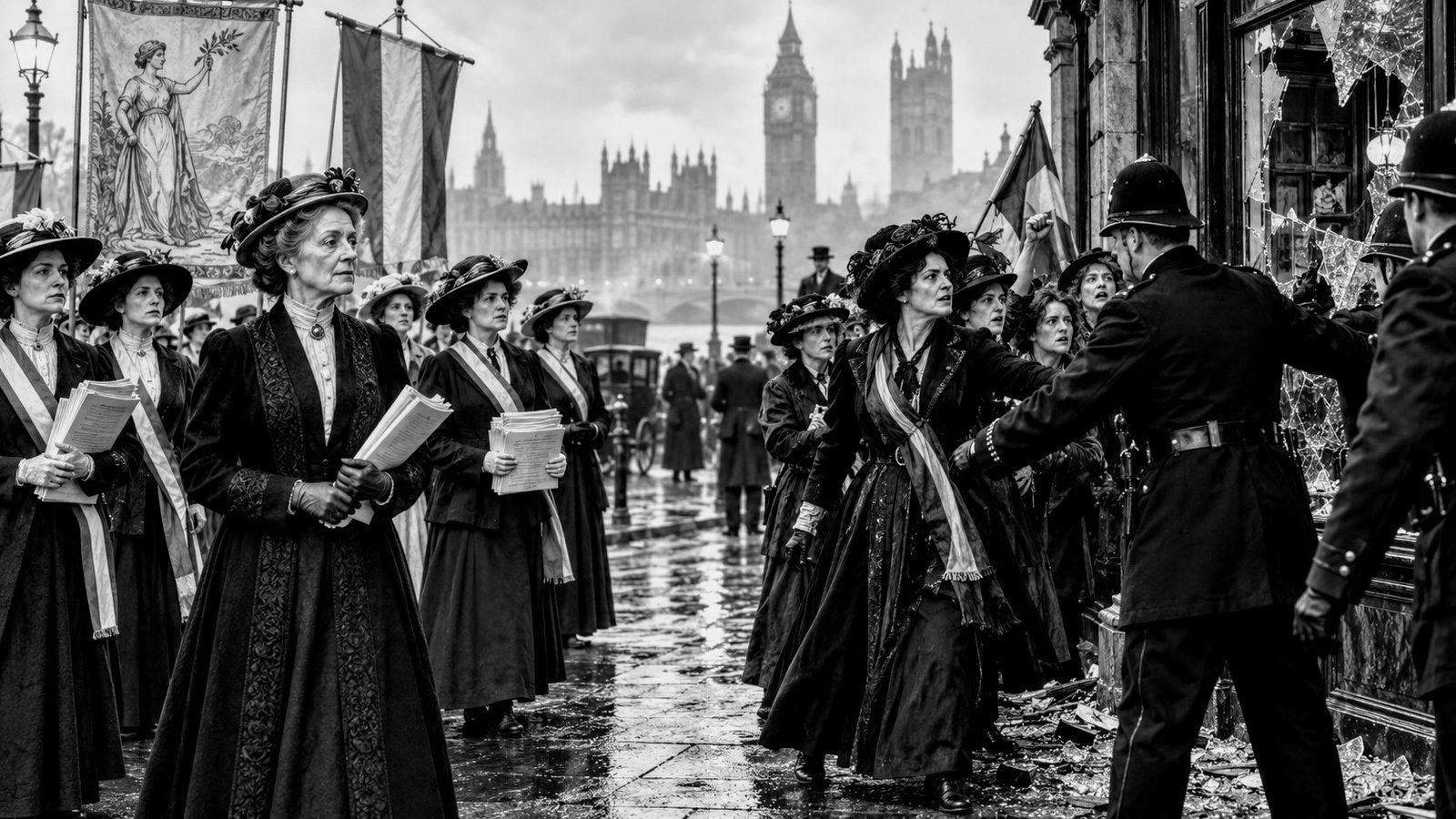
The distinction begins with language. A suffragist was simply somebody who supported extending the franchise, although in Britain the word became particularly associated with constitutional campaigners. The National Union of Women’s Suffrage Societies, or NUWSS, formed in 1897 under the leadership of Millicent Garrett Fawcett. It brought together seventeen organisations and eventually became a formidable national movement. By 1913, nearly 500 regional societies belonged to it, with around 50,000 members. They organised petitions, public meetings and marches, lobbied MPs and tried to persuade political parties that excluding half the population from national elections looked increasingly ridiculous.
Their patience deserves some perspective. Organised campaigning had begun decades earlier. The great petition of 1866 helped launch a sustained parliamentary campaign, and more than 16,000 petitions supporting votes for women eventually reached Parliament between 1866 and 1918. Progress nevertheless moved at approximately the speed one might expect from Victorian gentlemen discussing whether their wives could be trusted with pencils. Women gained some local voting rights, but the parliamentary franchise remained stubbornly male.
That frustration helps explain Emmeline Pankhurst. In Manchester in 1903, she and several other women founded the Women’s Social and Political Union, the WSPU. Its motto was wonderfully economical: “Deeds not words.” In 1905, Christabel Pankhurst and Annie Kenney disrupted a Liberal meeting by demanding an answer on women’s suffrage. They were thrown out, arrested and chose imprisonment rather than paying their fines. The incident helped push the WSPU towards increasingly militant politics.
Then came a rather brilliant piece of hostile branding. In 1906, the Daily Mail popularised “suffragette” as a dismissive label for the militants. Instead of complaining, the women adopted it. It became a political identity. The distinction therefore hardened: Fawcett and the constitutional campaigners became associated with suffragism, while Pankhurst’s militants became the suffragettes.
Yet describing the difference simply as peaceful versus violent misses much of the story. The suffrage movement contained dozens of organisations, overlapping memberships and ideological disagreements. Some campaigners supported direct action without supporting violence. Others left the WSPU when its tactics escalated. Sylvia Pankhurst eventually broke with the organisation led by her mother and sister and concentrated increasingly on working-class women in London’s East End. The neat schoolbook picture of two opposing camps looks considerably messier once actual women enter it.
Still, the WSPU unquestionably crossed boundaries that the NUWSS refused to cross. Militancy initially meant disruption, civil disobedience and attempts to force politicians to pay attention. Women interrupted meetings, demonstrated outside Parliament and deliberately got themselves arrested. Prison created another battlefield. Suffragettes went on hunger strike; authorities responded with force-feeding. In 1913, the government introduced the Prisoners (Temporary Discharge for Ill Health) Act. Hunger strikers could effectively be released when dangerously weak and arrested again after recovering. The arrangement quickly acquired the wonderfully sinister nickname of the “Cat and Mouse Act”.
By 1912, however, militancy had escalated dramatically. Suffragettes smashed shop windows, damaged postboxes, attacked artworks and carried out arson and bombing campaigns against property. Churches, public buildings and other targets came under attack across Britain. A bomb exploded beside the Coronation Chair in Westminster Abbey in 1914. St Anne’s Church in Liverpool suffered serious fire damage. Homemade bombs appeared elsewhere, while pillar boxes became such regular targets that posting a letter briefly acquired an unexpected element of adventure.
The WSPU maintained that attacks targeted property rather than human life, and many operations deliberately took place when buildings stood empty. That distinction matters, but it does not settle the moral argument. Bombs and fires can behave with disappointing independence once somebody lights the fuse. Critics argued that the campaign endangered innocent people and damaged public support for women’s suffrage. Some supporters themselves recoiled from escalating violence. Historians still debate whether militancy accelerated political change or made achieving it more difficult.
The most famous suffragette protest also remains one of the most misunderstood. At the Epsom Derby on 4 June 1913, Emily Wilding Davison entered the racecourse and collided with King George V’s horse, Anmer. She died four days later. The familiar story says that Davison deliberately committed suicide for the cause. Yet her precise intentions remain uncertain, and historians have debated whether she intended to attach a suffragette banner or scarf to the King’s horse rather than die beneath it. History likes martyrs with simple motives; actual human beings rarely provide them.
Meanwhile, the supposedly boring suffragists kept working. Their lack of explosions has cost them dearly in popular memory because peaceful lobbying makes less exciting television. Yet their nationwide organisation created political legitimacy, cultivated parliamentary allies and demonstrated that support for women’s suffrage extended far beyond a small militant fringe. The contrast becomes almost comic: the suffragettes became famous partly because they were smaller and louder, while the much larger constitutional movement became easier to overlook because it behaved itself.
Then the First World War changed everything. In 1914, Emmeline and Christabel Pankhurst suspended WSPU militancy and strongly supported the British war effort. The NUWSS also redirected considerable energy towards wartime activity, although divisions emerged within both movements over the war. Other suffrage organisations continued campaigning, and Sylvia Pankhurst’s East London organisation opposed the conflict. Once again, “the women’s movement” stubbornly refused to behave like a single movement.
In 1918, Parliament finally moved. The Representation of the People Act enfranchised women over 30 who met certain property conditions while extending the vote much more widely among men. Roughly 8.5 million women became eligible, but Britain had certainly not achieved electoral equality. Women represented about 43 per cent of the enlarged electorate, and many younger women who had worked through the war still could not vote. Full equality arrived only with the Equal Franchise Act of 1928, when women gained voting rights on the same terms as men.
So who won the vote: the suffragists or the suffragettes? Unfortunately for anyone hoping for a satisfying historical boxing match, the answer is probably both, alongside wider political and social changes created by decades of campaigning and the First World War. The suffragists built a broad, durable political movement. The suffragettes made ignoring that movement extraordinarily difficult. Wartime changes then altered assumptions about women’s economic and social roles, while electoral reform became unavoidable for other reasons as millions of servicemen risked losing their voting qualifications because residency rules no longer fitted wartime reality.
Perhaps their greatest difference therefore became their greatest combined strength. Fawcett could effectively demonstrate that reasonable women deserved the vote; Pankhurst could demonstrate what happened when reasonable women became tired of waiting. Politicians faced respectable constitutional pressure on one side and the possibility of renewed militancy on the other. Whether that amounted to deliberate good-cop, bad-cop strategy is another matter entirely, but from Westminster it cannot always have felt terribly different.
Modern memory has nevertheless handed the suffragettes the better costume department. Purple, white and green, prison stories, hunger strikes, smashed windows and Emily Davison make powerful historical imagery. Suffragists carrying petitions struggle to compete. Yet remembering only the suffragettes creates an ironic distortion. A movement that fought to make women’s political voices count becomes remembered mainly through its most dramatic minority.
The more interesting story contains both. Political change sometimes needs the person patiently constructing an argument and sometimes the person making continued indifference impossible. Britain’s suffrage campaign had plenty of both. The argument between suffragists and suffragettes was never really about whether women deserved political power. It was about something considerably more uncomfortable: how long people denied power should remain polite while waiting for those who possess it to change their minds.