
Mention plague and the mind immediately supplies the scenery: medieval streets, carts piled with bodies, terrified townspeople and doctors wearing those wonderfully sinister beaked masks. Plague belongs so completely to our image of the Middle Ages that it is tempting to assume humanity eventually defeated it, along with smallpox and the unfortunate habit of emptying chamber pots into the street. We did not. Plague still exists, people still catch it every year, and some still die from it. The reassuring part is that modern medicine has transformed it from an almost supernatural terror into a rare bacterial infection that doctors can usually cure. The less reassuring part is that the bacterium itself has never gone anywhere.
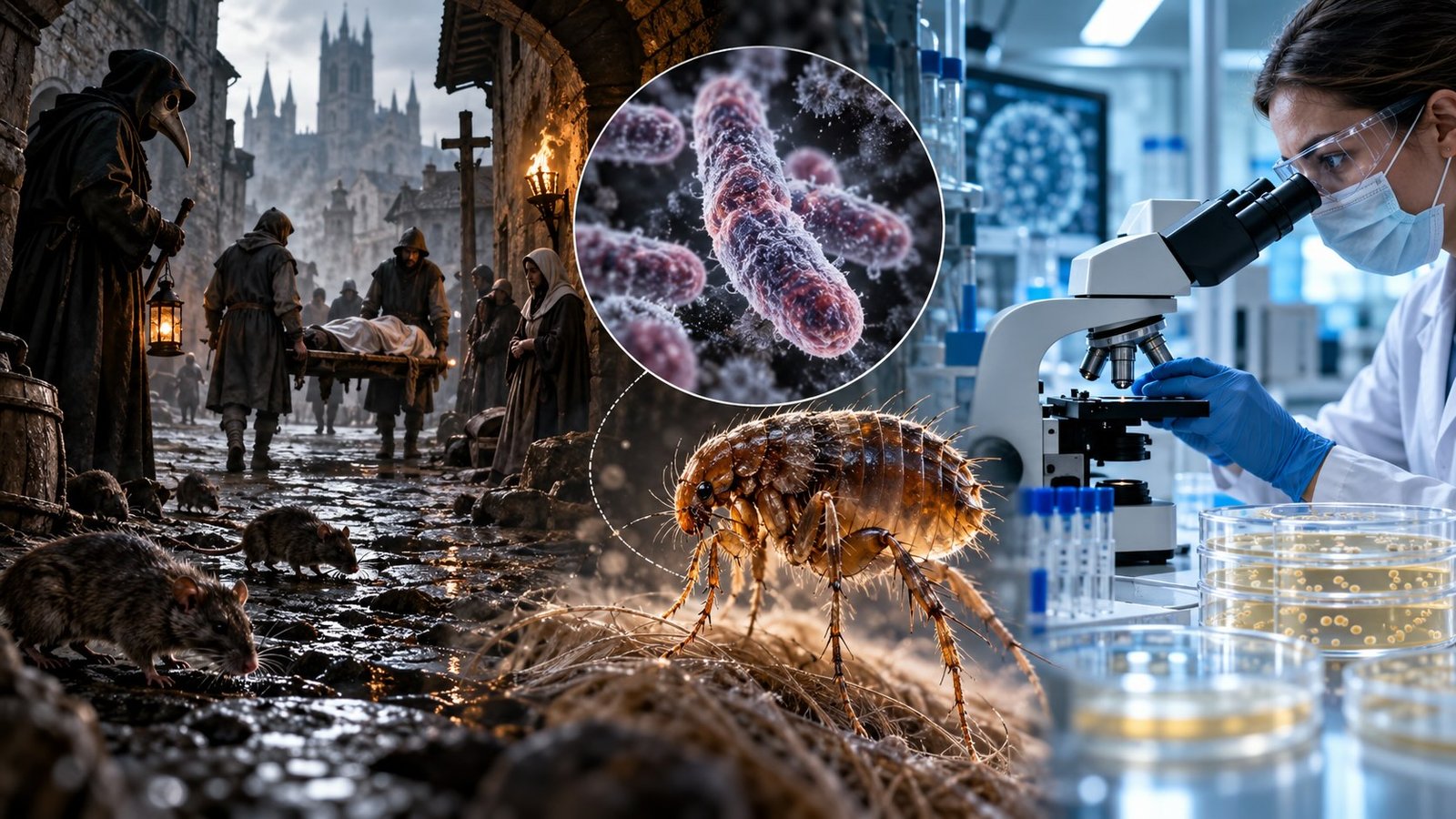
Plague comes from a bacterium called Yersinia pestis. Genetically, it evolved from Yersinia pseudotuberculosis, a rather less spectacular intestinal bacterium. Ancient DNA has dramatically rewritten the story of when this happened. Scientists have found Y. pestis in human remains from Eurasia dating back roughly 5,000 years, although those early strains lacked some of the genetic machinery that later allowed efficient flea-borne transmission. By around 3,800 years ago, strains capable of the familiar flea-to-mammal route associated with bubonic plague had appeared. In other words, plague is considerably older than Rome, classical Greece or Christianity. Humans have apparently been sharing the planet with it since the Bronze Age, which seems an unnecessarily long relationship.
Its great historical weapon was an ecological partnership between bacteria, rodents and fleas. Yersinia pestis circulates naturally among populations of wild rodents. Fleas feeding on infected animals can acquire the bacterium and subsequently transmit it when they bite another mammal, including a human. Rats became notorious because they lived so successfully alongside people, particularly in crowded settlements and ports, although the complete ecology of historical plague epidemics remains more complicated than the traditional schoolbook story of “rats plus fleas equals Black Death”. Modern research continues to debate the relative importance of different rodents, fleas, human ectoparasites, climate and human-to-human transmission in particular historical outbreaks.
The first securely identified historical plague pandemic erupted during the reign of the Byzantine emperor Justinian in the sixth century. Ancient DNA has confirmed that Y. pestis caused it, although its precise geographical origin remains disputed. Then came the catastrophe that permanently embedded plague in European memory: the Black Death. It swept through Europe, western Asia and North Africa in the middle of the fourteenth century. Remarkably, ancient DNA has brought us surprisingly close to its starting point. Researchers examining people buried near Lake Issyk-Kul in modern Kyrgyzstan found Y. pestis in individuals who died during an epidemic in 1338–39. The strain sits immediately before the enormous genetic diversification associated with the Black Death.
When the pandemic reached Europe in 1347, medieval society had almost no effective defence against it. There was no germ theory, no antibiotics and little understanding of transmission. Physicians blamed corrupted air, planetary alignments and various other culprits that offered the considerable disadvantage of being impossible to arrest. The Black Death killed on a staggering scale and plague subsequently returned to European cities repeatedly for centuries. Yet the bacterium that caused those medieval epidemics was not necessarily some uniquely monstrous super-plague. DNA recovered from victims buried in London’s East Smithfield cemetery shows that the medieval organism was surprisingly close to later strains. Its extraordinary mortality probably reflected a lethal combination of bacterial virulence, human susceptibility, ecology, living conditions and an almost complete absence of effective medicine.
Plague staged another international performance during the Third Pandemic, which developed from outbreaks in Yunnan in south-western China and reached Hong Kong in 1894. There, Alexandre Yersin identified the bacterium responsible. Four years later, Paul-Louis Simond helped establish the role of fleas in transmission. Steamships then transported infected rats and fleas around the world, carrying plague to ports from Bombay to Honolulu and San Francisco. India suffered particularly badly: an estimated six million people died there during the first decade of the twentieth century alone. The bacterium was eventually named Yersinia pestis after Yersin. Few scientists receive the honour of having their surname attached permanently to one of humanity’s most successful killers.
The disease itself comes in three important forms. Bubonic plague, the classic variety, usually follows an infected flea bite. The bacteria travel to nearby lymph nodes, which become enormously swollen and painfully inflamed. These swellings are the famous “buboes” that gave the disease its name. Septicaemic plague occurs when the bacteria multiply in the bloodstream, producing overwhelming infection, shock and sometimes bleeding into tissues. Pneumonic plague infects the lungs and is the form that public-health authorities fear most because an infected person can transmit bacteria directly to another person through respiratory particles.
That distinction answers an important question: plague is not generally highly infectious in the way influenza, measles or Covid can be. Bubonic plague does not normally spread from one person to another. You do not catch it simply by sitting beside somebody who has a swollen lymph node. Pneumonic plague is different. Someone with plague pneumonia can infect people through respiratory particles, particularly during close contact. Its incubation period can sometimes be as short as 24 hours, and untreated disease progresses frighteningly quickly. Consequently, suspected pneumonic cases require isolation, rapid contact tracing and immediate treatment. Even so, plague does not possess the effortless transmissibility of some respiratory viruses. Sustained international spread remains unusual.
The great modern advantage is wonderfully mundane: antibiotics work. Depending on circumstances and severity, doctors can use medicines including gentamicin or fluoroquinolones, alongside supportive treatment. The critical factor is speed. Doctors should start treatment as soon as plague is seriously suspected rather than waiting for laboratory confirmation because pneumonic and septicaemic plague can deteriorate extraordinarily rapidly. People who have had significant close exposure to pneumonic plague may also receive preventive antibiotics. With prompt diagnosis and appropriate treatment, recovery is common. Without treatment, however, plague remains brutally dangerous; WHO describes untreated pneumonic and septicaemic disease as essentially fatal.
So why has a supposedly medieval disease not disappeared? Because plague is fundamentally a disease of nature rather than merely a human infection. Yersinia pestis persists in wild animal reservoirs, particularly rodents, across enormous geographical areas. We cannot eradicate every infected rodent and flea population from the landscape, nor would attempting to do so make ecological sense. Human plague therefore still occurs naturally in parts of Africa, Asia and the Americas. WHO reports that during 2019–2025 most reported cases came from the Democratic Republic of the Congo and Madagascar. Even the United States continues to record occasional infections, particularly in rural areas of the West.
There is also a topical reason for renewed interest. In October 2026 the death of a laboratory worker at an anti-plague institute in Irkutsk, Russia, prompted international concern over a possible pneumonic-plague infection. Russian authorities subsequently told the World Health Organization that there were no plague cases in Irkutsk and that contacts had tested negative for dangerous infectious pathogens. WHO assessed the wider public risk as low, although questions surrounding the original illness remained. The episode illustrates perfectly why plague still commands attention: an unusual pneumonia potentially involving Y. pestis immediately triggers surveillance, isolation and international communication because nobody wants to discover through experience whether an outbreak will remain small.
The real danger, therefore, lies somewhere between complacency and medieval panic. Plague today is rare, diagnosable and treatable. Bubonic plague is not easily passed between people, while pneumonic plague can spread directly but generally requires relatively close exposure. Modern antibiotics, laboratories, infection control and contact tracing make another Black Death extraordinarily unlikely under ordinary circumstances. Nevertheless, the bacterium survives in nature, can kill extremely quickly when treatment comes too late and occasionally reminds us that “historical disease” is a misleading expression. History may have finished with the Black Death. Yersinia pestis, rather inconveniently, has not.