A horse can look at a photograph of an angry stranger, remember the expression hours later and behave differently towards that person when they finally meet. No shouting, no threatening gestures, no unpleasant conversation. Just one photograph. Meanwhile, humans can spend forty minutes in a meeting with an obviously furious colleague and emerge congratulating themselves on how well it went. Somewhere in the evolutionary history of emotional intelligence, something appears to have gone slightly wrong.
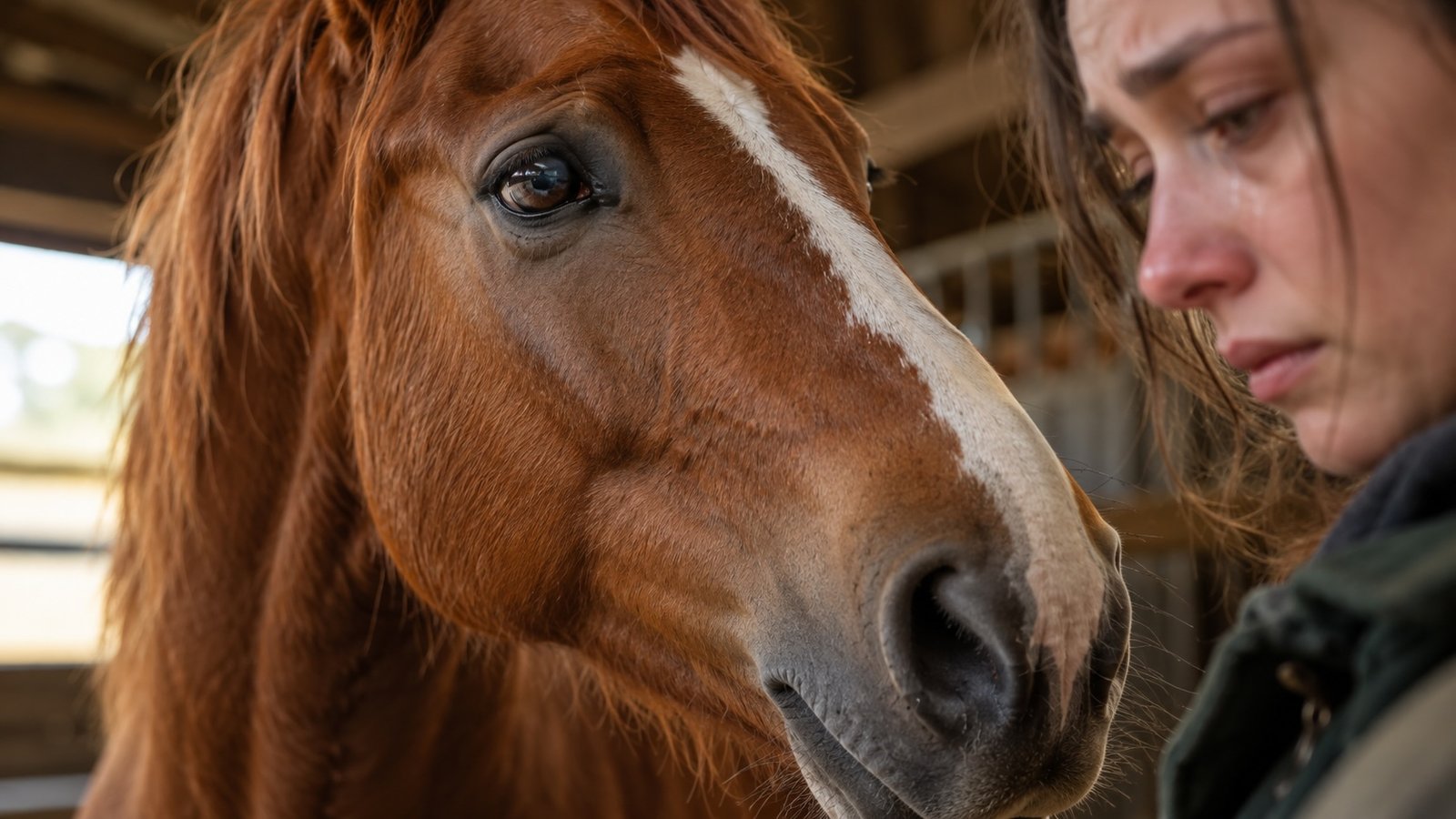
In 2018, researchers from the Universities of Sussex and Portsmouth demonstrated something rather inconvenient for anyone who considers horses intellectually inferior. They showed horses photographs of people displaying either happy or angry expressions. Several hours later, the animals met those same individuals, who now wore neutral expressions and had no idea which photograph the horse had seen. The horses responded differently depending on the earlier image. An angry face, it seemed, could leave an impression long after the anger had disappeared.
The experiment was particularly revealing because the humans had never behaved aggressively towards the animals. The horses were forming impressions from visual information alone. They were, in effect, judging people before meeting them, a skill humans have developed into an entire recruitment industry.
This was not the first indication that horses pay close attention to our emotional lives. In 2016, another study at Sussex found that horses reacted differently to photographs of happy and angry human faces. When confronted with angry expressions, they tended to look with their left eye, a response associated with processing potentially negative stimuli through the right hemisphere of the brain. Their heart rates also increased more rapidly. The animals were not merely noticing that two photographs looked different. Their bodies were responding to the emotional information.
Of course, scientists are careful about what such findings actually demonstrate. Recognising an angry expression does not necessarily mean understanding anger as humans experience it. A horse may associate particular facial configurations with danger or unpleasant consequences without contemplating the psychological condition of the person displaying them. It probably does not wonder whether the angry individual has suffered a disappointing annual appraisal or just received an electricity bill.
Still, the distinction becomes less reassuring when we consider how human emotional intelligence works. Much of our own social understanding relies on recognising patterns, remembering previous encounters and predicting behaviour. We see a colleague’s tightened jaw, hear a change in tone and decide that now might not be the ideal moment to request a favour. The horse performs a surprisingly similar calculation, although it has the advantage of not needing to pretend everything is fine.
The evidence becomes even more curious when voices enter the picture. In a study published in 2019, researchers tested whether horses could connect human facial expressions with emotional sounds. The animals watched images showing happiness and anger while hearing corresponding or conflicting vocalisations. They spent longer looking at faces that did not match the emotional tone of the sounds, suggesting they recognised something inconsistent.
In other words, a smiling face accompanied by an angry voice could puzzle a horse. Anyone familiar with the expression ‘I’m absolutely fine’ delivered through clenched teeth will appreciate the practical value of this ability.
Researchers subsequently extended their investigations beyond the familiar territory of happiness and anger. A 2023 study involving 28 horses examined whether they could distinguish human joy and sadness across facial expressions and voices. The horses watched silent videos of happy and sad faces while hearing an emotional voice. Their responses suggested that they could connect visual and auditory signals representing the same emotion. They also showed greater interest in joyful faces. That last detail is rather charming. Horses, it seems, may prefer cheerful company. Unlike certain humans, they do not appear to consider permanent dissatisfaction a mark of intellectual seriousness.
Then came an experiment that might sound like an unusually specialised children’s computer game. In 2024, French researchers trained eleven horses to use a touchscreen displaying pairs of human faces. Touching the correct emotional expression earned a food pellet. Six horses were trained to select sadness, while five were trained to select joy.
At the group level, both groups learned the task better than chance would predict. Horses trained to recognise joyful expressions could also apply their learning to photographs of unfamiliar people. Those trained on sadness did not demonstrate the same successful generalisation. The distinction matters: recognising a specific photograph is one thing; recognising an emotional expression across different faces is considerably more demanding.
It also provides a useful reminder that animal intelligence rarely fits into the simple categories humans prefer. A horse may perform impressively in one task and less convincingly in another. Individual animals differ, attention fluctuates, and food rewards can produce varying degrees of enthusiasm. Rather like a corporate training seminar, except that the participants are less likely to complain about the catering.
Why should horses possess these abilities at all? Part of the answer lies in their evolutionary background. Horses evolved as social prey animals. For an animal whose survival depends on noticing danger before danger notices it, sensitivity to subtle signals is a considerable advantage. Body posture, movement, attention and changes in behaviour can all carry useful information. An animal that fails to notice tension in its surroundings may not get a second opportunity.
Domestication added another dimension. Humans and horses have lived and worked together for thousands of years. During that time, horses have had ample reason to monitor human behaviour. A calm handler and an unpredictable one can produce very different experiences. Recognising emotional signals may help a horse anticipate what happens next.
But domestication alone cannot explain everything. Horses also recognise expressions in other horses, distinguishing signals associated with aggression from those linked to more positive situations. Their sensitivity to emotional information is therefore not simply a party trick acquired for the benefit of humans. It belongs to a broader social intelligence that existed long before riding schools and expensive equestrian clothing.
There is another, less comfortable aspect to this relationship. Horses do not necessarily interpret every human signal correctly, and their reactions depend partly on experience. Research published in 2025 found that horses living under different welfare and management conditions responded differently to emotional human voices. Animals with poorer welfare indicators and less stable relationships with humans showed stronger reactions to negative vocalisations. Those in better conditions generally reacted more calmly and showed greater interest in positive voices.
Emotional sensitivity, then, is not necessarily evidence of happiness or exceptional empathy. Sometimes it may reflect vigilance developed through unpleasant experiences. A horse that closely monitors an angry person might be demonstrating social intelligence, anxiety, or some combination of the two. The ability to read a room does not always mean enjoying being in it.
And here the story takes a particularly satisfying turn. In research published in 2026, scientists investigated how accurately humans recognise emotional expressions in horses. An online study involving 930 participants found that people were reasonably good at identifying expressions associated with negative situations. Positive emotional states proved much harder to interpret. Experience with horses improved recognition of some negative expressions but did not consistently help with positive ones. The asymmetry is delicious. We have spent years asking whether horses understand our feelings, only to discover that we are not especially accomplished at understanding theirs.
None of this establishes that horses possess human-style empathy, understand our private thoughts or can detect dishonesty. Popular claims that horses can read minds or sense someone’s moral character go well beyond the evidence. A horse reacting to nervousness is not delivering a psychological diagnosis. It is responding to observable information, potentially including posture, movement, voice and learned associations.
Nevertheless, the findings raise an awkward question about what we mean by emotional intelligence. Humans possess language, abstract reasoning and elaborate social conventions. We can describe our feelings with impressive precision, write lengthy messages about them and spend considerable sums discussing them with professionals. Yet our ability to recognise emotional signals is frequently compromised by distraction, assumptions and the simple inconvenience of paying attention.
Horses have no comparable vocabulary. They cannot explain why somebody seems threatening or cheerful. They simply observe, remember and adjust their behaviour. Their social judgements are not infallible, but they can be remarkably efficient. Perhaps the most revealing difference is not that horses are better at recognising emotions than humans. The scientific evidence does not support such a sweeping comparison. It is that horses have demonstrated sophisticated emotional discrimination without possessing any of the elaborate intellectual machinery we usually associate with social understanding.
A horse does not need a workshop on active listening, a personality assessment or a management consultant to explain the importance of non-verbal communication. It watches the face, listens to the voice and remembers what happened last time. The average office could probably learn something from this approach, although replacing the human resources department with a stable of horses might present certain logistical difficulties.