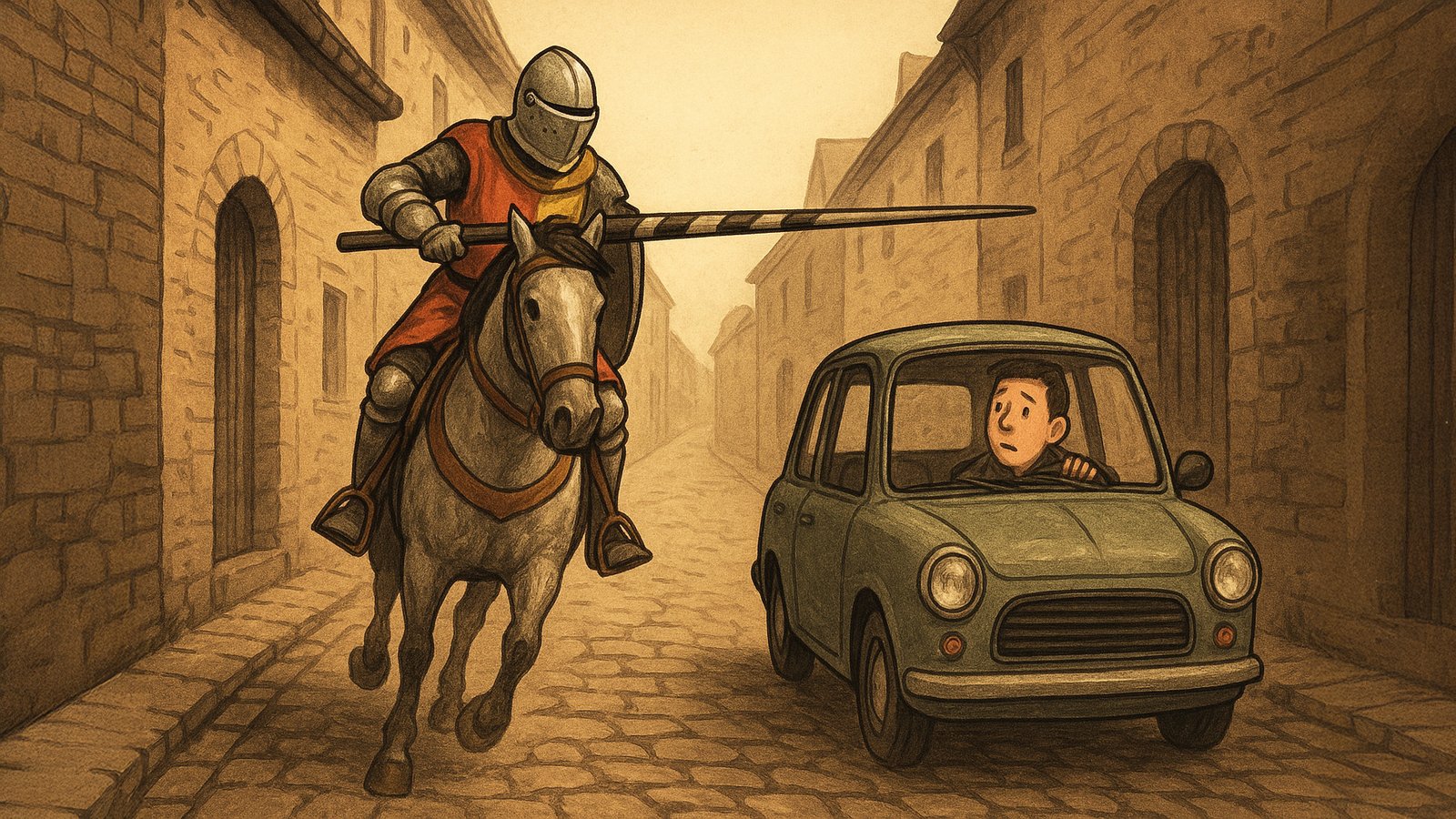
There are explosions, and then there is the kind that quietly rearranges an entire forest and leaves scientists arguing about it for more than a century. On a summer morning in 1908, somewhere deep in Siberia, the sky briefly behaved like it had lost patience with Earth. A fireball streaked overhead, brighter than the Sun, followed by a shockwave so powerful it flattened around 80 million trees. No crater. No obvious debris. Just a landscape that looked as though it had been pressed down by an invisible hand.
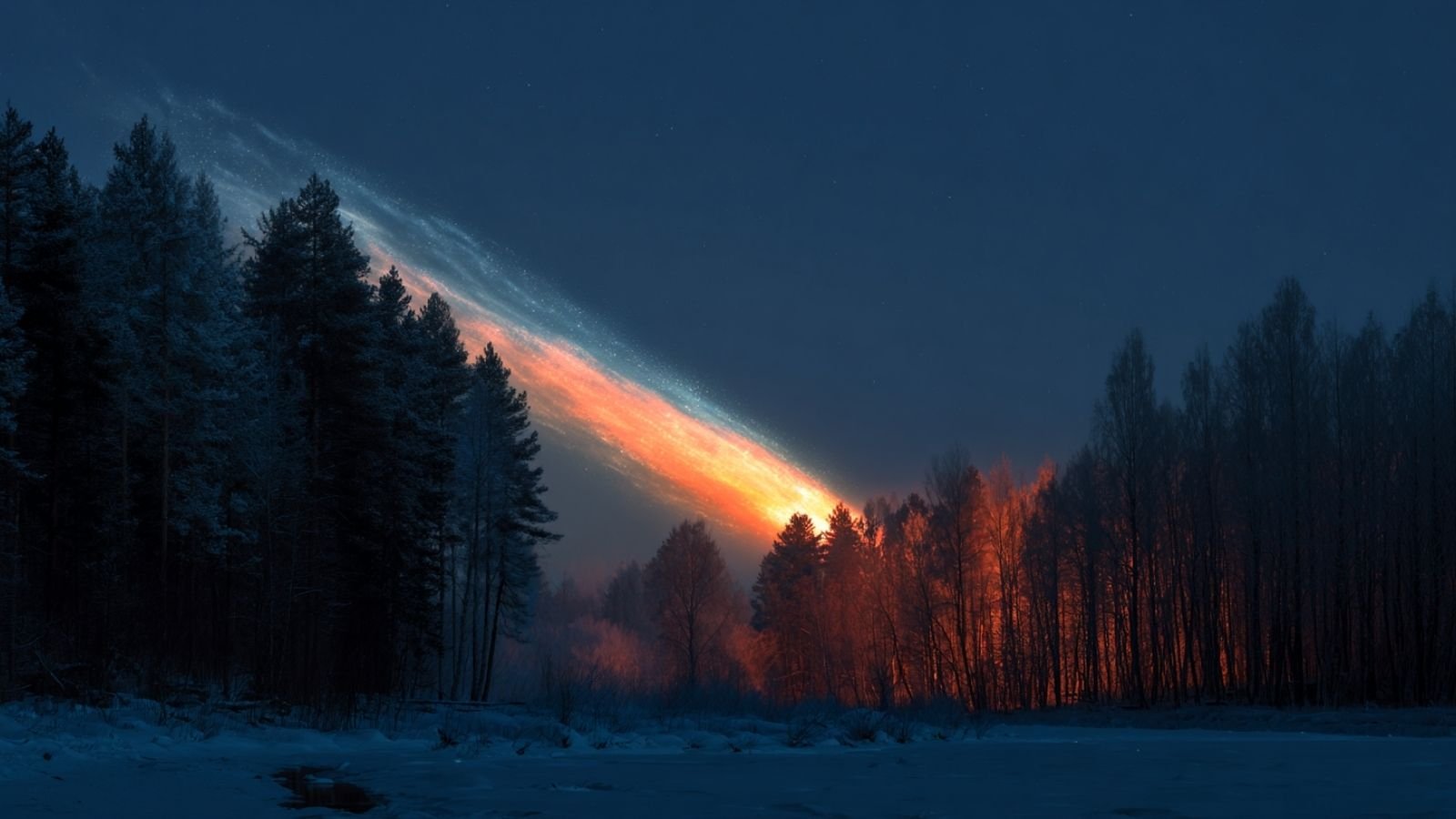
Naturally, the absence of a neat, reassuring explanation invited something far more entertaining: myths. The most cinematic theory insists that this was an alien spacecraft, inconveniently exploding mid-flight. It is easy to see why that one stuck. No crater means no obvious impact. Eyewitnesses described strange lights, glowing skies, and a sound that seemed to arrive late, like a delayed punchline. Add early twentieth-century isolation, patchy reporting, and a generous imagination, and suddenly Siberia becomes the site of an interstellar mishap. The problem is that every serious investigation since has found precisely zero evidence of anything remotely extraterrestrial. No alloys, no fragments, no signals. Just trees lying flat in a pattern that, inconveniently for the alien narrative, looks exactly like a massive atmospheric blast.
Then there is the black hole idea, which sounds impressively scientific until you think about it for more than a few seconds. A black hole passing through Earth would not politely flatten a forest and carry on its way. It would tear through the planet with catastrophic consequences, likely leaving a second, equally dramatic exit event on the other side. The Tunguska explosion, dramatic as it was, remained stubbornly local. The rest of the planet carried on with its day, blissfully unaware that Siberia had just hosted one of the most powerful natural explosions in recorded history.
Another theory, quieter but far more exotic, suggests an encounter with antimatter. In this version, a fragment of antimatter meets ordinary matter in the atmosphere and annihilates instantly, releasing enormous energy. It has a certain scientific elegance, almost too neat to resist. Yet it falls apart under scrutiny. Such an event would produce distinctive gamma radiation signatures that have never been detected in relation to Tunguska. Moreover, the energy distribution would likely differ from what was observed. It remains a fascinating idea, but one that sits firmly in the realm of theoretical curiosity rather than evidence-based explanation.
Perhaps the most charmingly persistent myth involves Nikola Tesla, who seems to have acquired the reputation of being capable of anything, provided it sounds vaguely electrical. The story goes that Tesla, experimenting with wireless energy transmission, somehow managed to beam a multi-megaton burst of power into a remote patch of Siberia. It has all the ingredients of a good legend: a brilliant inventor, mysterious technology, and a dramatic outcome. What it lacks is any practical mechanism. The technology of the time, even in Tesla’s most ambitious visions, was nowhere near capable of delivering that scale of energy, let alone with the precision required. Still, the myth survives, largely because Tesla himself has become a sort of historical magnet for speculative ideas.
More grounded, though still misleading, is the notion that Tunguska was a kind of natural nuclear explosion. The comparison is not entirely unreasonable. The energy released, estimated at up to 15 megatons of TNT, falls squarely into the range of large thermonuclear devices. Witnesses described intense heat, a blinding flash, and a shockwave that knocked people off their feet hundreds of kilometres away. Yet when scientists looked for the telltale signatures of nuclear activity, they found nothing. No radiation patterns, no isotopic traces. The resemblance is visual and physical, not nuclear. Tunguska looks like a nuclear explosion in the same way a thunderstorm can resemble artillery fire: similar effects, entirely different causes.
Even the idea that nothing happened at all has made occasional appearances, usually in the form of claims that the event was exaggerated or misreported. That argument collapses quickly under the weight of evidence. Seismic stations across Europe registered the shockwave. Atmospheric disturbances lit up night skies thousands of kilometres away. Eyewitnesses, despite their variations, consistently described a blazing object crossing the sky followed by a delayed, devastating blast. If this was an exaggeration, it was a remarkably coordinated one involving half a continent.
So what actually happened? Strip away the speculation, and the explanation becomes both simpler and, in its own way, more unsettling. A relatively small cosmic object, likely between 50 and 60 metres across, entered Earth’s atmosphere at tremendous speed. It might have been a stony meteoroid or a fragment of a comet; the distinction still sparks debate. As it plunged through the atmosphere, it compressed the air in front of it, generating extreme heat and pressure. Eventually, the stress became too much. Instead of reaching the ground, it exploded mid-air in what scientists call an airburst.
That detail, the explosion happening several kilometres above the surface, explains almost everything. Without a direct impact, there is no crater. The energy, released in the atmosphere, spreads outward as a shockwave, flattening trees in a radial pattern. Near the centre, some trees remain standing but are stripped bare, as though shaved by the blast. It is a peculiar, almost artistic arrangement, one that puzzled early investigators and continues to fascinate researchers today.
And then there are the quieter details, the ones that make the event feel oddly modern. People in London reportedly read newspapers outdoors at midnight without artificial light, thanks to the high-altitude dust scattering sunlight across the night sky. Seismic instruments recorded the disturbance long before anyone fully understood what had happened. Yet it took nearly two decades before a scientific expedition reached the site, led by Leonid Kulik in 1927. By then, the forest had already begun to recover, as if nature had decided to tidy up after the spectacle.
Despite decades of research, a few uncertainties remain. Scientists still debate whether the object was primarily rock or ice, asteroid or comet. Physical fragments are scarce, which complicates definitive conclusions. Models of the explosion continue to improve, especially with modern simulations, but Tunguska refuses to become entirely predictable. It sits in that uncomfortable space where science has strong answers, but not perfect ones.
What makes the story linger, however, is not just the mystery but the implication. Tunguska was not a once-in-a-billion-years anomaly. Objects of that size pass near Earth more often than we might like to admit. In 2013, a much smaller meteor exploded over Chelyabinsk, injuring over a thousand people, mostly through shattered glass. It served as a reminder that the sky remains, in a quiet way, an active participant in our lives.
If a Tunguska-scale airburst were to occur over a modern city, the outcome would be difficult to ignore. The same physics would apply, but the consequences would be measured in infrastructure, not just trees. That, more than alien spacecraft or experimental energy beams, is the real story. The universe does not need to be imaginative to be dramatic. Sometimes, a rock moving very fast is more than enough.