The Hidden Rhythm of Sleep: Inside Your REM Cycles
You fall asleep thinking nothing much is happening. Lights off, eyes closed, the day quietly folds into the background. Yet within minutes, your brain starts running a tightly choreographed sequence that repeats itself several times before morning. Sleep, it turns out, is not a passive shutdown. It is a rhythm, and REM cycles sit right at its most intriguing edge.
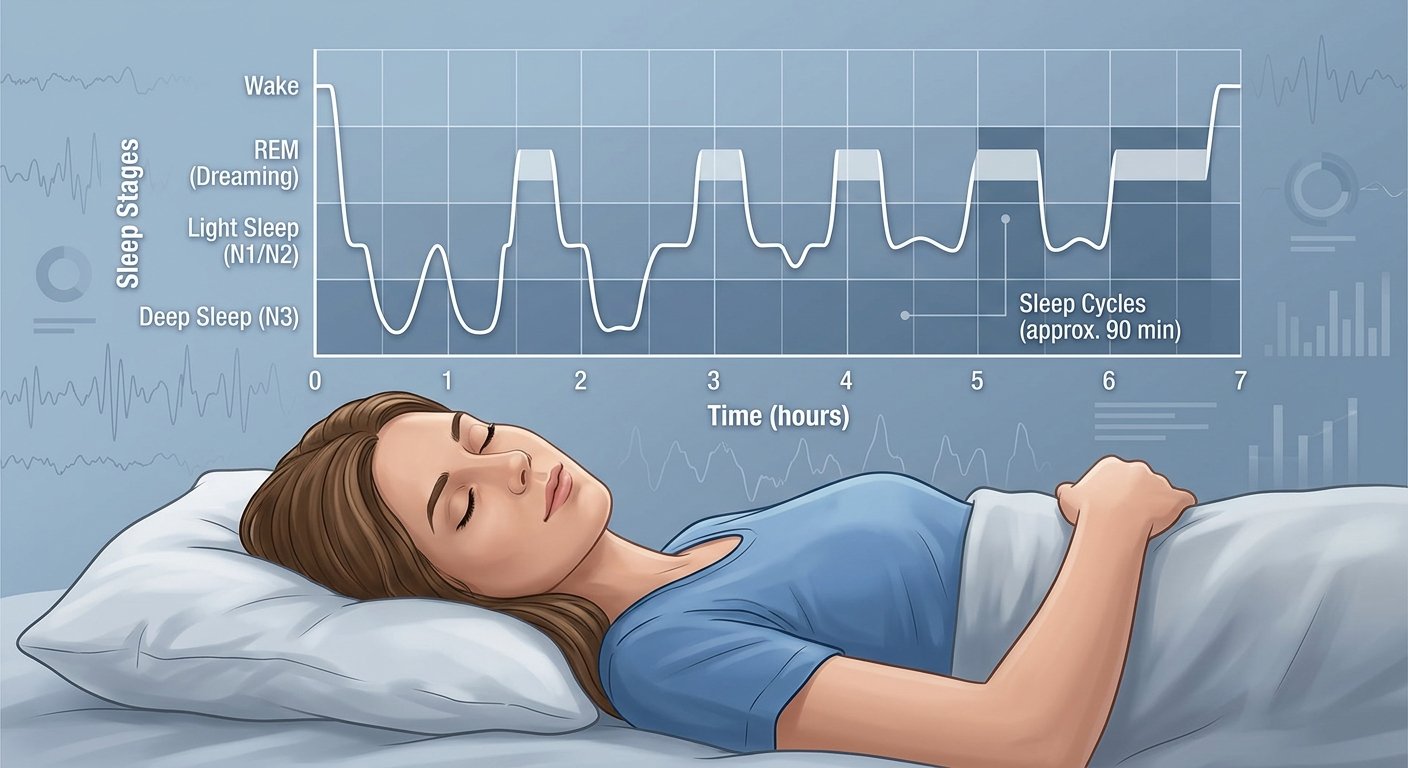
A typical night is divided into chunks of roughly ninety minutes. Each one carries you through a familiar pattern: drifting into light sleep, sliding deeper into restorative stages, and then, almost unexpectedly, entering REM sleep, where the mind lights up again. The strange part is that this doesn’t happen once. It loops. Four, five, sometimes six times, depending on how long you stay in bed and how cooperative your body feels that night.
At the start of the night, your body prioritises physical repair. Deep sleep dominates. Muscles relax fully, growth hormone is released, and the immune system quietly gets on with its maintenance work. If someone wakes you during this phase, you feel it immediately. Heavy, disoriented, slightly annoyed at the world. It is the kind of sleep your body defends quite fiercely.
Then, something shifts. As the first cycle nears its end, the brain begins to stir again. Not enough to wake you, but enough to change the rules. You enter REM sleep, short at first, almost tentative. Eyes flicker beneath closed lids, breathing becomes uneven, and the brain starts producing the kind of activity you would normally associate with being awake. This is where dreams begin to take shape, sometimes vivid, sometimes forgettable, often strange in ways that make perfect sense only while you are inside them.
As the night progresses, the balance flips. Deep sleep gradually retreats, making space for longer and more frequent REM phases. By the final hours before waking, REM can stretch to nearly an hour at a time. That explains why dreams often feel more elaborate toward morning. You are not imagining it. The brain is simply spending more time in that state.
What makes REM sleep particularly fascinating is that it looks, on paper, like a contradiction. The brain is highly active, almost as if it has woken up, yet the body remains effectively paralysed. This temporary paralysis is not a design flaw. It is a safety feature. Without it, you would act out your dreams, turning a quiet night into something far less restful.
Scientists have spent decades trying to understand why REM sleep exists at all. One of the leading ideas links it to memory processing. Throughout the day, your brain collects fragments of information, conversations, emotions, and impressions. During REM, it begins sorting through that material, strengthening some connections while quietly discarding others. It is less like filing documents neatly into folders and more like reorganising a cluttered desk in the dark.
There is also a strong emotional dimension. REM sleep appears to help regulate mood by allowing the brain to revisit emotional experiences in a safe, disconnected environment. In other words, it lets you feel things again, but with the volume turned down. That might explain why poor sleep often leaves people more reactive, more anxious, or simply less resilient to everyday stress.
Interestingly, not all sleep is created equal. You can spend eight hours in bed and still feel exhausted if your REM cycles are disrupted. Alcohol, for instance, has a habit of cutting into REM sleep. It may help you fall asleep faster, but it fragments the later cycles, precisely when REM becomes most important. The result is a night that looks adequate on the surface but feels insufficient the next day.
Stress plays a similar trick. A restless mind can interfere with the natural progression of sleep stages, shortening or delaying REM periods. Over time, this creates a subtle but persistent deficit. You are technically sleeping, yet missing out on some of the most cognitively valuable parts of the night.
There is a practical angle to all this. Because sleep cycles follow a fairly predictable rhythm, waking up at the end of a cycle tends to feel easier than waking in the middle of one. That is where the idea of ninety-minute blocks comes from. Six hours gives you roughly four cycles, seven and a half hours brings you closer to five, and nine hours allows for six. It is not a perfect system, but it offers a useful way to think about timing sleep rather than just counting hours.
Of course, real life rarely aligns perfectly with theory. Alarms go off at inconvenient moments, late nights stretch longer than planned, and early meetings do not care where you are in your cycle. Yet even a rough awareness of how REM sleep works can change how you approach rest. It shifts the focus from simply getting enough sleep to getting the right kind of sleep.
There is also something quietly humbling about the whole process. While you sleep, your brain continues working through problems, consolidating knowledge, and reshaping emotional responses without any conscious input from you. It is as if part of your mind refuses to clock off, choosing instead to tidy up the day before handing control back in the morning.
Perhaps that is why dreams can sometimes feel unexpectedly insightful. They are not random in the way they appear. They are fragments of memory, emotion, and imagination being rearranged in real time. Occasionally, that rearrangement produces something useful. More often, it produces something absurd. Either way, the process itself matters.
So the next time you wake up from a particularly vivid dream, it might be worth remembering that you have just surfaced from one of those REM phases, likely toward the end of a cycle. Your brain has been busy, even if the results feel slightly surreal.
Sleep, in that sense, is not just rest. It is maintenance, reflection, and quiet recalibration. REM cycles are simply the most visible part of that hidden work, the moments when the mind becomes active again while the body stays still. And all of it repeats, night after night, largely unnoticed, until something interrupts the rhythm and reminds you just how essential it really is.