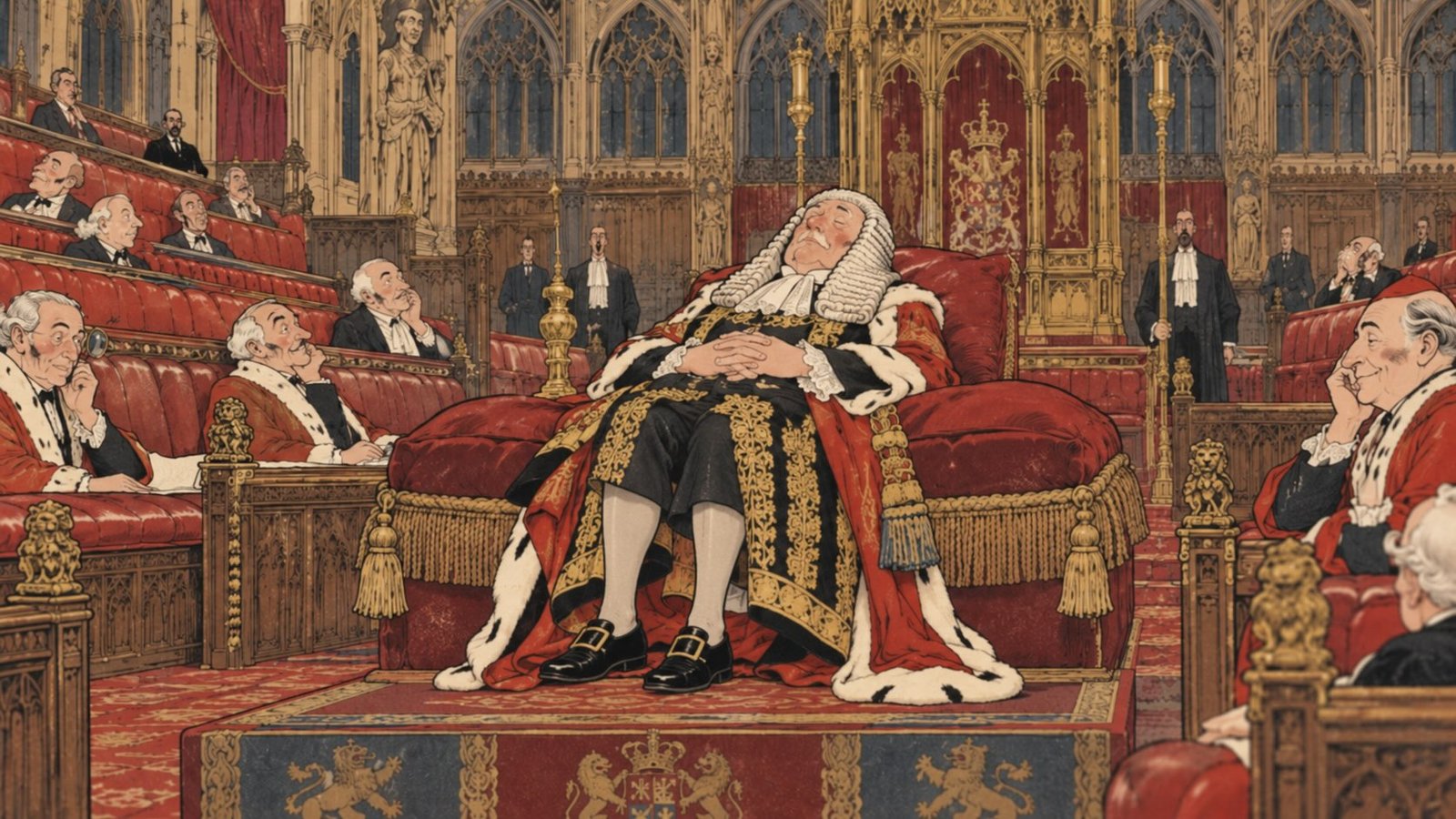
Imagine walking into one of the most magnificent parliamentary chambers in the world. Gold glitters from the ceiling, Gothic carvings cover the walls, and an elaborate royal throne stands beneath an ornate canopy. Everything announces centuries of power, wealth and ceremony. Yet right in the middle of this splendour sits something rather unexpected: an enormous red cushion stuffed with sheep’s wool. And on this glorified sack sits one of Britain’s most senior parliamentary officials.
Welcome to the House of Lords, where the furniture tells a remarkable economic story. The cushion has a name, the Woolsack, and its origins stretch back to a time when England’s greatest national asset wasn’t banking, technology or property. It was sheep. More precisely, it was what grew on their backs, and the extraordinary fortunes that merchants, monarchs and monasteries could make from it.
The Woolsack looks like a peculiarly British joke, but its symbolism was once deadly serious. Medieval England depended heavily on wool exports, particularly to the great textile-producing centres of continental Europe. Wool generated commercial fortunes, provided the Crown with valuable tax revenues and helped finance the machinery of government. Today, the tradition survives in Westminster, where a medieval economic statement has become one of the country’s most unusual pieces of political furniture.
The story traditionally begins with King Edward III, who ruled England from 1327 to 1377. According to parliamentary tradition, he wanted the Lord Chancellor to sit on a sack of wool as a permanent reminder of the trade that sustained the kingdom’s prosperity. Historians cannot establish every detail of that origin story, but Parliament traces the Woolsack to the fourteenth century. The message would have been perfectly clear to contemporaries: the country’s rulers quite literally rested upon the source of its wealth.
To understand why wool deserved such an honour, we need to forget the modern image of sheep as decorative inhabitants of green fields. In medieval England, they were four-legged economic engines. English wool, particularly the fine fleeces produced in regions such as the Cotswolds and the Welsh Marches, attracted buyers from across Europe. Flemish and Italian textile centres turned raw wool into valuable cloth, while merchants organised sophisticated international trading networks long before anyone invented the phrase global supply chain.
Wool also offered medieval rulers something even more attractive than prosperous merchants: taxable exports. Kings needed money for wars, administration and ambitious political projects, and duties on wool provided an important source of revenue. Edward III’s government relied heavily on the trade during a reign marked by expensive military campaigns, including the opening decades of the Hundred Years’ War. Sheep did not march into battle, but their fleeces helped pay for the soldiers who did.
The profits transformed the English landscape. Wealthy wool merchants financed grand houses, charitable foundations and extraordinary parish churches, especially in the Cotswolds. Places such as Chipping Campden and Northleach still display architectural evidence of the trade’s success. Their elaborate stonework and soaring church towers tell the story of communities whose prosperity came from wool rather than aristocratic inheritance alone. Some merchants clearly understood that a fortune looked even better when converted into something that would impress the neighbours for several centuries.
However, the industry was not simply a cheerful procession of prosperous shepherds and grateful kings. Wealth accumulated unevenly, taxation created tensions, and European politics could disrupt the trade. English producers depended on overseas buyers, while continental clothmakers depended on English supplies. This mutual reliance created opportunities for profit, diplomatic bargaining and occasional economic confrontation. The medieval wool trade combined international commerce with political leverage, a combination that modern governments would find depressingly familiar.
Over time, England also developed its own clothmaking industry, increasingly exporting finished textiles rather than simply raw wool. Nevertheless, the Woolsack remained. The economic realities changed, but the parliamentary symbol endured, apparently demonstrating that Westminster could adapt to new industries without necessarily updating the furniture.
The cushion itself deserves a closer look. Despite its name, it isn’t an ordinary sack casually abandoned on the floor. The Woolsack is a substantial square seat covered in red cloth, without the conventional back and arms of a chair. It occupies a prominent position in the House of Lords Chamber, directly in front of the Royal Throne. Its appearance may suggest comfort, although anyone expecting a luxurious armchair would probably feel disappointed.
For centuries, the Lord Chancellor occupied the Woolsack. This was a particularly remarkable office because the Lord Chancellor historically combined responsibilities across government, Parliament and the judiciary. The arrangement reflected a constitutional world rather different from today’s separation of institutional functions. Following reforms under the Constitutional Reform Act 2005, the newly established office of Lord Speaker took over the presiding role in 2006. The occupant changed, but the sheep retained their privileged position.
There is another peculiarity. Unlike the Speaker of the House of Commons, the Lord Speaker cannot routinely decide who speaks next or call unruly members to order. The House of Lords regulates its own proceedings, leaving the Lord Speaker with a more limited procedural role. Consequently, the person occupying Britain’s most symbolically significant cushion has less direct control over debate than many visitors might imagine. It is an impressive seat, but not necessarily an impressive instrument of discipline.
Even the Woolsack’s stuffing has a history of minor scandal. During the twentieth century, officials discovered that the supposedly wool-filled symbol of Britain’s wool industry contained horsehair instead. Somewhere along the way, practical upholstery had quietly defeated centuries of economic symbolism. In 1938, Parliament restored the appropriate material, using wool from Britain and Commonwealth countries. Evidently, if the nation’s prosperity was going to rest on wool, someone thought it advisable to ensure that wool was actually present.
The matter returned to Parliament in the 1960s, when peers debated the Woolsack’s contents with a seriousness normally reserved for matters of state. In January 1966, the government confirmed that it had received wool from fourteen Commonwealth countries and territories for another refilling. The contributors included Australia, Canada, New Zealand, India, Pakistan and the Falkland Islands, alongside the constituent parts of the United Kingdom. A medieval symbol of English commerce had evolved into a rather soft celebration of Commonwealth connections.
The debates also produced some excellent parliamentary humour. In 1965, one peer complained that the Woolsack had sunk and needed attention. Another remarked that the peer concerned had evidently made a deep impression upon it. The exchange demonstrated that even the House of Lords occasionally recognises the comic possibilities of its own upholstery.
The Woolsack is not alone, either. The chamber contains additional cushions known as the Judges’ Woolsacks, which recall the historic involvement of senior judges in parliamentary proceedings. During the State Opening of Parliament, senior judges occupy these seats. At other times, members of the Lords may sit on them. The result is an institution where cushions possess constitutional biographies considerably more interesting than those of most household furniture.
Perhaps the most fascinating aspect of the Woolsack is how completely its original economic context has disappeared. Britain no longer depends on wool exports to finance its government. Financial services, pharmaceuticals, advanced manufacturing and countless other industries now occupy places that sheep once held in the national economy. Yet Parliament continues to preserve the physical reminder of a world in which wool could influence royal finances, international diplomacy and the fortunes of entire regions.
There is something rather appealing about that stubborn continuity. Modern economies constantly celebrate whatever industry currently promises the next great transformation. Medieval England had wool, Victorian Britain had coal and steam, and today’s politicians speak enthusiastically about artificial intelligence and digital technology. Every generation imagines that its economic priorities represent the future, while history quietly prepares to turn them into museum exhibits.
The Woolsack offers a different perspective. It reminds us that national prosperity rests on real productive activities, however unglamorous they may appear to later generations. It also shows how economic power can shape political institutions, architecture and public ceremony long after the original industry has lost its dominance.
So, the next time someone describes British parliamentary traditions as unnecessarily eccentric, consider the Woolsack. A red cushion full of wool may look absurd among gilded thrones and solemn ceremonies, but it tells a surprisingly sophisticated story about trade, taxation, international dependence and the relationship between economic wealth and political authority.
And perhaps that is the most British part of the whole arrangement. Other countries commemorate their former economic greatness with monuments, statues and museums. Britain makes one of its senior parliamentary officials sit on it.