London has plenty of famous residents. Some occupy palaces, others appear on television, and a few have spent centuries standing on pavements without attracting much attention. Among the most successful are the London plane trees, those enormous green giants with strangely mottled trunks that line the capital’s streets, squares and embankments. They have witnessed horse-drawn carriages, Victorian gentlemen, two world wars, millions of motorcars and the occasional drunken tourist. Yet most Londoners walk past them without giving them a second glance.
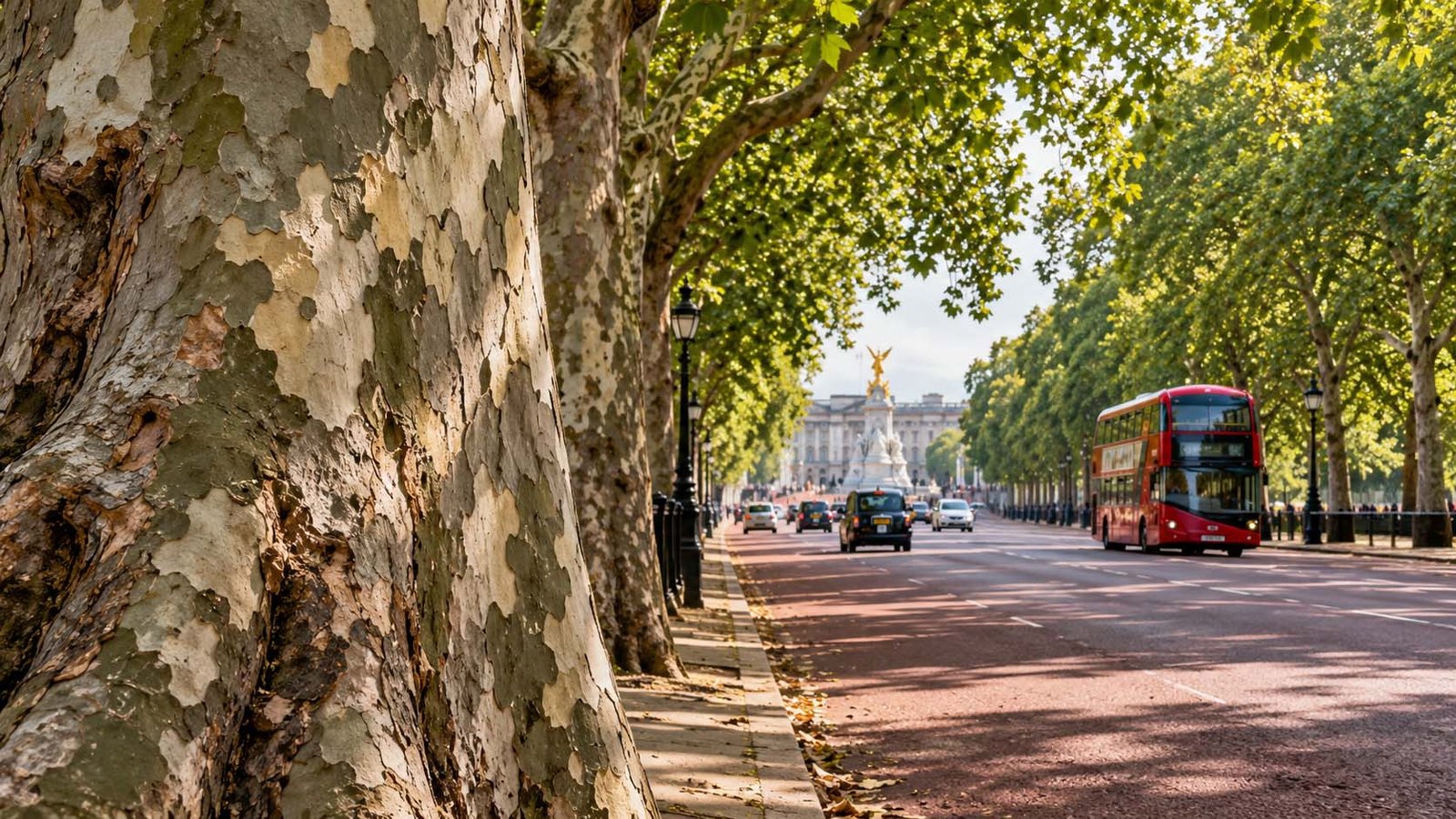
Look more closely at one of their trunks, however, and you will notice something peculiar. Its bark resembles military camouflage, with irregular patches of olive green, cream, grey and brown. The tree looks as though someone has been peeling away its skin. In fact, that is precisely what happens, and this unusual habit helped make the London plane one of the great botanical success stories of the Industrial Revolution. While coal smoke blackened buildings and made breathing an increasingly unpleasant activity, these trees developed a remarkable reputation for coping with the filth. London had found a tree that could live with its worst habits.
The London plane, Platanus hispanica, has a surprisingly international family background. Botanists generally regard it as a hybrid between the Oriental plane, native to parts of southeastern Europe and western Asia, and the American sycamore, which comes from North America. The two species probably met in a European garden during the seventeenth century, where someone had planted them close enough for cross-pollination. Nature handled the rest, producing a vigorous hybrid that would eventually become a familiar sight across European cities.
Exactly where this botanical romance took place remains disputed. One popular British account credits the garden of John Tradescant the Younger, a celebrated plant collector, in Lambeth. Other theories favour Oxford, Spain or France. Unfortunately, nobody thought to record the happy occasion, so the London plane has something of a mysterious birth certificate. Its name reflects its extraordinary popularity in the British capital rather than an unquestionably London birthplace. For a tree that became such a symbol of the city, its origins remain delightfully uncertain.
By the eighteenth century, London was expanding rapidly, and the nineteenth century turned that growth into something approaching urban chaos. Factories, workshops, domestic fireplaces and industrial furnaces consumed enormous quantities of coal. Smoke filled the atmosphere, soot settled on buildings, and fog mixed with pollution to create the notorious London smog. The city’s increasingly crowded streets offered little comfort to ordinary vegetation. Trees faced polluted air, compacted soil, restricted roots and the constant disturbance of urban construction. Being a tree in Victorian London was hardly a promising career.
Yet the London plane seemed remarkably comfortable. It tolerated dirty air, difficult soils, wind and the pressures of growing in crowded streets. Its broad leaves formed generous canopies, while its vigorous growth helped it survive conditions that troubled many other species. Victorian planners increasingly embraced it, especially as tree-lined boulevards became fashionable in European cities. London borrowed some inspiration from Paris, but the plane proved particularly suited to the British capital’s industrial character. It offered something fashionable, practical and unexpectedly resilient, a combination that Victorians generally appreciated.
Its most famous trick involved the bark. Unlike trees that retain much of their outer bark for long periods, the London plane regularly sheds large, thin plates as its trunk expands. Pollutants and soot particles that accumulate on the surface can disappear with those discarded layers, revealing fresh, lighter bark underneath. The result is that extraordinary patchwork pattern, almost as though the tree continually renews its wardrobe. The process helps explain its tolerance of polluted urban environments, although it would be an exaggeration to suggest that peeling bark alone made London’s air clean. The trees survived the smoke rather than magically eliminating it.
Their leaves also contributed to the relationship between the tree and the city. Large, tough and generally five-lobed, they intercept airborne particles and offer shade during hot weather. Rain can wash some accumulated dirt away, while falling leaves remove other material from the canopy. Meanwhile, the trees absorb carbon dioxide as they grow and store carbon in their wood. Unlike a mechanical air purifier, however, a tree does not make pollutants disappear without consequences. Its environmental benefits depend on its size, health, location and the surrounding air conditions. Nevertheless, the London plane provided a remarkably useful combination of survival and service.
The Victorian enthusiasm transformed the capital’s appearance. During the construction of the Victoria Embankment in the nineteenth century, planners planted planes along the new riverside thoroughfare, helping establish the grand tree-lined streetscape that Londoners recognise today. Elsewhere, the trees flourished in squares, parks and residential avenues. Their enormous crowns softened hard architectural lines, while their trunks acquired a dignity that few decorative street plants could match. The capital gradually developed a distinctive green architecture, with branches forming ceilings above pavements and roads.
Some specimens became celebrities in their own right. Berkeley Square in Mayfair contains magnificent mature planes that have watched the neighbourhood change around them. At Barn Elms, near the Thames, stands an extraordinary veteran nicknamed Barney, often described as one of London’s oldest and largest plane trees, with an estimated age exceeding three centuries. Meanwhile, a plane at the junction of Wood Street and Cheapside has long served as a curious landmark in the City. Surrounded by commercial buildings and centuries of urban redevelopment, it survives as a reminder that London’s living history sometimes grows in the most unlikely places.
One particularly charming detail concerns the Cheapside tree’s place in Victorian commercial life. In the days before digital maps, local businesses sometimes described their addresses in relation to the tree. A cab company advertised itself as operating beneath it, while another business used the tree as a reference point for customers. Imagine giving directions in modern London by saying, “You’ll find us opposite the enormous plane.” In an age of satellite navigation, it sounds wonderfully imprecise, yet Londoners once considered the tree a more reliable landmark than many buildings. Even William Wordsworth wrote about a thrush singing at the corner of Wood Street, a small moment of nature interrupting the commercial bustle.
Of course, the London plane has its less agreeable characteristics. Its enormous roots can interfere with pavements, and its branches require careful management. More irritatingly, its pollen and the fine hairs released from its leaves and seed balls can aggravate allergies and respiratory conditions. For some Londoners, the arrival of spring beneath a plane tree means sneezing rather than poetic inspiration. There is also a botanical irony here: a tree celebrated for improving urban air quality can occasionally make breathing uncomfortable for particular individuals. Even the most successful city resident has a few antisocial habits.
Today, the London plane faces challenges that Victorian gardeners could scarcely have imagined. Climate change brings periods of intense heat and drought, while construction continues to restrict the space available for roots. Fungal diseases present another concern. Massaria disease can cause serious branch decay, creating safety risks in busy public spaces. Meanwhile, canker stain of plane, a destructive disease present in parts of continental Europe, represents a potential threat to Britain’s trees. Modern arborists must therefore balance the preservation of magnificent old specimens with the practical demands of maintaining safe streets.
Yet these trees remain extraordinarily valuable. Research reported by the London Museum found that London planes accounted for around 6 per cent of the city’s estimated tree carbon storage despite representing only about 1.4 per cent of its tree population. Their sheer size explains much of that disproportionate contribution. A mature plane offers something a newly planted sapling cannot immediately reproduce: decades of accumulated growth, extensive shade and an established place in the urban landscape. Replacing a centuries-old giant with several young trees might look satisfactory on a planting spreadsheet, but the environmental and visual benefits take generations to recover.
Perhaps the most remarkable thing about the London plane is how completely it has become part of the capital’s identity. It is not native to Britain, its exact birthplace remains uncertain, and its ancestors came from opposite sides of the Atlantic. Nevertheless, it has become as recognisably London as the red bus or the black cab. Its spotted bark records a remarkable adaptation to urban life, while its vast canopy connects the smoky Victorian metropolis with the modern city beneath it.
Next time you walk along the Embankment, through Berkeley Square or beneath the trees of The Mall, look at those enormous trunks rather than the traffic. Their camouflage-like bark tells a story of botanical chance, industrial pollution and extraordinary resilience. London has reinvented itself repeatedly over the past three centuries, demolishing buildings, widening roads and replacing entire neighbourhoods. Through it all, these peculiar international immigrants have quietly remained at their posts. And unlike most London institutions, they have managed to grow more impressive with age.