For more than a century, a small piece of dinosaur skull sat in a drawer at London’s Natural History Museum, apparently attracting little attention. It had been collected on the Isle of Wight in 1924, catalogued and stored away among thousands of other prehistoric specimens. Then researchers took another look. On 14 October 2026, scientists announced that the overlooked fossil belonged to an entirely new species of carnivorous dinosaur, the first member of its group ever identified in Europe. The creature had lived approximately 120 million years ago, possessed formidable claws and might have considered a human a perfectly reasonable lunch. It had taken a hundred years to establish its identity, which is fairly impressive even by the standards of British museum administration.
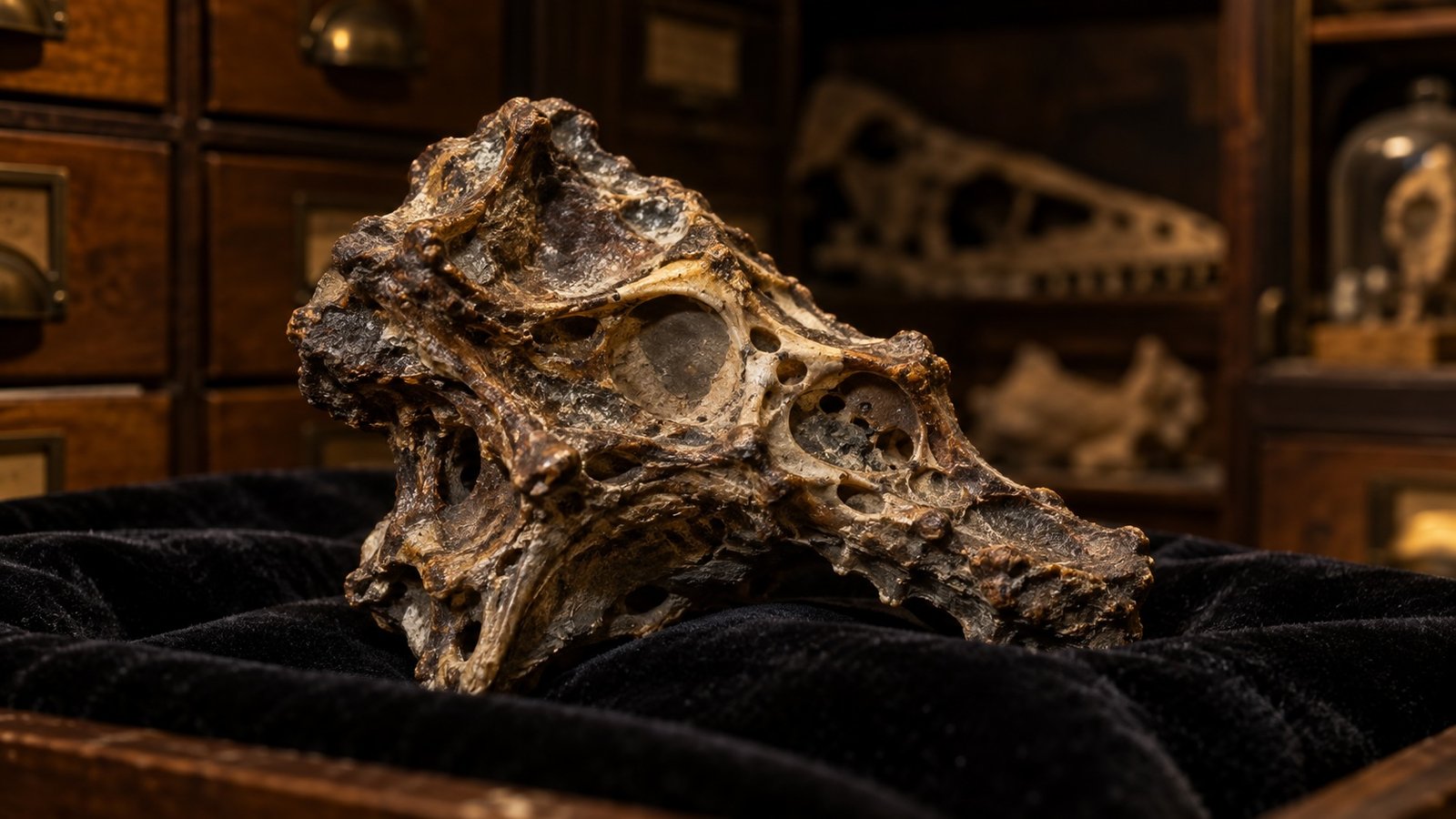
The newly identified dinosaur has been named Invictibellatrix amberina. The first part means ‘unconquered female warrior’, a rather grand title for an animal known from a fragment of its skull. The second refers to amber associated with the geological deposits where the fossil originated. The animal belonged to the megaraptorans, a group of agile, two-legged predators related to the wider evolutionary branch that includes tyrannosaurs. Unlike the famous Tyrannosaurus rex, which relied on an enormous head and crushing jaws, megaraptorans developed long, powerful arms equipped with large curved claws. They were built for a different style of hunting, and the new British specimen provides an unexpected clue to how these predators spread around the prehistoric world.
The story began on the south-west coast of the Isle of Wight, where amateur palaeontologist Reginald Walter Tooley collected the fossil from beneath a cliff. The island was already recognised as one of Britain’s most productive dinosaur hunting grounds. Its sedimentary rocks preserve evidence of the Early Cretaceous, when the area was part of a much warmer environment of rivers, floodplains, lagoons and forests. Dinosaurs wandered across a landscape inhabited by crocodile-like reptiles, turtles, fish and early mammals. The English Channel did not exist in its modern form, and the Isle of Wight was certainly not a convenient seaside destination.
The Natural History Museum acquired Tooley’s fossil in 1924, but its scientific significance remained unrecognised for decades. This was not necessarily carelessness. A partial braincase, the bony structure surrounding the brain, is considerably less impressive to the casual observer than a complete skeleton with teeth the size of bananas. Identifying such fragments requires detailed anatomical comparisons, and the necessary knowledge was not always available to earlier generations of researchers. Museums contain enormous collections assembled over centuries, and many specimens await examination using techniques that did not exist when they were collected.
Based on comparisons with related animals, researchers estimate that Invictibellatrix measured approximately three to four metres in length and stood a little over one and a half metres tall. Its weight may have been comparable to that of a large tiger. It probably had some form of feather-like covering, although no feathers have been found with the specimen. Its claws may have measured between 10 and 20 centimetres, but those dimensions are also estimates based on relatives rather than direct measurements. Reconstructing a dinosaur from a piece of braincase involves a considerable amount of anatomical detective work, with some educated guesswork thrown in.
Its probable diet included small dinosaurs, lizards and mammals. The researchers suggested that it may have occupied an ecological position comparable to that of a modern hyena, hunting smaller animals while sharing its environment with considerably larger predators. The comparison concerns its role in the food chain rather than any direct resemblance in appearance or behaviour. Invictibellatrix was not the dominant carnivore of Early Cretaceous Britain. Other theropods were larger and presumably capable of tackling more substantial prey.
Nevertheless, the scientists offered an entertaining thought experiment. Had humans existed alongside this animal, Invictibellatrix might have presented a greater personal danger than Tyrannosaurus rex. Morrison argued that a human would have been an appropriately sized target for the smaller predator, whereas a gigantic tyrannosaur might not have considered such modest prey worth the effort. This is, of course, speculation about animals separated from humanity by more than 100 million years. Nobody can establish whether a hungry tyrannosaur would have ignored a passing human, and it would be unwise to test the proposition if time travel ever becomes commercially available.
The greater scientific significance of the fossil concerns geography rather than appetite. Until this research, megaraptorans were known principally from other parts of the world, especially southern continents. Their evolutionary origins and movements have remained difficult to reconstruct because relatively few fossils have survived. One leading hypothesis proposes that these dinosaurs originated in Asia and dispersed through Europe towards the southern landmasses, where some of their descendants eventually became enormous predators.
The Isle of Wight specimen provides the first confirmed European evidence for the group, filling a conspicuous gap in that proposed migration route. It does not prove every stage of the journey, but it makes a European connection considerably more plausible. Researchers also used evolutionary and geographical modelling to investigate how megaraptorans might have dispersed as continents shifted and ancient environments changed. Their findings offer a clearer picture of a dinosaur group whose history has been much less thoroughly documented than that of its tyrannosaur relatives.
By the Late Cretaceous, some megaraptorans had become giants. Maip macrothorax, discovered in Argentina, lived roughly 70 million years ago and may have reached around ten metres in length. While tyrannosaurs dominated many northern ecosystems, large megaraptorans occupied major predatory roles in parts of the southern world. Their exact evolutionary relationships remain debated, and palaeontologists continue to disagree about precisely where the group belongs on the theropod family tree. The new British fossil adds evidence to that discussion without settling every argument.
There is also something particularly British about the circumstances of the find. The Isle of Wight has supplied dinosaur fossils for generations, and its cliffs continue to reveal new specimens through erosion. Yet this latest species was not recognised through an expedition into unexplored territory or the excavation of an enormous skeleton. Its remains were already safely housed in South Kensington. What changed was the ability to interpret them.
Professor Paul Barrett of the Natural History Museum, a senior author of the study published in Royal Society Open Science, emphasised the value of returning to historical collections. The museum’s drawers contain material gathered by professionals and amateurs whose contributions can acquire new significance as scientific understanding advances. Tooley could hardly have imagined that a fragment he recovered in 1924 would help researchers trace the movements of prehistoric predators across continents.
For a creature called the unconquered female warrior, Invictibellatrix amberina enjoyed an unusually quiet century. It survived 120 million years underground, another hundred years in museum storage, and finally emerged into scientific recognition without moving an inch. Somewhere in the Natural History Museum, there may be another piece of ancient bone waiting patiently for somebody to open the right drawer.