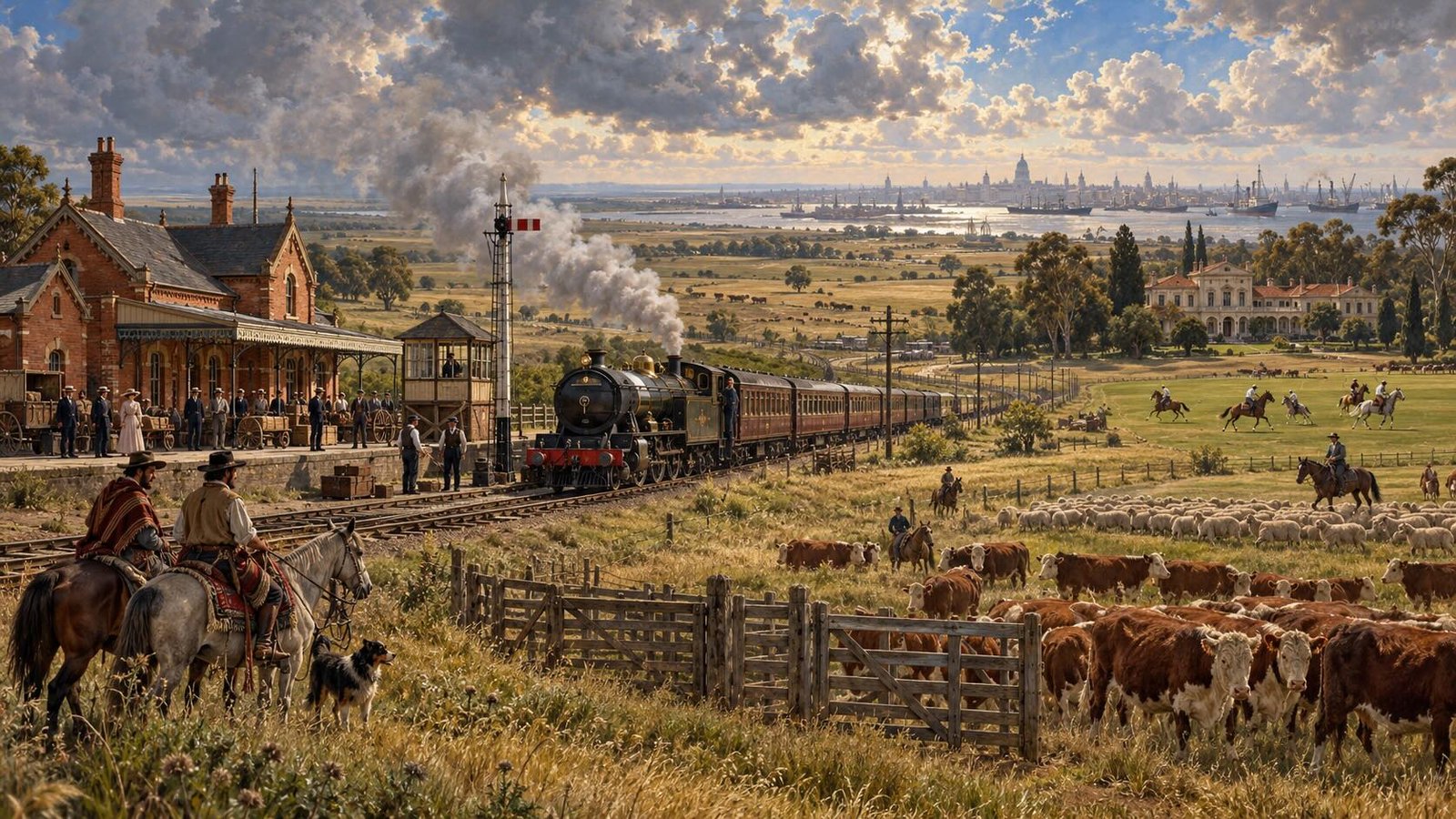
Stand on an old railway platform somewhere in the Argentine Pampas and you may experience a peculiar geographical confusion. The station has red brickwork, a pitched roof, iron columns and the faint architectural air of somewhere outside York. Nearby there may be an avenue of trees, an estancia with an English-looking garden and perhaps a town with a name such as Hurlingham, Banfield or Temperley. Then a gaucho rides past and reminds you that Yorkshire is several thousand miles away. Britain never ruled Argentina, never planted the Union Jack over Buenos Aires and never appointed a governor-general. Yet during the nineteenth and early twentieth centuries, British money, engineers, merchants, farmers and railwaymen left fingerprints across the country so deep that parts of modern Argentina still carry them.
The relationship grew because the two countries possessed exactly what the other wanted. Industrial Britain needed food, wool and raw materials. Argentina possessed an almost indecent quantity of fertile land. Argentina, meanwhile, needed capital, machinery, railways and access to international markets. London could provide all four. British investors therefore poured money into Argentine railways, ports, utilities, banks and commercial companies. By 1913 Argentina had more than 32,000 kilometres of railway, compared with just 2,516 kilometres in 1880. Much of this extraordinary expansion depended on British finance. The great Buenos Aires Great Southern and Central Argentine systems became businesses of enormous scale, with individual networks capitalised at around £50 million by 1914.
Look at a railway map from the period and its logic becomes obvious. The lines spread across the Pampas like the ribs of an enormous fan, with Buenos Aires and its port near the handle. They connected agricultural districts with ships waiting to carry grain, wool and meat across the Atlantic. The railway did not merely transport Argentina’s agricultural revolution; it helped create it. Land near a new line became more valuable. Settlements grew around stations. Farmers could produce for distant markets rather than merely local ones. Argentina’s vast interior suddenly became economically much closer to Liverpool and London.
The British influence reached directly into the estancia. One charming myth imagines the Argentine cattle industry as something completely indigenous: gauchos, criollo cattle and endless grass, with Britain appearing conveniently at the docks to buy the steaks. Reality was more entangled. British livestock breeds helped transform Argentine farming. Scottish-born John Miller became famous for introducing the Shorthorn bull Tarquino during the 1820s. Later estancias bred Shorthorn and Hereford cattle, Lincoln and Romney Marsh sheep and British horse breeds. Argentine farmers were not simply copying Britain; they were creating an increasingly sophisticated agricultural system designed partly around international demand.
Refrigeration completed the marriage. Before refrigerated shipping, an Argentine cow had the unfortunate commercial disadvantage of being alive on the wrong side of the Atlantic. Freezing and later chilling changed everything. British and Argentine companies built meat-processing businesses capable of sending enormous quantities of meat northwards. By 1913 Argentina supplied an astonishing 99 per cent of Britain’s chilled-beef imports. British consumers developed an intimate relationship with the Pampas without necessarily knowing it. Somewhere behind the respectable Sunday roast stood an Argentine steer, a refrigerated ship and several City investors.
Sheep created another British connection, especially farther south. Scottish shepherds played an important role in developing sheep farming in Patagonia and Tierra del Fuego. Animals arrived from the Falkland Islands, while experienced British shepherds and managers brought knowledge of large-scale wool production. However, this story has a darker edge. The expansion of ranching across indigenous territories contributed to violent dispossession, particularly in Tierra del Fuego. Some European ranch employees participated directly in atrocities against indigenous peoples. The picturesque image of hardy Scottish shepherds conquering an empty wilderness therefore requires one important correction: the wilderness was not empty.
Back around Buenos Aires, British railway employees, businessmen and their families built something resembling a parallel social universe. They established schools, churches, newspapers and clubs. St George’s College opened in Quilmes in 1898. Hurlingham Club, founded by members of the British community in 1888 and modelled on its London namesake, offered cricket, polo, golf, tennis and other reassuringly British activities. The Pacific Railway even supported the club because it stood near its new line. Soon a station appeared beside it and inherited the name Hurlingham. Britain had achieved the impressive trick of exporting not only a railway and a sports club but eventually a place name.
Polo offers perhaps the most elegant example of cultural transplantation becoming something distinctly Argentine. British residents helped institutionalise the sport through clubs such as Hurlingham, whose polo history began around 1890. Yet Argentina did not remain Britain’s enthusiastic pupil for long. The enormous open spaces of the Pampas, its horse culture and generations of extraordinary players transformed Argentina into a world centre of polo. The imported game became so thoroughly Argentine that today the direction of admiration has largely reversed. British polo players look towards Argentina for horses, players and expertise.
Football performed an even more spectacular escape from its British parents. Scottish teacher Alexander Watson Hutton arrived in Argentina in 1882, founded the Buenos Aires English High School in 1884 and treated sport as an essential part of education. He later helped organise the Argentine Association Football League in 1893. Railway workers, schools and British clubs spread the game. Then Argentines seized football culturally, emotionally and stylistically until its British beginnings became little more than archaeological remains beneath one of the world’s great football cultures. Britain supplied the rulebook. Argentina eventually supplied Maradona and Messi. One suspects Watson Hutton would have considered that a satisfactory return on investment.
Money, however, produced a more complicated legacy. Argentina became one of London’s favourite overseas investments, but intimacy created vulnerability. The Baring Crisis of 1890 demonstrated just how closely Buenos Aires and the City had become connected. Baring Brothers had become dangerously exposed to Argentine finance, and trouble in Argentina helped push the famous London bank towards collapse. The Bank of England organised a rescue operation to prevent a wider financial panic. Long before economists invented fashionable expressions such as “financial contagion”, Argentina and Britain were already demonstrating it rather effectively.
This enormous British presence later encouraged historians to describe Argentina as part of Britain’s “informal empire”. The phrase sounds wonderfully sinister: no red-coated soldiers required, just bankers, railway engineers and refrigerated beef. There is some logic to it. British capital controlled strategically important infrastructure, while Britain provided a crucial market for Argentine exports. Yet the label remains controversial. Argentina remained a sovereign state, Argentine politicians actively courted foreign capital, local investors participated in railway development, and British businessmen themselves often behaved less like imperial missionaries than businessmen interested in dividends.
By the 1930s, however, the relationship had become politically uncomfortable. The controversial Roca–Runciman agreement of 1933 protected Argentine access to the British meat market while granting important advantages to British commercial interests. Argentine nationalists attacked the arrangement as evidence of excessive economic dependence. What had once looked like modernisation increasingly looked, to critics, like foreign control. Railways became the most visible symbol. When Juan Perón’s government bought the British-owned systems, the transfer finally took effect in 1948. At that point, 57 per cent of Argentina’s railway network remained British-owned. Nationalisation became a celebration of economic sovereignty, although Britain itself was hardly heartbroken to dispose of ageing assets in the financially difficult aftermath of the Second World War.
The British economic empire faded, but its fingerprints proved harder to remove. They remain in railway stations and suburban architecture, in old schools and clubs, in cattle bloodlines and sporting traditions. Even the landscape of the Pampas was partly reorganised around a nineteenth-century economic conversation between Argentine land and British capital. Neither country simply imposed itself upon the other. Argentina borrowed, adapted and eventually transformed what arrived.
That may be the most interesting part of the Anglo-Argentine connection. Britain exported railways, Shorthorns, football and polo institutions, but Argentina rarely left the imports in their original packaging. It turned British-financed railways into part of its national mythology, British cattle into Argentine beef, British football into something approaching a secular religion and British polo into an Argentine speciality. Empire, influence, investment and imitation all played their part. Yet cultural borrowing has an inconvenient habit of ignoring ownership rights. Britain left its fingerprints on the Pampas, certainly. Argentina then proceeded to make many of those fingerprints unmistakably its own.