At first glance, Uruk can seem oddly familiar. Not because its mud-brick walls resemble anything in a modern skyline, but because the questions it forced humanity to confront are recognisably our own: how do you organise strangers, feed a growing population, manage labour, store wealth, record transactions, and persuade thousands of people to live by systems larger than kinship? Long before the modern city acquired its glass, soot and traffic, Uruk had already staged the first great urban rehearsal.
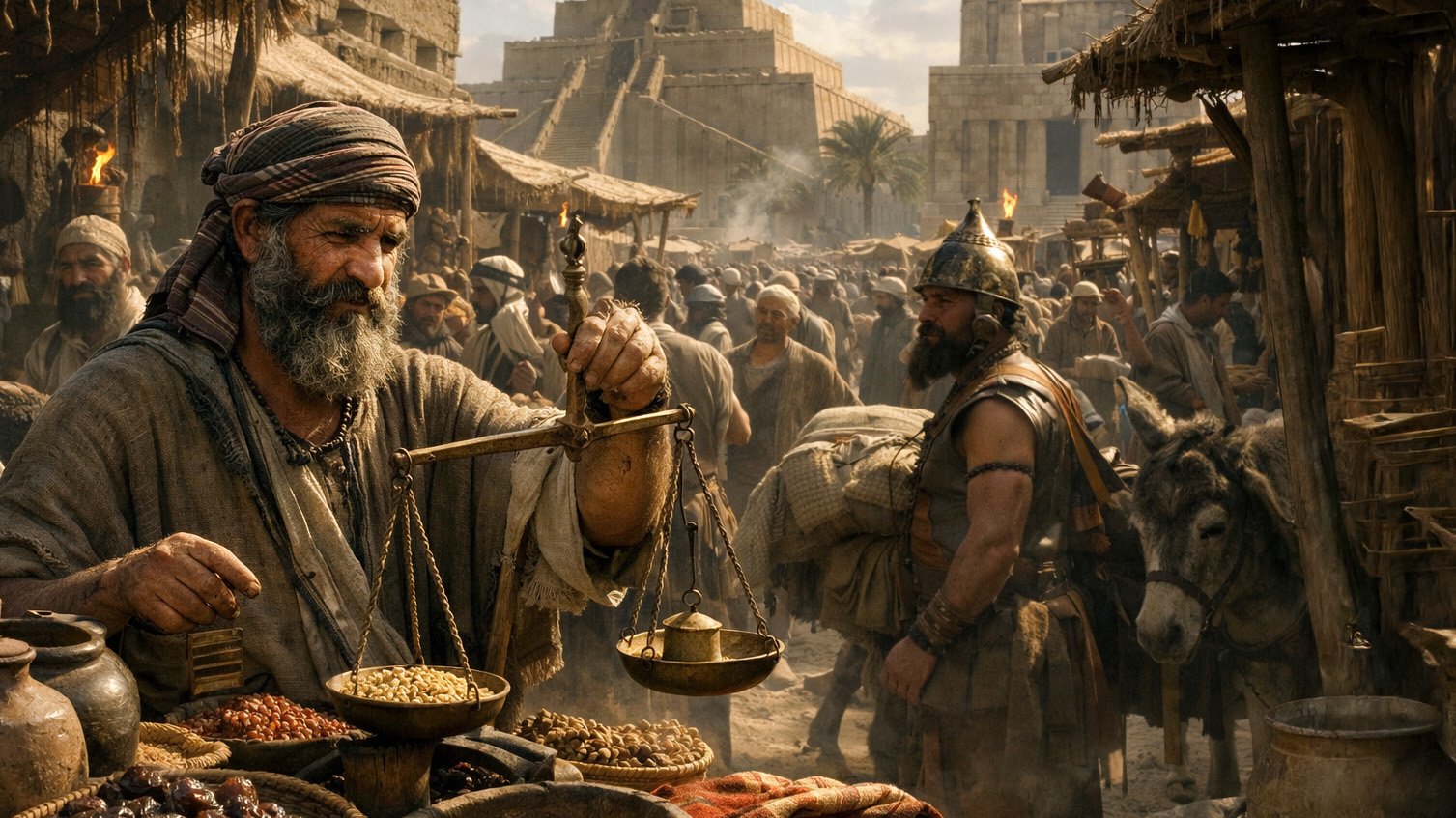
In the deep south of Mesopotamia, in what is now southern Iraq, Uruk emerged not merely as a large settlement but as something qualitatively new. It was not just a village that happened to become crowded. It became, over the course of the fourth millennium BCE, a place where scale itself altered the social order. For that reason, many historians and archaeologists regard it as the world’s first true city: the earliest settlement to combine population density, monumental building, specialised labour, administrative control and cultural influence on a genuinely urban level.
That distinction matters. Human beings had lived in substantial settlements long before Uruk. Places such as Çatalhöyük in Anatolia were large and complex in their own way. But Uruk represented a further step. It was a settlement that did not simply house people; it coordinated them. It created institutions capable of managing surplus, labour and belief across a scale previously unseen. In that sense, Uruk was not just big. It was systemic.
Its rise was made possible by geography, though not in any cosy pastoral sense. Southern Mesopotamia was an alluvial plain built by the Tigris and Euphrates rivers, a flat and difficult landscape that rewarded organisation. Agriculture there depended on irrigation, canal management and careful coordination of water and labour. This was not a place where one could simply scatter farms and leave nature to do the rest. The environment encouraged collective effort, and collective effort, once routinised, tends to produce administration. Administration, in time, develops a taste for permanence.
By the late fifth and especially the fourth millennium BCE, Uruk began to outstrip neighbouring settlements dramatically. Archaeological evidence suggests that it expanded to a scale unprecedented in the ancient world, perhaps covering hundreds of hectares at its peak during the Uruk period. Estimates vary, as they do for nearly every ancient population large enough to interest modern argument, but the consensus is clear enough: Uruk had become vast by prehistoric standards, likely supporting tens of thousands of inhabitants, with influence extending far beyond its immediate hinterland.
What made that growth urban rather than merely demographic was the city’s internal differentiation. Villages are generally structured around households doing much the same work, even when some families prosper more than others. Cities divide function. Uruk appears to have done precisely that. There were priests, labourers, craft specialists, administrators, traders and probably many others whose lives were no longer confined to subsistence farming. This specialisation depended on stored agricultural surplus, but it also reinforced the institutions that controlled it. Once a society can feed people who do not grow food, it can build almost anything, including bureaucracy.
And bureaucracy, in Uruk, left one of the most consequential traces in human history: writing. The earliest known writing system emerged in this broader urban and administrative context, initially not as literature, philosophy or lyrical self-expression, but as accounting. It is one of history’s more telling jokes that civilisation’s first written marks appear to have been less concerned with beauty than with inventories, rations and goods. The city needed records. Tokens, seals and eventually clay tablets offered a way to track commodities, labour obligations and institutional stores. Out of that need grew proto-cuneiform, and with it the beginnings of written history.
This is one reason Uruk deserves its reputation. It was not simply the setting for early writing; it was the sort of place that made writing necessary. A small kin-based settlement can rely on memory, familiarity and face-to-face trust. A city of strangers cannot. Once exchange, labour and authority operate at scale, memory must be externalised. Clay becomes an archive. Marks become power.
The monumental architecture of Uruk tells a related story. The city was dominated by temple complexes, especially those associated with deities such as Inanna and Anu. These were not merely places of worship in the narrow modern sense. In early Mesopotamian urban life, temple institutions were deeply entangled with economy and governance. They owned land, organised labour, distributed rations and helped structure collective life. Religion, administration and production were not separate departments with politely worded mission statements. They were part of one institutional fabric.
The Eanna precinct, associated with Inanna, is particularly significant. Excavations have revealed impressive buildings, ceremonial spaces and evidence of sustained rebuilding over time. Monumentality here was more than display. It was a way of asserting order in a landscape that required human management to remain productive. Massive platforms, formal precincts and storage facilities made visible the concentration of labour and authority. In other words, the city announced itself in brick.
Uruk’s development also depended on exchange networks that reached well beyond southern Mesopotamia. The alluvial south was agriculturally productive but poor in many raw materials. Stone, timber and certain metals had to be acquired from elsewhere. That meant trade, diplomacy, perhaps coercion, and certainly some form of organised long-distance contact. Uruk’s cultural influence appears in settlements across Mesopotamia and beyond, in what scholars often describe as the “Uruk expansion”. Whether this amounted to colonisation, trading enclaves, prestige emulation or a shifting mixture of all three remains debated. But the broader point stands: Uruk was not an isolated giant. It was the centre of a network.
That networked quality is another mark of urbanity. A city is not just a dense settlement; it is a hub. It pulls in goods, people and ideas, and in turn projects forms of power and culture outward. Uruk seems to have done exactly this. Standardised bevel-rim bowls, seal imagery, administrative practices and architectural forms connected it to a wider sphere of influence. Even in prehistory, the city was already becoming an exporter of systems.
One could argue that the true novelty of Uruk lay in abstraction. Village life is personal. You know who owes what, who belongs where, who can be trusted with grain or tools. Urban life requires categories. Populations become labour pools. Harvests become quotas. Offerings become distributions. Identity begins to sit alongside office, function and record. The city transforms lived relationships into manageable units. That sounds rather dry until one notices how much of modern life still depends on the same move.
The old literary tradition remembered Uruk in a similarly ambivalent way. In the Epic of Gilgamesh, Uruk is a place of walls, kingship, grandeur and mortality. The city stands as an emblem of human achievement, but also of human restlessness. Gilgamesh is inseparable from the built environment around him: the walls of Uruk are both civilisational triumph and quiet rebuke. They endure longer than the king. That is perhaps the earliest urban lesson: institutions and monuments outlast the individuals who create them, though not always in the manner those individuals intended.
There is also a subtler point in Uruk’s claim to being the first true city. “First” in history is always a slightly unstable honour. It depends on definitions, evidence and the mood of the archaeologist. Some scholars are cautious, preferring to describe Uruk as the earliest known large-scale urban centre rather than issuing an absolute title. That caution is sensible. Ancient evidence is fragmentary, and human development is rarely as tidy as textbook chapter headings suggest. Urbanism did not arrive in a single morning with trumpets. It emerged unevenly, through centuries of growth, innovation and institutional thickening.
Even so, Uruk remains exceptional. It provides the clearest early case of a settlement crossing the threshold into full urban life. Its scale, monumental core, specialised workforce, administrative apparatus and regional influence together make it more than a precursor. It is the prototype.
What Uruk invented, or at least brought into unusually sharp focus, was a new human condition. For most of our species’ existence, social life had been organised in relatively small groups bound by kinship, locality and custom. Cities changed that. They created environments in which strangers had to cooperate under shared systems, where labour could be detached from household subsistence, where authority could be concentrated and symbolised, and where information had to be stored independently of memory. In that respect, the city was not only an architectural development. It was a psychological and political one.
The consequences have been difficult ever since, which is one reason urban history remains so interesting. The city enables culture, administration, innovation and scale; it also produces hierarchy, dependence and control. Uruk contained both possibilities from the start. Its temples coordinated resources and belief, but they also concentrated authority. Its writing system made complex organisation possible, but it also served institutional power. Its walls protected a civic world, but they demarcated insiders from outsiders. Urban civilisation did not begin innocent and then later become complicated. It began complicated.
Perhaps that is why Uruk still feels less remote than its age ought to allow. Beneath the archaeological terminology and the battered bricks is a recognisable experiment: can large numbers of humans live together under impersonal systems and call the result civilisation? Uruk’s answer was yes, though with the sort of caveats history has been adding ever since.
In the end, Uruk’s real importance lies not only in being early, but in being formative. It showed that human communities could become something larger, denser and more administratively ambitious than anything that had come before. It drew together irrigation, surplus, labour, religion, trade and record-keeping into a durable urban order. The modern city, for all its algorithms and underground lines, still lives in the shadow of that invention.
The first true city did not look much like London, Lagos or Shanghai. It had no steel, no asphalt and no polite planning disputes about mixed-use developments. But it established the essential urban bargain: in exchange for scale, opportunity and collective power, people submit to systems that no individual fully controls. That bargain was first negotiated in mud and reed on the plains of southern Mesopotamia. Its name was Uruk.