Black Rod: The Parliamentary Official Who Has a Door Slammed in Their Face
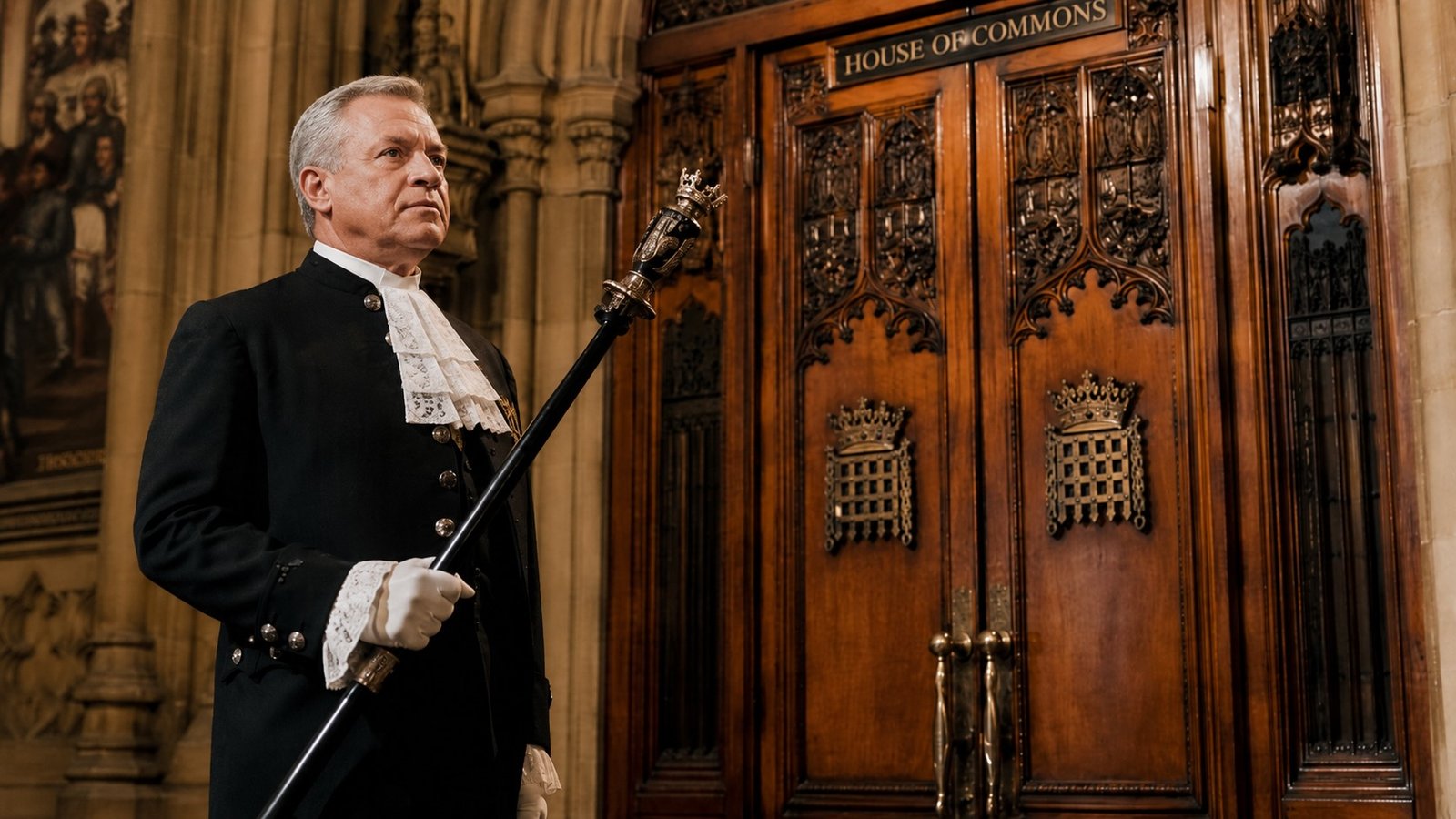
There are not many jobs in Britain where a door slammed in your face means everything has gone beautifully. For most people, it would suggest a bad meeting, a failed romance, or at least a deeply awkward Tuesday. For Black Rod, however, it marks one of the most recognisable performances in the British constitutional calendar.
The scene takes place during the State Opening of Parliament, when the monarch arrives at Westminster to deliver the King’s Speech. The speech comes from the throne, but the words come from the government. That is already very British: the monarch reads it, ministers write it, MPs debate it, and everyone behaves as though the arrangement is perfectly normal because, constitutionally speaking, it is.
Before the speech can begin properly, MPs from the House of Commons must be summoned to the House of Lords. Naturally, nobody simply sends a message saying, “Please come upstairs.” Westminster prefers tradition with props, tension and several centuries of historical suspicion folded neatly into the choreography. So Black Rod, a senior official of the House of Lords, walks through the Palace of Westminster towards the Commons chamber.
Then the door is shut in their face.
Not gently closed. Not politely left ajar. Shut. The point is not personal. Black Rod has not offended the catering team, taken someone’s parking space, or made an unfortunate joke in the members’ lobby. The closed door symbolises something far larger: the House of Commons does not belong to the monarch. Even the monarch’s representative cannot simply walk in.
Black Rod then knocks three times on the door with the ceremonial rod. Only after this does the Commons allow entry. MPs then follow Black Rod back to the Lords, usually with enough chatter and noise to make clear that they are not exactly marching in humble silence. The whole thing looks theatrical because it is theatrical. Yet, like much good theatre, it carries a serious argument beneath the costume.
The historical shadow behind the ritual reaches back to one of the most dramatic moments in parliamentary history. In January 1642, King Charles I entered the House of Commons with soldiers, hoping to arrest five MPs accused of treason. It was a staggering move. A monarch had walked into the elected chamber to seize his political enemies. In the language of modern office life, it was not an outstanding stakeholder engagement strategy.
Charles failed. The five MPs had already slipped away. The Speaker of the House, William Lenthall, gave one of the great careful answers in British history, telling the king that he had “neither eyes to see nor tongue to speak” except as the House directed him. It was polite, devastating, and probably the kind of sentence one rehearses mentally while hoping not to be executed.
The incident did not create the English Civil War on its own, but it captured the central problem of the age. Could the king override Parliament? Could royal authority enter the Commons and take what it wanted? After years of conflict, the answer became increasingly clear: not without consequences.
That is why the monarch does not enter the Commons chamber. During the State Opening, the monarch sits in the Lords. MPs are summoned, but they must not look as if they are merely being commanded. The slammed door keeps that distinction alive. It turns an old constitutional anxiety into a controlled public performance.
Black Rod’s title sounds wonderfully dramatic, almost as though Westminster secretly hired a character from a Gothic novel. The full title is Lady or Gentleman Usher of the Black Rod. The rod itself is real, not metaphorical: a ceremonial staff associated with the office and its authority. Like much of Westminster’s symbolism, it looks ancient, formal and slightly theatrical all at once.
The office has medieval roots and became closely connected with Parliament over the centuries. Today, Black Rod’s role is not limited to knocking on doors while cameras watch. The official helps manage order, access and ceremony in the House of Lords. Black Rod also plays a part in major state occasions and ceremonial life within the Palace of Westminster. In other words, the famous knock is the visible tip of a much larger iceberg of protocol.
Still, the door moment remains the one people remember. It is too perfect not to remember. One side represents the Crown’s formal authority. The other represents the elected chamber’s independence. Between them stands a closed door, a ceremonial rod and several centuries of political suspicion wearing very nice clothes.
There is also something oddly funny about the choreography. The Commons knows Black Rod is coming. Black Rod knows the door will close. Everyone knows the door will open after the knocks. Nobody involved expects genuine confusion. Yet the ritual would lose its meaning if anyone skipped the small act of rejection. Without the slammed door, it would become a procession. With the slammed door, it becomes a constitutional memory.
That is one reason British political rituals can seem so strange to outsiders. They often look like decorative survivals from another age, but many of them encode real conflicts. The robes, rods, processions and formal phrases can distract the eye. Underneath them sit hard questions about power. Who may enter? Who must ask permission? Who speaks for whom? Who gets to say no?
Black Rod’s annual walk answers one of those questions with unusual clarity. The Commons may be messy, noisy and occasionally theatrical in a much less elegant way than the State Opening. Yet it remains the chamber that claims democratic legitimacy. The monarch’s messenger must knock before entering. The elected House lets them in, not the other way round.
The role itself has also changed. Sarah Clarke made history as the first woman to serve as Black Rod, and Ed Davis took up the post in 2025. That matters because it shows how tradition can adapt without losing its symbolic charge. The costume may remain old-fashioned, the route may remain formal, and the knock may remain familiar. But the person carrying the rod can change, as can the world watching the ceremony.
This balance between continuity and adaptation helps explain why the ritual survives. Remove every old ceremony from public life, and politics risks becoming flatter, more forgetful and strangely less honest about its own history. Keep every ceremony without explaining it, and the whole thing risks becoming heritage wallpaper. Black Rod works best when people understand both the absurdity and the importance.
Yes, it is funny that a senior parliamentary official gets ceremonially rejected before being allowed to do their job. Yes, it is faintly ridiculous that a modern democracy still stages such an event with rods, robes and choreographed door management. However, it also says something useful. Power should not move unchallenged through every doorway. Authority should sometimes be made to pause, knock and wait.
That lesson does not feel especially outdated. In fact, it may feel more relevant because modern power often prefers smoothness. It likes frictionless access, instant messages, private influence and quiet assumptions. The slammed door offers the opposite. It makes the boundary visible. It tells the most ceremonial figure in the building: you cannot just come in.
So the next time Black Rod approaches the House of Commons and the door shuts, it is worth resisting the temptation to see only pomp. The moment is funny, yes. It is also sharp. Britain has wrapped a warning about overreach in a ritual so polished that it almost looks harmless.
Almost.
The knock comes. The door opens. MPs follow. The King’s Speech begins. Everyone plays their part, and the machinery of constitutional monarchy turns again. But for a few seconds, before the door opens, the message could not be clearer.
Even in Westminster, even during a royal ceremony, even surrounded by all the velvet and gold Britain can reasonably carry, power must still knock.