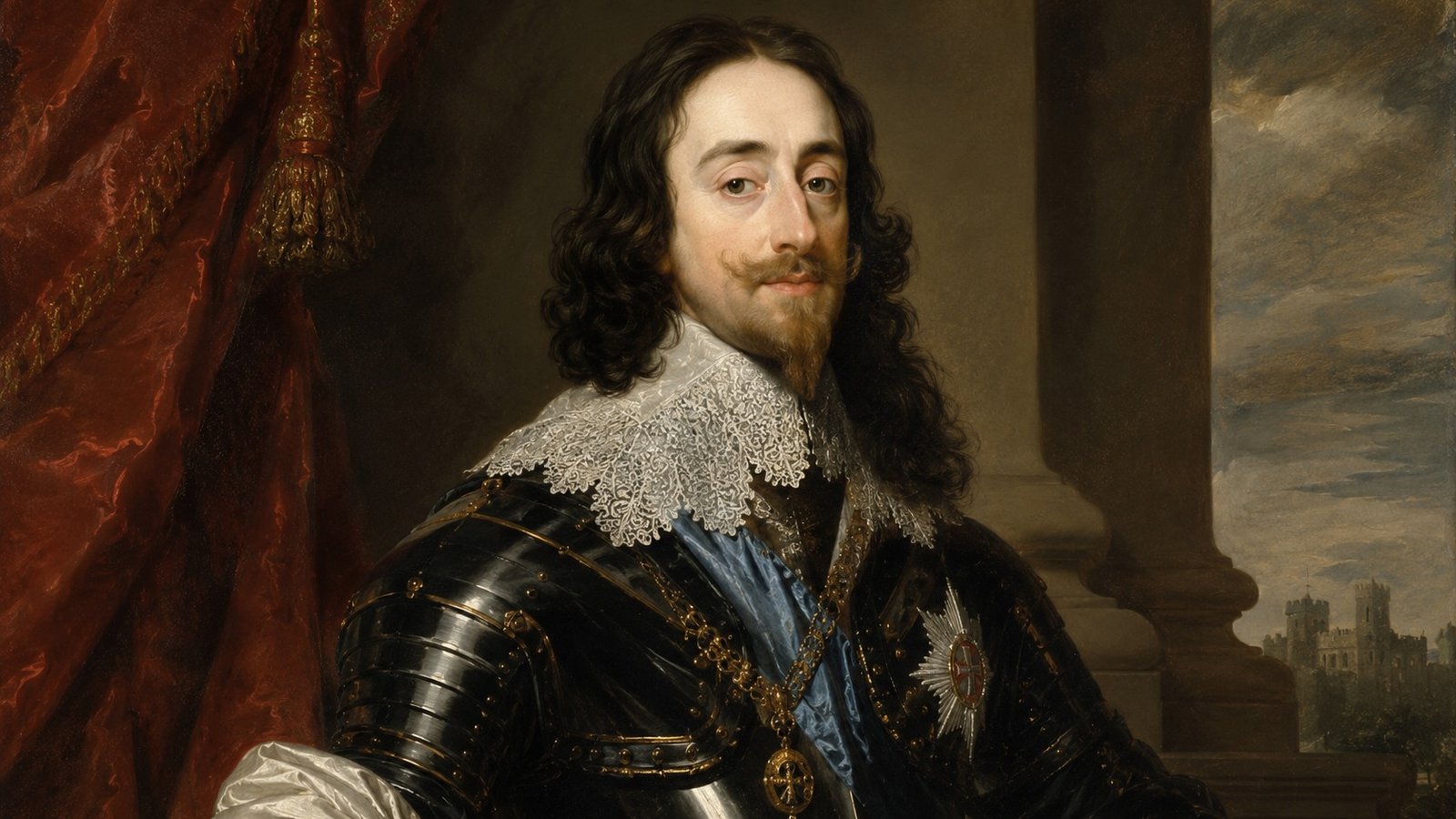
King Charles I had the kind of face that seemed designed for oil paint. In Van Dyck’s portraits, he looks elegant, remote and almost irritatingly composed, like a man who has never had to queue, explain himself, or read the mood of a difficult room. He stands beside horses, wears silk with heroic calm, and gives the impression that kingship is not a job but a natural element, like weather or gravity. Unfortunately for Charles, seventeenth-century Britain had begun to ask a rather dangerous question: what if a king was not gravity at all? What if he was just a man with a crown, debts, bad advisers, and a serious talent for making enemies?
Charles I was born in 1600 at Dunfermline Palace in Scotland, the second son of James VI of Scotland, who later became James I of England. He was not born to be the great Stuart hope. That role belonged to his elder brother Henry, Prince of Wales, a dazzling, athletic young man who collected admiration as easily as other people collect dust. Then Henry died in 1612, and Charles, quieter, physically weaker and less naturally magnetic, moved into the line of succession. History has a wicked sense of humour. The spare heir became the king who would test monarchy almost to destruction.
When Charles came to the throne in 1625, he inherited more than a crown. He inherited a financial headache, a tense relationship with Parliament, and a royal ideology that treated monarchy as sacred. His father had believed strongly in divine right kingship, and Charles absorbed that belief with complete seriousness. To him, the king did not simply manage the state. He stood above ordinary political bargaining because God had placed him there. That sounds majestic enough in a sermon, but it becomes slightly awkward when you need Parliament to approve taxes.
Money caused trouble almost immediately. Charles wanted funds for war and royal government; Parliament wanted answers, limits and concessions. Neither side trusted the other. Parliament suspected the king of ignoring the law whenever it became inconvenient. Charles suspected Parliament of nibbling away at monarchy under the noble disguise of constitutional principle. Their arguments were not polite disagreements over administrative detail. They touched the raw nerve of power itself. Who could tax? Who could imprison? Who could command soldiers? Who had the final word when king and Parliament collided?
The Petition of Right in 1628 tried to put some of those grievances into legal form. Parliament objected to forced loans, imprisonment without proper cause, martial law in peacetime and the billeting of soldiers in private homes. Charles accepted the petition, but acceptance did not mean enthusiasm. He treated concessions rather like a man signing a restaurant bill he believed someone else should pay. The relationship continued to sour, and in 1629 he dissolved Parliament. For the next eleven years, he ruled without it.
That period became known as the Personal Rule, though critics preferred the less flattering “Eleven Years’ Tyranny”. The phrase has a nice dramatic thunder to it, and Charles’s supporters would argue that the 1630s were not simply a decade of darkness, whips and royal villainy. England remained largely peaceful. Government continued. Court culture glittered. The problem was that Charles had solved the Parliament problem by avoiding Parliament, which is not quite the same as solving it. He still needed money, and he still had to govern a country where many influential people believed that taxation without parliamentary consent smelled strongly of royal overreach.
Then came ship money, the tax that sounds like an accounting footnote but behaves like a constitutional grenade. Traditionally, ship money helped fund naval defence and was associated with coastal areas in times of emergency. Charles expanded it, including to inland counties, and used it as a regular source of revenue. To his mind, defence of the kingdom required money, and kings had responsibilities that did not pause politely until Parliament felt generous. To his critics, he had found a clever way to tax without asking. John Hampden’s famous legal challenge in the 1630s turned ship money into a symbol. Charles technically won the case, but politics does not always care who wins in court. Sometimes the damage happens because everyone has been forced to look closely at what you are doing.
Religion made the crisis sharper, louder and more explosive. Charles was not a Catholic, but he married a Catholic queen, Henrietta Maria of France, and supported Archbishop William Laud’s high-church reforms. Many Protestants saw ceremonial worship, decorated churches and Laudian discipline as suspiciously close to Rome. In a century haunted by religious war, that suspicion mattered. People did not argue about altar rails and prayer books as if they were discussing interior design. They saw them as signs of salvation, corruption, tyranny and national danger. Charles believed he defended order and reverence. His opponents believed he was dragging the country towards popery by candlelight.
Scotland turned fear into rebellion. Charles tried to impose a new prayer book there in 1637, and the reaction was ferocious. The Bishops’ Wars followed, and suddenly the great advantage of ruling without Parliament collapsed. War required serious money. Serious money required Parliament. So in 1640 Charles had to summon the institution he had spent eleven years avoiding. One imagines the atmosphere was not warm.
The Short Parliament lasted only weeks. The Long Parliament proved far more consequential. Members arrived with a long memory and a long list of grievances. They attacked royal advisers, challenged royal policies and began dismantling the machinery of Personal Rule. Trust had drained away on both sides. Charles did not believe Parliament merely wanted reform; he feared it wanted to reduce kingship to a decorative office. Parliament did not believe Charles merely wanted stability; many feared he would reverse every concession as soon as he regained strength. In January 1642, Charles entered the House of Commons with soldiers to arrest five members. They had already escaped. The Speaker, William Lenthall, refused to reveal where they had gone, saying he had neither eyes to see nor tongue to speak except as the House directed him. It was superb theatre, and dreadful politics for the king.
Civil war followed later that year. Charles raised his standard at Nottingham in August 1642, and the kingdom split into Royalists and Parliamentarians. The labels can mislead. This was not a clean fight between medieval monarchy and modern democracy. Parliament did not represent democracy as we would understand it. Many of its leaders were aristocrats, landowners and deeply conservative Protestants. Yet the war still forced a revolutionary question into the open: could a king be resisted by armed force if he endangered the laws and liberties of the kingdom?
Charles had courage, dignity and a strong sense of his own role. He also had a fatal talent for negotiation without trust. After his defeat in the first Civil War, he tried to play different factions against each other: Parliament, the Scots, the army. In ordinary politics, clever manoeuvring can buy time. In a civil war, it can convince your enemies that peace will never last while you remain alive and active. The second Civil War in 1648 hardened opinion against him. By then, many in the New Model Army regarded Charles not as a difficult monarch, but as the chief obstacle to any lasting settlement.
His trial in January 1649 turned monarchy into theatre of a very different kind. Charles refused to recognise the court. He asked by what authority they tried him, and from his perspective the question made perfect sense. A king, anointed and crowned, could not be judged by subjects. Yet that was exactly the point the court wished to make. Its authority rested on the claim that the king had betrayed the people and made war against the kingdom he was meant to protect. Charles stood on sacred kingship. His judges stood, however unevenly and controversially, on public accountability.
On 30 January 1649, Charles walked to the scaffold outside the Banqueting House in Whitehall. The location was almost unbearably symbolic. Inside that building, Rubens’s ceiling celebrated the glory of Stuart monarchy and the divine ascent of Charles’s father, James I. Outside, the son faced the axe. Charles reportedly wore extra clothing so the cold would not make him shiver and allow the crowd to mistake discomfort for fear. Whether polished by memory or not, the detail suits him perfectly. Even at the end, image mattered.
The execution did not abolish monarchy forever. England became a republic, then Oliver Cromwell’s Protectorate, and in 1660 Charles’s son returned as Charles II. Crowns came back, court life revived, and the theatre of monarchy reopened. Yet something had changed. The old spell had cracked. After Charles I, British monarchy could still be grand, ceremonial and emotionally powerful, but it could no longer pretend that splendour alone settled the argument.
That may be the real story of Charles I. He did not lack style. He did not lack belief. He did not even lack bravery. What he lacked was the political instinct to understand that authority depends on more than looking majestic beneath a painted ceiling. He treated monarchy as sacred architecture, built to stand above ordinary dispute. Parliament, war and the scaffold proved it was also a bargain. And once enough people decide the bargain has broken, even a divinely confident king can find himself standing in the cold, dressed carefully, while history sharpens the blade.