Mumbai has never been a straightforward city. It began as a group of low-lying islands on the Arabian Sea, home to Koli fishing communities whose lives followed the tides long before imperial maps gave the place a grander role. Over time, those islands became a Portuguese possession, a British royal dowry, an East India Company experiment, a global cotton port and eventually the financial capital of modern India.
That transformation was not inevitable. It happened because geography, empire, trade and opportunism collided in one unusually useful harbour.
The Portuguese saw the islands as a foothold on the western coast of India. The British saw something larger. In 1661, Bombay came to the English crown as part of the marriage treaty between Charles II and Catherine of Braganza. A few years later, in 1668, Charles leased Bombay to the East India Company for a modest annual rent. The Company inherited a place with a superb natural harbour, but also a practical problem: the islands were separated by creeks, marshes and tidal flats. Before Bombay could become a city, it had to stop behaving like a scattered archipelago.
Much of early colonial Bombay was therefore a battle against water. Causeways, embankments and land reclamation projects slowly joined the islands together. The work changed the physical city, but it also changed who could live and trade there. Warehouses, docks, roads, markets and eventually railway lines turned a difficult coastal settlement into a place where goods, people and capital could move with growing speed.
Even the city’s name carries layers of history. “Bombay” is often linked to Portuguese forms such as Bom Bahia, meaning “good bay”, though the exact etymology remains debated. The name “Mumbai” is associated with Mumbadevi, the patron goddess worshipped in the region, and with older local usage in Marathi and other languages. For centuries, the British used “Bombay” in maps, laws, railway boards and commercial records, giving the colonial name global recognition.
After Indian independence, the name Bombay remained in official and international use for decades. That changed in 1995, when the Maharashtra government formally changed the city’s English name to Mumbai. The change reflected more than administrative tidying. It was part of a broader assertion of regional identity, linguistic pride and postcolonial self-definition. “Bombay” did not vanish from memory or conversation, but “Mumbai” became the official name of a city increasingly determined to describe itself in its own vocabulary.
Commerce gave Bombay its early momentum. Merchants arrived from across India and beyond. Parsi families built powerful trading houses. Gujarati merchants linked the city to wider networks across the Arabian Sea and the British Empire. Baghdadi Jewish traders helped develop commercial and financial connections. The city became a layered bazaar of ambition, credit, risk and reinvention long before its skyline filled with towers.
Cotton turned that ambition into a boom. By the early nineteenth century, cotton from the Deccan and other parts of western India moved through Bombay’s harbour towards Britain’s textile mills. Lancashire needed raw cotton, and Bombay offered a route to supply it. Cotton did not simply create export revenue. It reshaped neighbourhoods, drew workers and merchants into the city, and encouraged the growth of presses, warehouses, docks, banks and brokerage networks.
Then the American Civil War changed everything. When war broke out in 1861, cotton exports from the American South were severely disrupted. Britain’s textile industry suddenly needed alternative supplies. India became central to that search. One historical account notes that India’s share of British cotton imports rose sharply during the war years, from around 31% in 1860 to as much as 90% in 1862. Bombay was perfectly placed to profit from that shock.
Cotton prices soared. Traders who had been comfortable became rich. Some became spectacularly rich. Speculators entered the market with the confidence that prices would keep rising. Land, shares and cotton contracts became objects of feverish enthusiasm. The city experienced one of its first great financial manias.
For a few years, Bombay seemed to have discovered a shortcut to wealth. Ships left the harbour loaded with cotton. Brokers chased rumours. Merchants extended credit. Families and investors who had never previously touched speculative finance began to behave as if they had mastered the global market. The boom gave Bombay a taste of fast money, and the city liked the flavour.
Then the war ended. As American cotton returned to global markets after 1865, prices fell. Bombay’s cotton bubble collapsed. Speculators were ruined, brokerage houses failed, and families that had treated the boom as permanent suddenly faced debt and embarrassment. The crash became a cautionary tale about markets, confidence and the danger of assuming that one extraordinary moment will last forever.
Yet Bombay did not stop. Cities rarely do.
Some of the wealth generated during the cotton boom remained visible in stone. South Bombay filled with institutions, public buildings, libraries, colleges and commercial landmarks. Philanthropy, civic ambition and reputation-building often travelled together. Wealthy merchants funded buildings that gave the city a new sense of permanence, while British officials wrapped imperial confidence in Gothic towers, domes, arches and ornament.
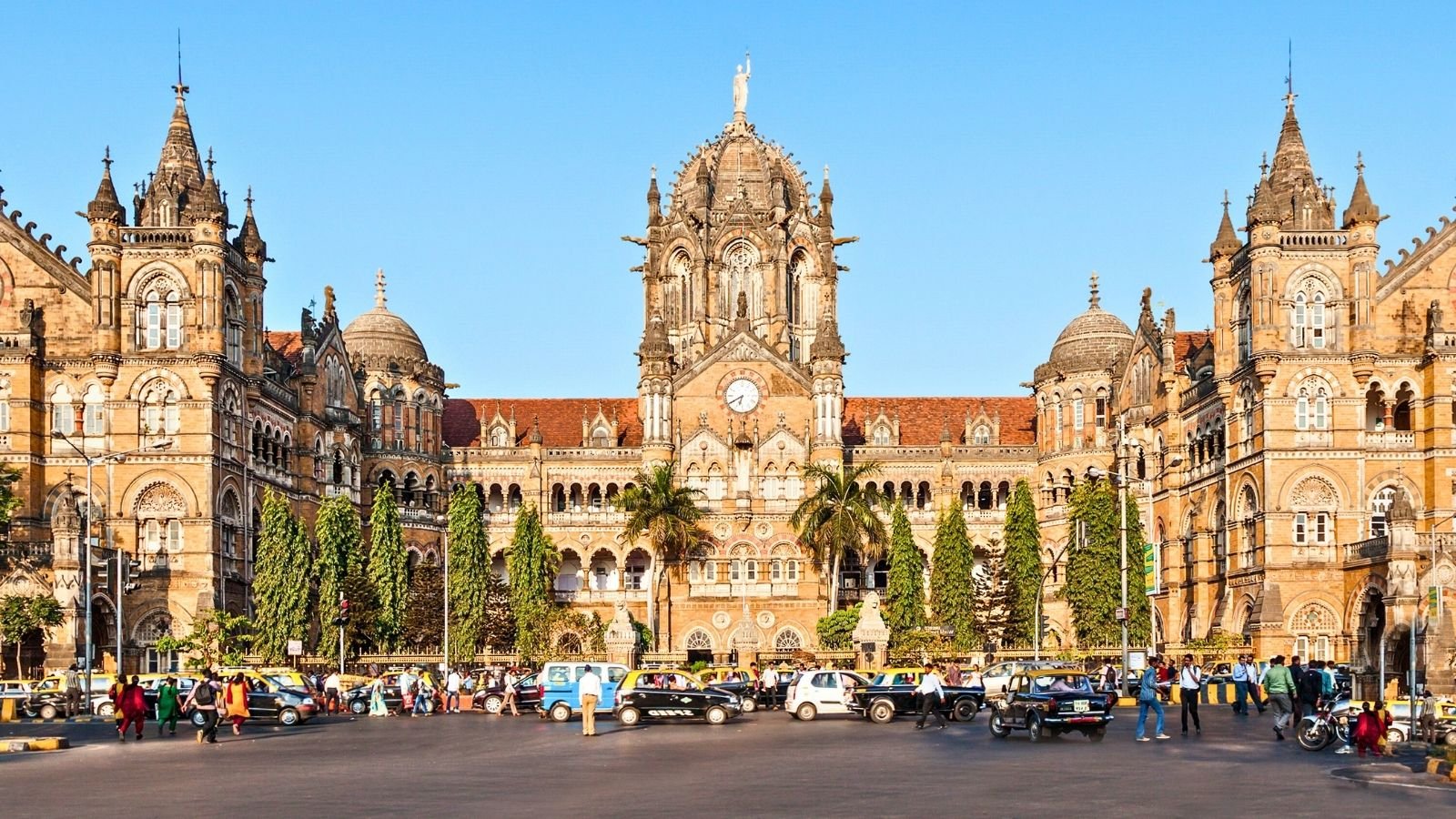
The greatest symbol of this era is the building once known as Victoria Terminus, now Chhatrapati Shivaji Maharaj Terminus. Designed by Frederick William Stevens, it was built over roughly a decade from 1878. UNESCO describes it as an outstanding example of Victorian Gothic Revival architecture in India, blended with themes from traditional Indian architecture. Its domes, turrets, pointed arches and carved details make it one of the most recognisable railway buildings in the world.
But the station was more than decoration. It stood at the centre of a transport system that connected the cotton-growing interior to the port. Railways helped move raw cotton, workers, traders, clerks and ideas. The station announced that Bombay was not merely a colonial outpost. It was a mercantile city with global reach.
The same buildings that once projected imperial power later witnessed the weakening of that power. In the twentieth century, Bombay’s textile mills expanded and drew migrant workers into crowded neighbourhoods and chawls. These workers gave the city much of its industrial energy, but they also faced harsh conditions, insecure housing and the pressures of an unforgiving urban economy. Labour unions emerged. Political meetings, protests and nationalist activity grew. The city that had enriched empire also became one of the places where empire was challenged.
This is what makes Mumbai’s colonial history complicated. The city was shaped by British power, but never simply controlled by it. Local communities, migrant workers, Indian merchants, financiers, religious groups, political organisers and ordinary commuters all helped build the city’s identity. Mumbai was not just made from above by governors and engineers. It was also made from below by people who came to work, trade, survive and start again.
Over time, the city moved far beyond cotton. Textile mills declined. Finance, film, services, media and real estate took on larger roles. Former mill districts changed character. Warehouses gave way to offices, studios and luxury developments. The city’s economy kept reinventing itself, sometimes brilliantly, sometimes brutally.
The renaming of Victoria Terminus to Chhatrapati Shivaji Terminus in the 1990s, and later to Chhatrapati Shivaji Maharaj Terminus, echoed the same broader shift as Bombay becoming Mumbai. These changes were not just about names. They were about memory, ownership and the right to decide which stories a city tells about itself.
Today, Chhatrapati Shivaji Maharaj Terminus remains a working railway station, not a frozen museum piece. That matters. Commuters rush through a building created by empire, renamed by postcolonial India, and absorbed into the daily life of a modern megacity. Its platforms carry not only passengers, but the layered history of a place built from trade, migration, ambition and argument.
Mumbai’s story is not neat. It is a mosaic of islands and markets, dowries and docks, cotton bales and railway lines, speculative bubbles and political reinvention. It shows how a war in America could transform prices in India, how mills in Lancashire could shape labour in Bombay, and how a city built partly for empire could become a symbol of self-definition.
Above all, Mumbai reminds us that cities are never just their monuments or official names. They are made by tides, traders, workers, worshippers, migrants, speculators, commuters and the millions of small decisions that turn geography into destiny.