Dionysus was the Greek god of wine, which sounds wonderfully simple until you spend five minutes with him. Then you realise wine was only the front door. Behind it stood theatre, madness, fertility, masks, ecstasy, religious panic, family trauma, wild dancing, and the very Greek idea that civilisation works best when it occasionally lets people behave as if civilisation has briefly gone out for lunch.
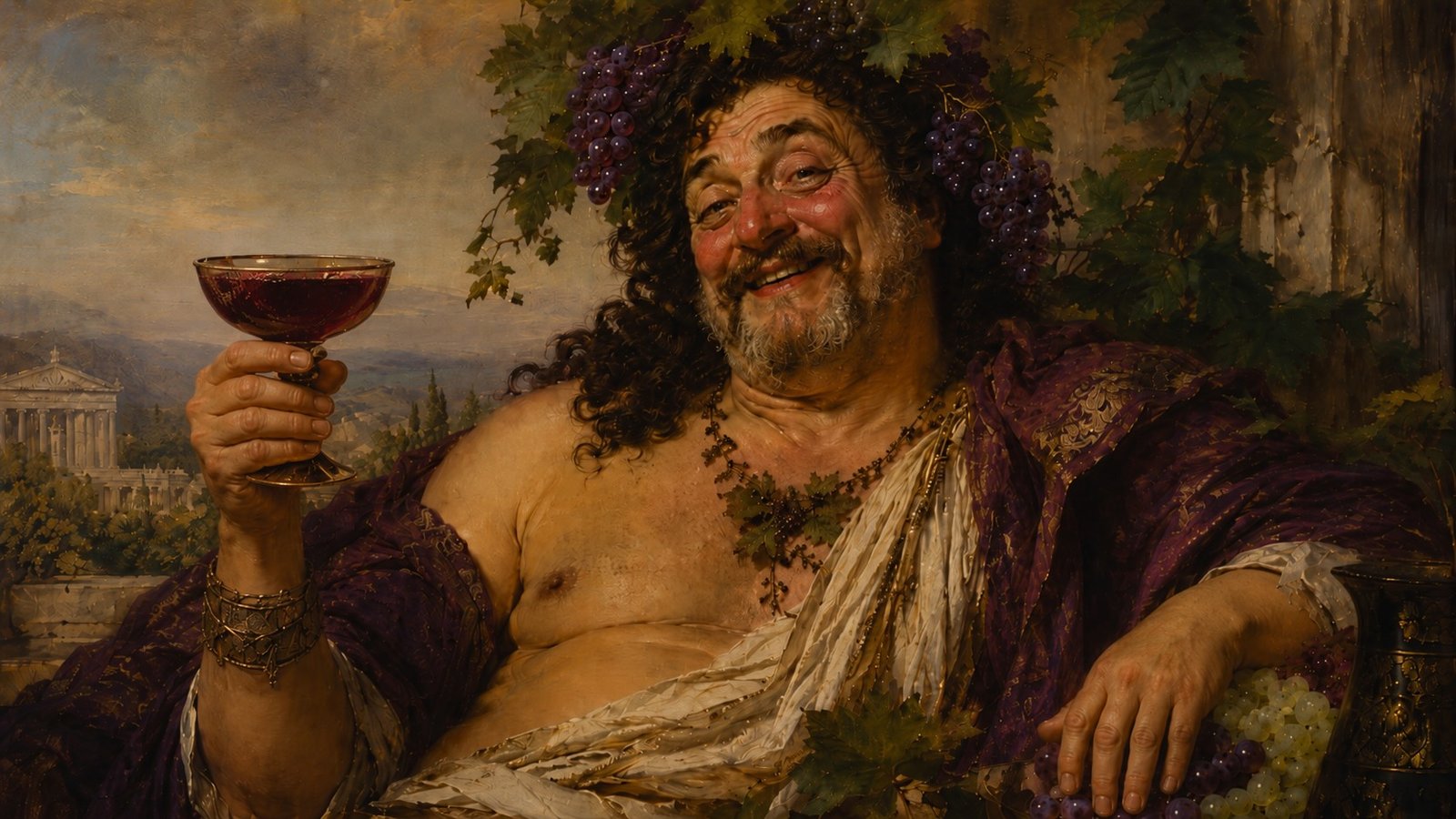
He was not the tidy kind of god who sat on a cloud looking noble. Dionysus arrived in stories like a beautiful threat. He could bring joy, music, grapes, laughter, and the soft glow of a good evening. He could also bring frenzy, humiliation, violence, and the sudden collapse of everyone’s carefully arranged public image. In a world where Greek gods often behaved like overpowered aristocrats with no HR department, Dionysus still managed to stand out.
His birth story sets the tone nicely. Dionysus was the son of Zeus and Semele, a mortal princess of Thebes. This already placed him in dangerous territory, because Zeus’s romantic decisions had a habit of creating paperwork, enemies, and mythological disasters. Hera, Zeus’s wife, was not delighted. Disguised as an old woman, she persuaded Semele to ask Zeus to reveal himself in his true divine form. Zeus had promised to grant her any wish, because apparently even kings of gods made reckless commitments. So he appeared in full splendour, thunderbolts and all. Semele, being mortal, did not survive the experience.
Zeus then rescued the unborn child and sewed him into his thigh until he was ready to be born. That is how Dionysus became “twice-born”: once from Semele, once from Zeus. It is a bizarre image, but it fits him perfectly. Dionysus belonged to more than one world from the beginning. He was mortal and divine, insider and outsider, familiar and foreign, charming and alarming. Even his origin story refused to stay in one category.
This boundary-crossing made him fascinating. Greek myth often presents Dionysus as arriving from somewhere else, as if his worship came from abroad with strange music and questionable manners. Yet evidence suggests his name existed in the Greek-speaking world long before classical Athens polished its marble self-image. So the “foreign god” may have been much more local than people liked to admit. That feels very Dionysian. Nothing unsettles a society quite like discovering that the wild thing it fears has been part of the family all along.
His followers were not exactly a quiet book club. Dionysus travelled with satyrs, sileni, nymphs, and maenads — women caught up in ecstatic worship, dancing in the mountains, shaking the thyrsus, wearing ivy, and ignoring the sort of social rules that kept respectable households comfortable. The thyrsus, his famous staff, was topped with a pine cone and wrapped with ivy or vine leaves. It looked decorative, which in mythology usually means someone should worry.
The maenads gave Dionysus his most dangerous energy. They represented release, but not the mild kind promised by a spa weekend. Their ecstasy could turn violent. They left the city, entered the wild, and abandoned ordinary identity. In the Greek imagination, this was thrilling and terrifying at the same time. Dionysus did not simply invite people to drink. He invited them to loosen the entire structure of the self and see what crawled out from underneath.
That is why Euripides’ tragedy The Bacchae remains one of the best windows into his power. In the play, King Pentheus of Thebes tries to suppress Dionysus and his followers. This is not one of history’s better management decisions. Pentheus sees Dionysus as a threat to order, masculinity, politics, and common sense. Dionysus responds with divine patience, by which I mean manipulation, disguise, psychological warfare, and eventual catastrophe.
Pentheus ends up dressed as a woman, spying on the Bacchic rites from a tree. The maenads, including his own mother Agave, mistake him for a wild animal and tear him apart. It is a horrifying story, but also a sharp one. Pentheus tries to control what he refuses to understand. Dionysus shows him that denied forces do not disappear. They wait. Then they return wearing better costumes.
This is where Dionysus becomes more than a wine god. He represents everything society needs but fears: pleasure, emotion, instinct, intoxication, music, sexuality, grief, and the temporary breakdown of rank. Greek cities valued order, law, male citizenship, hierarchy, and public control. Dionysus did not destroy those things permanently, but he opened controlled spaces where people could step outside them. His festivals gave chaos a calendar slot. Very sensible, really. If madness must appear, better give it a date, a procession, and some seating.
His connection with theatre may be his greatest cultural legacy. The great dramatic festivals of Athens honoured Dionysus, especially the Great Dionysia. There, the city watched tragedies, comedies, and satyr plays. This was not theatre as a polite evening out with an overpriced interval drink. It was religion, politics, civic identity, competition, emotional excavation, and mass entertainment rolled into one enormous public event.
The Theatre of Dionysus sat beneath the Acropolis, which feels symbolically perfect. Above stood temples, order, marble, and divine architecture. Below, citizens gathered to watch kings go mad, families collapse, women speak inconvenient truths, heroes make catastrophic decisions, and gods behave badly. Theatre gave Athens a mirror, but not a flattering one. Dionysus did not offer the kind of mirror that says, “You look well today.” His mirror said, “Here is your ambition, your violence, your fear of women, your terror of death, and your tendency to blame foreigners for problems you created yourself.”
Masks mattered too. Actors in Greek theatre wore them, and Dionysus himself was strongly associated with masks and transformation. A mask hides a face, but it also reveals a role. It lets a person become someone else, or perhaps admit they were never as fixed as they pretended. That is pure Dionysus. He knew identity could wobble. He enjoyed the wobble. He probably brought snacks.
The Romans inherited him as Bacchus, and Rome, being Rome, soon became anxious. The Bacchanalia, rites linked to Bacchus, worried the Roman Senate so much that it restricted them in 186 BCE. Officially, the concern involved secret meetings, moral corruption, conspiracy, and social disorder. Perhaps some of that was real. Perhaps some of it was elite panic dressed up as public virtue. Rome often liked a little moral panic, especially when women, foreigners, night-time gatherings, and religious enthusiasm appeared in the same sentence.
This controversy shows how powerful Dionysus could seem. A god of wine might sound harmless until wine becomes a symbol of unsupervised community, hidden ritual, ecstatic loyalty, and people gathering beyond state control. Then suddenly the party looks political. Dionysus never needed a manifesto. A drumbeat, a cup, and a crowd were enough to make rulers nervous.
There is also a deeper, stranger Dionysus in Orphic traditions. In some versions, he appears as a divine child connected to death, dismemberment, rebirth, and the fate of the soul. The Titans kill him, and some later interpretations link human nature to this violent myth. Here Dionysus stops being merely theatrical and becomes cosmic. He belongs not only to vineyards and festivals, but to questions about suffering, purification, and what survives after the body falls apart.
Modern readers often try to turn Dionysus into a simple symbol: party god, rebel god, queer god, nature god, drug god, theatre god, trauma god. He can carry many of these meanings, but he slips away from anything too neat. That is the point. Dionysus resists tidy branding. He is not a logo. He is a disturbance.