How Hannibal Barca Won the Battles but Lost the War
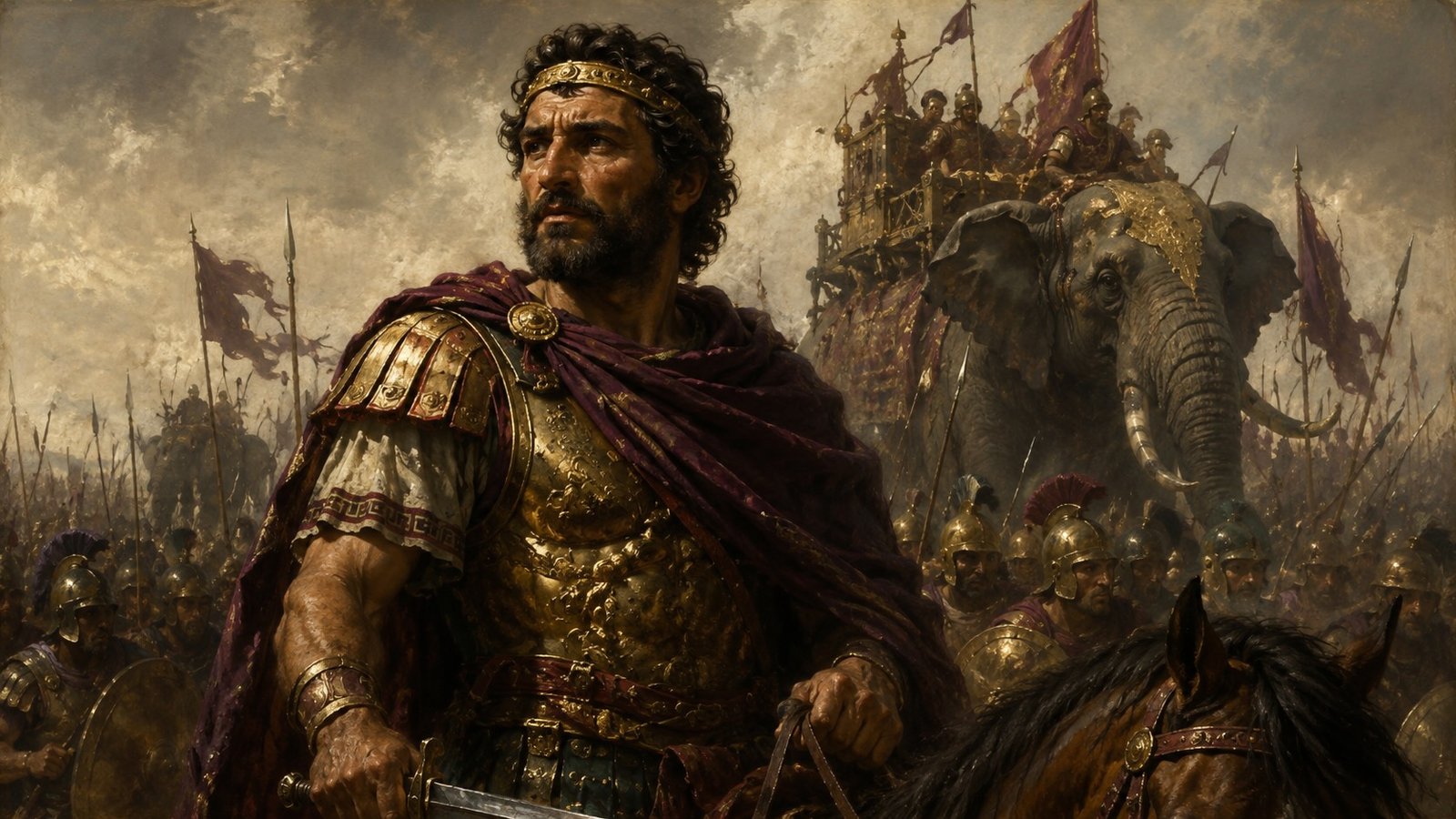
Hannibal Barca is one of those historical figures who sounds as if he escaped from a slightly overexcited screenplay. A Carthaginian general, raised in the shadow of Rome’s growing power, decides that the best way to attack the most stubborn republic in the Mediterranean is not by sea, not by negotiation, and certainly not by doing anything sensible. No, he marches an army from Spain, through Gaul, over the Alps, and into Italy with elephants. Even by ancient standards, this was not normal behaviour.
He was born in 247 BCE in Carthage, the great North African city that stood where modern Tunisia is today. Carthage was rich, commercial, maritime, clever, and deeply inconvenient to Rome. The two powers had already fought one enormous war before Hannibal became famous, and Rome had won it. His father, Hamilcar Barca, never really got over that defeat. According to later tradition, he made young Hannibal swear eternal hatred of Rome. Historians still argue over how literally we should take that scene, but as family branding goes, it was superb. Some children inherit land. Hannibal inherited a geopolitical grudge.
The Barca family rebuilt Carthaginian power in Iberia, modern Spain and Portugal, where silver mines, soldiers and strategic space offered Carthage a second chance. Hannibal grew up among soldiers rather than comfortable drawing rooms, and by the time he took command, he had become exactly the sort of man Rome did not want appearing on its strategic horizon. He was bold, patient, ruthless when needed, and annoyingly good at understanding what his enemies expected him to do before doing something else entirely.
The immediate trigger for the Second Punic War came when Hannibal attacked Saguntum in 219 BCE. Saguntum had links with Rome, and Rome demanded that Carthage hand Hannibal over. Carthage declined, presumably without sending flowers. The result was war. Rome expected danger, of course, but probably imagined a more conventional campaign. Hannibal had other ideas, which is usually where Roman headaches begin.
His greatest gamble came in 218 BCE. Instead of sailing directly towards Italy, where Roman naval strength could make life difficult, Hannibal chose the land route. He led a mixed army of Africans, Iberians, Gauls, Numidians and others across the Pyrenees, through southern Gaul, across the Rhône, and finally towards the Alps. This was not a neat national army with matching uniforms and a shared school song. It was a coalition of different peoples, languages, loyalties and fighting styles. Holding it together required more than charisma. It required discipline, rewards, fear, negotiation and the kind of personal authority that cannot be faked for very long.
Then came the Alps. Popular memory turns this episode into a grand cinematic procession: snowy peaks, heroic soldiers, magnificent elephants, perhaps a tragic flute somewhere in the background. The reality was much uglier. Hannibal’s army faced cold, hunger, landslides, hostile tribes, exhausted animals and terrifying mountain paths. Many men and animals died before they even reached Italy. The exact route remains one of history’s favourite arguments, with scholars still debating which pass he used. That uncertainty somehow makes the story better. Hannibal crossed the Alps so dramatically that, more than two thousand years later, people are still arguing about the road.
And yes, the elephants matter, but perhaps not in the way we imagine. They were not just ancient tanks with trunks. They frightened horses, unsettled troops and looked spectacular, which is useful when your war plan includes psychological theatre. Yet elephants could panic, suffer, and become as dangerous to their own side as to the enemy. Most of Hannibal’s military genius did not stand on four legs. It lived in his understanding of terrain, timing, deception and morale. The elephants were the poster. Hannibal was the campaign.
Once in Italy, he did not merely survive. He started beating Rome with alarming regularity. At the Trebia in 218 BCE, he defeated a Roman army. At Lake Trasimene in 217 BCE, he used the landscape like a trapdoor, ambushing Roman forces between the hills and the water. It was one of the great ambushes of antiquity, and not exactly the sort of thing that improves morale back in the Senate.
Then came Cannae in 216 BCE, the battle that made Hannibal immortal. Rome sent a massive army to crush him. Hannibal arranged his forces so that the Roman centre pushed forward, believing it was winning, while his flanks gradually wrapped around them. The result was a double envelopment, a beautiful phrase for a horrifying reality. The Romans found themselves surrounded and slaughtered. Cannae became one of the most studied battles in military history. Commanders centuries later still looked at it with admiration, envy and possibly a slight sense of personal inadequacy.
After Cannae, Rome should, in theory, have collapsed. Many states would have sued for peace after such a disaster. Rome did not. That is the strange irony of Hannibal’s career. He won battles with genius, but Rome survived with institutions. The republic absorbed losses that should have broken it, raised new armies, punished defectors, rewarded loyalty and refused to accept that defeat on the battlefield meant defeat in the war. Rome’s talent was not always elegance. Sometimes it was simply being punched in the face, standing up, and asking whether that was all.
This is where the famous criticism appears. After Cannae, Hannibal did not march on Rome itself. Ancient tradition has his cavalry commander Maharbal telling him that he knew how to win victory, but not how to use it. It is a devastating line, which is probably why it survived. Yet the reality looks more complicated. Hannibal lacked siege equipment, sufficient reinforcements and, most importantly, a complete political collapse among Rome’s allies. Capturing a city like Rome was not a matter of turning up with confidence and a few elephants. Even in antiquity, vibes alone rarely breached walls.
Rome adapted. Quintus Fabius Maximus, nicknamed Cunctator, “the Delayer”, avoided direct battle and wore Hannibal down. This annoyed Romans who wanted heroic revenge, because patience rarely gets statues as quickly as reckless courage. Still, Fabian strategy worked. Rome harassed Hannibal, limited his opportunities and slowly shifted the war elsewhere. In Spain, Roman forces attacked Carthaginian power at its source. Eventually Scipio, later called Africanus, carried the war to North Africa. Hannibal had to leave Italy, where he had spent around fifteen astonishing years, and return home.
At Zama in 202 BCE, the story turned. Scipio had studied Hannibal’s methods and learned from Rome’s disasters. When Carthaginian elephants charged, Roman troops opened lanes and let many pass through. The battle ended in defeat for Hannibal and catastrophe for Carthage. Rome won the Second Punic War, and Carthage never again stood as an equal military rival. Hannibal had terrified Rome more than any enemy before him, but he had not destroyed it.
His later life adds another twist. Hannibal became involved in Carthaginian politics and tried to reform public finances, which suggests that even world-historical generals sometimes end up arguing about budgets. His reforms annoyed local elites and worried Rome, which still treated him as a dangerous man long after his defeat. Eventually he fled into exile and moved among eastern rulers who opposed Rome. Cornered at last in Bithynia, he reportedly took poison rather than fall into Roman hands. The man who had once haunted Roman nightmares refused to become their trophy.
Hannibal’s reputation survives because his story contains a magnificent contradiction. He was one of history’s greatest battlefield commanders, yet he lost the war that defined him. He outmanoeuvred Roman armies, but not Roman resilience. He mastered shock, speed and surprise, while Rome mastered recovery, alliances and grim persistence. That makes him more interesting than a simple conqueror. He shows us that brilliance can change history, but systems often decide who owns the ending.
The elephants made him famous, of course. They still lumber through paintings, schoolbooks and popular imagination, carrying half the myth on their backs. But the real Hannibal was not a circus act with a sword. He was a strategist who turned geography into a weapon, fear into an ally, and Roman confidence into Roman trauma. He did not bring Rome down, but he forced it to become harder, cleverer and more dangerous. In a rather cruel historical joke, Hannibal helped build the very Rome that would later dominate the Mediterranean.